

When Nepalis fly kites as Dashain approaches, a small diamond of coloured paper can become one of Nepal’s most recognisable seasonal symbols. Families gather for tika, blessings and meals, while a kite rises above a neighbourhood and announces the festival in a different language: wind, string and laughter. But why has kite flying become associated with Dashain in particular? The answer mixes a popular story about the rain god, the practical rhythms of an agricultural society and the pleasure of a game passed between generations. These explanations belong together, but they are not equally well documented.
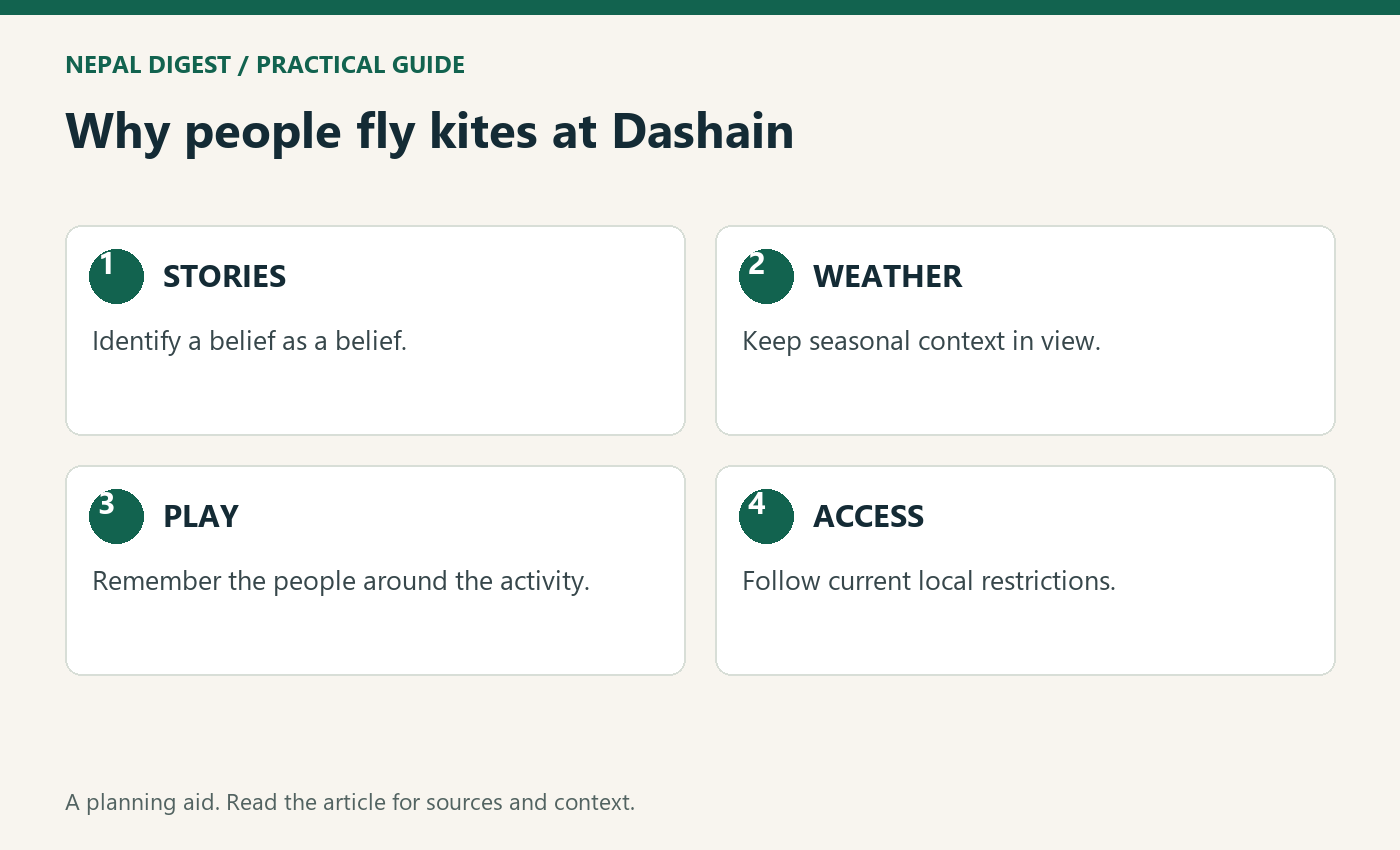
Table of Contents
Fly kites: the story about sending a message to Indra
One widely repeated explanation says that flying a kite sends a message to Indra, the Hindu deity associated with rain and thunderstorms: the monsoon has brought its water, the crops have grown, and the time for rain to end has arrived. In some tellings the message is a request; in others, it is gratitude. The colourful object in the sky becomes an imagined messenger between people and the heavens.
This is best understood as folklore, not a provable account of how the custom began. Newspapers and cultural commentators describe the belief, but its repetition does not establish a single inventor, founding date or ancient religious rule requiring kite flying. Customs often gather stories around them long after they become popular. The Indra explanation reveals something meaningful about how the season is understood, even when it cannot serve as a documented historical origin.
The weather explains a great deal
Dashain comes as Nepal moves out of the summer monsoon, although the exact timing and weather vary across the country’s climates. Around Kathmandu, calmer autumn intervals and clearer skies have traditionally made kite flying appealing. A light, steady wind lifts a properly balanced kite; heavy rain, erratic gusts and wet paper make the activity frustrating. The connection between season and pastime therefore has a practical dimension as important as its mythology.
For many farming families, the festival also arrived at a different point in the annual work cycle. The Kathmandu Post’s 2021 reporting connects the tradition to the end of monsoon labour and a moment when families could find time for leisure. When children had holidays and relatives met again, flying kites offered an inexpensive shared activity. A ritual calendar, favourable conditions and free time reinforced one another without requiring a formal command to fly.
How a simple kite became a neighbourhood game
Traditional kites can be remarkably modest objects: a light frame, colourful paper or another lightweight sail, a bridle and a long line. The familiar lattai is a reel used to manage the string. Skilled flyers learn to launch a kite into the breeze, let out line without losing tension, recover control in gusts and bring it home without breaking the frame. It is a lesson in patience disguised as a festival game.
Then there is changa chait, the celebratory shout associated with a kite being cut during a contest. Rooftop rivals try to manoeuvre their lines against each other, and spectators follow the drama overhead. That competitive version became part of the collective memory of Kathmandu’s autumn. Yet contest flying is only one expression of the custom. A child’s first stable flight in an open field can be every bit as meaningful as a rooftop victory.
Older than a smartphone, but not frozen in time
Kite shops help trace the tradition through living commercial history. Reporting by The Kathmandu Post in 2024 described longstanding kite businesses around Kathmandu, including traders whose families have sold supplies over several generations. Such accounts are stronger evidence of continuity than claims that a particular form of changa dates back an exact number of centuries. Materials and sources have also changed; merchants in 2026 described supplying customers with products imported from India and elsewhere.
The presence of a shop, however, does not mean every family practises the tradition in the same way. Some remember handmade reels and paper kites. Others know inexpensive ready-made versions, decorative kites, or community flying events. In diaspora households the practice may shift from a rooftop to a park. Traditions survive by being recognisable even when their setting changes.
What flying kites means today
The kite can symbolise a celebration of the season, a link between generations and the enjoyment of open space. Those meanings do not need to be identical in every household. Not every Nepali celebrates Dashain, and among those who do, some have never flown a kite. Treating a cultural pastime as an essential test of identity would turn an invitation into an obligation. Its strength lies in being accessible, playful and voluntary.
Dashain 2026 provides a useful reminder of continuity and change. Traders reported both enthusiasm and challenges, while news coverage described families reconnecting children with the activity. The right conclusion is neither that everyone has abandoned changa nor that the old neighbourhood sky has returned unchanged. It is a tradition negotiating modern city life, prices, free space and new habits.
Fly responsibly, especially during Dashain
Aviation authorities specifically warned in October 2026 against kite flying near Tribhuvan International Airport and aircraft flight paths. This is a safety issue, not a symbolic one. Fly only where local rules allow and far from power cables, busy roads and unprotected rooftops. Choose ordinary, non-abrasive line rather than glass-coated or hazardous synthetic strings, and supervise children. A cut kite is never worth chasing across traffic or onto an unsafe roof.
Perhaps the most useful answer to why Nepalis fly kites is that several reasons overlap. Folklore supplies an imaginative story, autumn supplies the wind, festivals supply shared time and practice supplies its own reward. When one person teaches another how to hold a reel and feel the pull of a kite, all four come together. A small piece of paper becomes an unusually enduring way of saying that Dashain has arrived.
Related Nepal Digest guides: Changa Chait! The Childhood Sound That Defined Dashain in Nepal; From Rooftops to Smartphones: How Nepal’s Kite-Flying Culture Is Changing.
If you want to fly kites with someone learning for the first time, explain the activity before choosing a place. An invitation to fly kites is easier to accept when the location, supervision and current restrictions have already been checked.