

At the first hint of autumn, many Nepalis still look upwards. In a familiar version of Dashain, rooftops become meeting places, kites rise above crowded neighbourhoods and a victorious cry travels from one house to another: “Changa chait!” Yet the view from Kathmandu today is more complicated. Some skies seem quieter, some shops sell fewer kites, and children have more ways to spend their holidays. Elsewhere, parents are buying spools again and neighbourhoods are organising competitions. The question is not simply where the kites went. It is what changed beneath them.
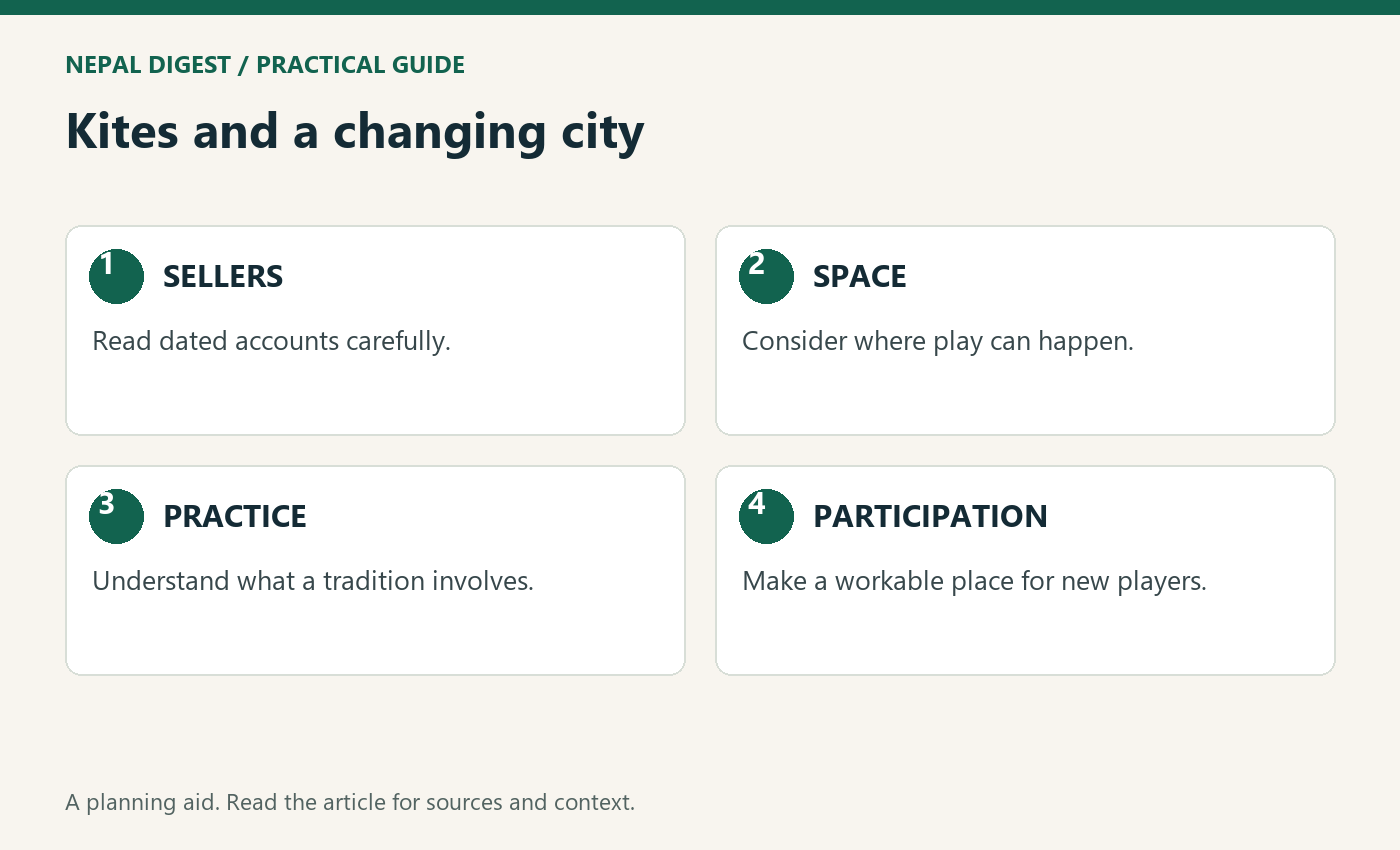
Table of Contents
Kites: a festival once heard from the rooftops
Kite flying is not a compulsory Dashain ritual. Nobody needs a kite to receive tika or visit family. Its importance comes from the everyday experiences that surround the festival: school breaks, clear spells after the monsoon, a free afternoon, and neighbours with enough time to turn a patch of sky into a playground. A kite’s flight could draw an audience without a ticket, stage or screen. Children learned to judge wind direction, adjust the string and accept that even a well-launched kite might disappear within minutes.
Historic accounts of Kathmandu recall shops in Asan, Tyauda and Kalimati serving generations of flyers. The Kathmandu Post documented longstanding trading families and kite centres in 2024, including a business believed by its owners to have existed for roughly a century. That history matters because kite culture was not merely a set of individual childhood hobbies. It supported craftspeople, importers, merchants and whole neighbourhood networks. The people who sold the lattai, the wooden or bamboo reel, helped make the festival visible.
What today’s kite sellers actually report
It would be convenient to declare that the tradition has vanished. The evidence is less tidy. In September 2025, Nepal News reported that some Valley traders had seen substantial declines in demand. Buyers described shrinking enthusiasm and fewer shops stocking supplies. Then, in October 2026, The Rising Nepal reported families purchasing kites again, a staff competition and renewed activity at an old Asan shop. A September 2026 Ratopati report also described traders preparing for seasonal demand and supplying Nepali customers abroad.
These are accounts from particular shops and communities, not a nationwide survey. Their different findings can coexist. A single lively market does not prove a revival across Nepal; a quiet rooftop does not establish cultural extinction. Weather, holiday travel, where a family lives and the age of local children all affect how many kites appear in any given area. The more useful story is about uneven change, not an imaginary moment when everyone collectively stopped flying.
The city beneath the kite has changed
One explanation is physical. Kathmandu’s dense buildings, rooftop water tanks, overhead cables and fewer accessible open grounds leave less forgiving space for beginners. A rooftop is not automatically a safe playground. Parents who remember kite battles may also remember falls, sharp strings and the temptation to chase a severed kite across traffic. Choosing an indoor activity can be a rational safety decision rather than evidence that a family no longer values tradition.
Time has changed, too. More children spend holidays with digital entertainment, and families have different school, work and travel routines. Phones certainly compete for attention, but blaming screens alone ignores the practical challenge of finding a suitable place, an experienced adult and uncomplicated flying equipment. A child cannot learn an outdoor tradition solely through a lecture about how wonderful earlier generations had it.
What we lose when we lose the practice
Changa provided something difficult to reproduce in an app: a shared, unpredictable activity. One person held the reel; another offered advice; spectators on nearby terraces cheered the same small contest. The skill was passed on through demonstration, failure and patience. A kite that sank unexpectedly was an invitation to try again, not a screen that could simply be refreshed. Even the sounds and arguments formed part of the experience of belonging to a neighbourhood.
At the same time, nostalgia can hide exclusions. Not every child had access to a safe roof, enough money for supplies, or adults willing to include them. Boys’ competitive memories are particularly prominent in some retellings, but the tradition should belong to girls, younger children and first-time flyers just as much. Reviving kite flying should not mean recreating every risk or social barrier that accompanied it.
Tradition also has to be safe
The aviation warning issued ahead of Dashain 2026 is a reminder that celebration has boundaries. The Civil Aviation Authority of Nepal cautioned against flying kites and similar objects around Tribhuvan International Airport or aircraft flight paths. Elsewhere, flyers should keep clear of electricity lines, roads and unprotected roof edges, supervise children and avoid abrasive, glass-coated or hazardous synthetic lines that can injure people and wildlife. Never pursue a fallen kite into unsafe areas.
How the next generation might reclaim the sky
A workable revival is smaller and more practical than a slogan. Schools could organise demonstrations in suitable open spaces. Families could purchase a basic paper kite and ordinary safe cotton line, practise together, then leave the reel in a child’s hands. Communities could reserve supervised festival sessions and invite older enthusiasts to teach how to launch, balance and steer. Kite shops could demonstrate repair, not just sell replacement supplies.
This creates a living skill rather than a museum exhibit. The point is not to compete with every digital pastime or force children to cherish adults’ memories. It is to let them make memories of their own. In some parts of Nepal the sky may no longer be crowded as it once was. But whenever a child learns to read the wind with an elder nearby, changa has found a way to remain part of Dashain.
Related Nepal Digest guides: Why Do Nepalis Fly Kites During Dashain? The Story Behind Changa; A Kite, a Rooftop, and a Memory of Home: Dashain Through the Eyes of Nepalis Abroad.