
Nepal’s traditions live through people practising, teaching and adapting them. Continuity is not guaranteed by a festival photograph or a public declaration that heritage matters. It depends on whether the people doing the work have time, resources and a meaningful say in what happens next.
The country contains many cultural histories and different understandings of change. This analysis offers practical questions for safeguarding living traditions while respecting those differences. It does not assume that every adaptation is welcome or that every inherited arrangement must remain beyond discussion.
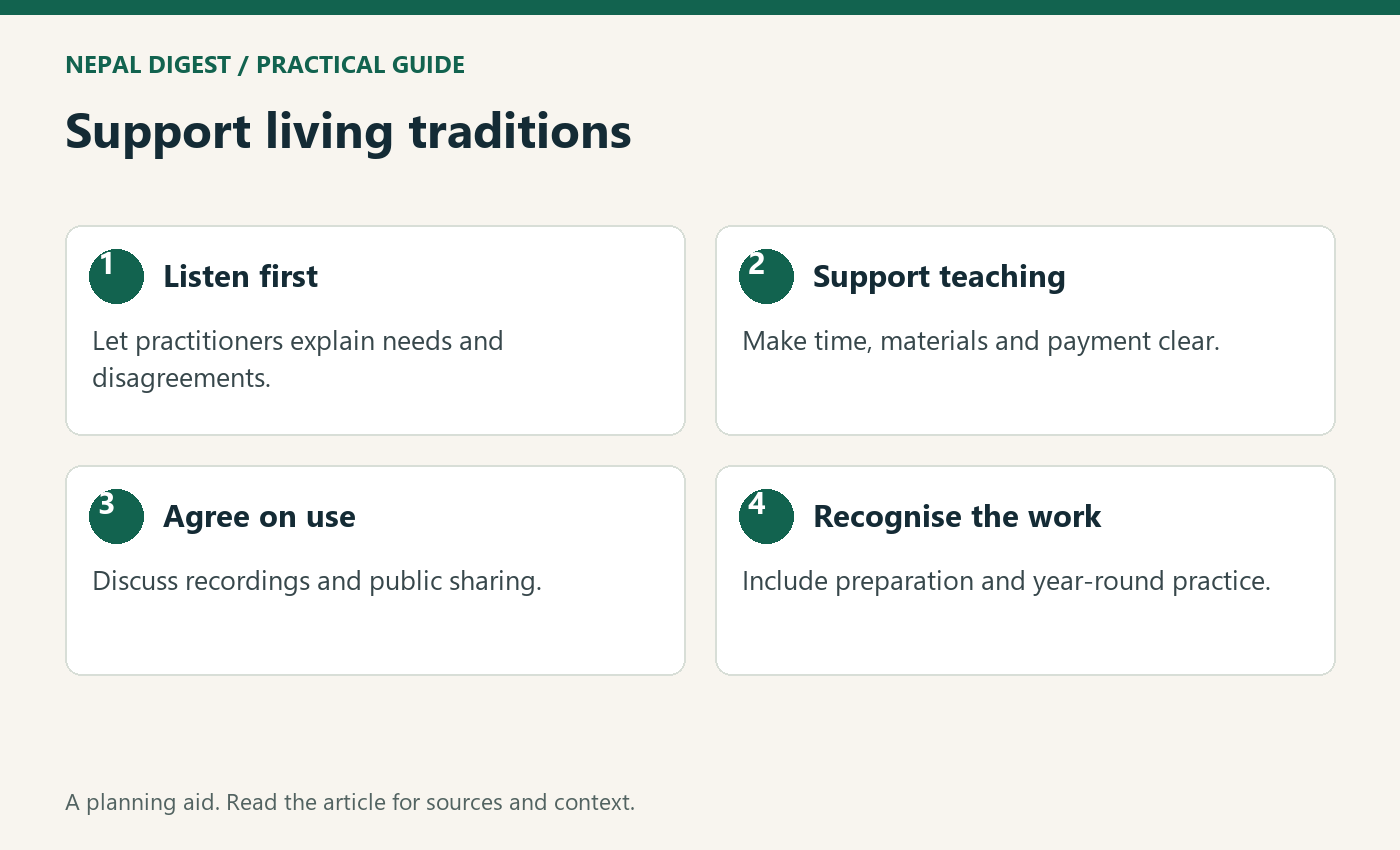
Table of Contents
Living traditions depend on people who can keep practising
A craft, song or festival is sustained through time, skill and relationships. Someone prepares materials, organises a gathering, teaches a sequence or remembers when a task must begin. Celebrating the finished result while overlooking that work can leave the practice visible to visitors and increasingly difficult for its own participants.
UNESCO’s April 2026 description of a Nepal heritage-inventory project puts community participation at the centre of safeguarding. It proposes training community members and documenting practices across the country’s seven provinces. Those are project aims, rather than evidence that every proposed activity has already been completed.
The useful principle for a local initiative is to start with practitioners’ priorities. Ask what makes participation difficult, what should be passed on and what support would help. A camera or public event may be useful, but neither automatically resolves the shortage of time, teaching space or materials.
Teaching requires more than asking young people to care
It is easy to describe a generation as uninterested when the practical conditions for learning have disappeared. A young person may want to learn a craft but have school, paid work and travel competing for the same hours. A teacher may value transmission while being unable to offer repeated unpaid lessons.
A workable arrangement makes expectations explicit. How often will the group meet, what will learners need, and how will the teacher’s time be recognised? Start with a manageable skill or part of a practice rather than demanding immediate mastery of the whole tradition.
Learning can also be reciprocal. Younger participants may help organise recordings, invitations or accounts while older practitioners explain technique and meaning. That exchange works best when technical help does not quietly become control over how the practice is presented. The people contributing cultural knowledge should remain part of the decisions.
Change should be discussed by the people affected
Traditions do not exist outside ordinary life. Available materials, working hours, migration, public space and household resources can change how a practice is carried out. Adaptation may make participation possible, but it can also create disagreement about what must remain central.
The useful discussion separates purpose from detail. Which parts carry religious, social or historical meaning? Which arrangements were responses to conditions that have since changed? People may disagree about the answer, and an outside writer should not settle the dispute by selecting the version that looks most colourful.
Nor should a community be treated as if it has only one spokesperson. Teachers, women doing preparation, younger learners, organisers and people who feel excluded may have different experiences. Giving those differences room to be heard can strengthen a practice’s future without requiring everyone to describe its past in the same way.
A recording is not the same as a public right to reuse
Documentation can help preserve a process or pronunciation that is difficult to explain in writing. Before recording, agree on the purpose, audience and intended use. A person’s willingness to teach a visitor does not automatically mean they want the lesson posted publicly or reused in a commercial promotion.
UNESCO’s ethical guidance on living heritage stresses transparent collaboration and informed, continuing consent in work with practitioners. It also recognises their interests in the use, documentation and adaptation of their heritage. The guidance offers a starting point for respectful practice rather than a shortcut around local discussion.
A practical recording agreement can be simple. Identify who is being recorded, who will keep the file, where it may appear and whom to contact about an error or changed permission. Some knowledge may be suitable for a family archive but inappropriate for unrestricted sharing. Respecting that boundary is part of safeguarding.
Income can support a practice without defining all of it
Tourism and sales can provide money for materials, teaching and continued work. They can also push a practice toward what buyers understand quickly. A demonstration shortened for a visitor may be useful, provided it is not presented as the complete meaning of a ceremony or technique.
Ask how payment is distributed. The visible performer may not be the only person whose work makes an event possible. Preparation, instrument care, costume maintenance, cooking and coordination can require substantial labour. A credible initiative should explain who is paid and what the quoted fee includes.
Allow practitioners to decline an unsuitable request. A buyer’s deadline or a tourism itinerary should not determine access to every cultural activity. Commercial opportunities become more sustainable when the people involved can negotiate terms rather than being expected to provide authenticity on demand.
Festivals need practical support as well as publicity
A public celebration requires access, preparation space, storage, crowd arrangements, clean-up and coordination with neighbours. These are ordinary municipal concerns, but they can determine whether participants are able to continue. Publicity should not take priority over the people doing the work.
A local review can record the practical difficulties after an event. Was a route blocked? Did preparation fall repeatedly on the same households? Were older participants able to attend? Could residents raise concerns without being accused of opposing the tradition itself?
Small improvements may matter more than a new slogan. A reliable rehearsal space, a clear arrangement for equipment or support for teaching can help throughout the year. The measure of success is continued participation and transmission, not simply a larger audience at one performance.
Describe traditions precisely and leave room for the next generation
A writer should name the community, place and version being described. Avoid turning one household’s experience into a claim about all Nepal, or presenting a recently observed practice as unchanged for centuries without evidence. Explain who provided the information and distinguish an account of meaning from a verified historical date.
Ask participants what an outsider is likely to misunderstand. That question often produces a more useful explanation than a request for a picturesque story. It can reveal why a familiar gesture matters, why an apparently small variation is significant or why some details should not be publicly explained.
Traditions survive through people choosing to continue them under real conditions. Supporting that choice requires attention to work, consent, access and teaching. Explore Nepal Digest’s related discussions of crafts and new makers, Ranjana script in public life and folk sounds in contemporary music.