
A weekend does not need a flight, a resort package or a long list of attractions to feel like a break. It needs a change of rhythm that fits the time, money and energy available. In Nepal, nearby towns, local food, heritage places and hill destinations offer different ways to build that change.
This is a planning guide rather than a claim that every household now enjoys the same leisure opportunities. Work schedules, income and caring responsibilities remain different. The useful question is how to make a short outing enjoyable without turning it into another source of pressure.
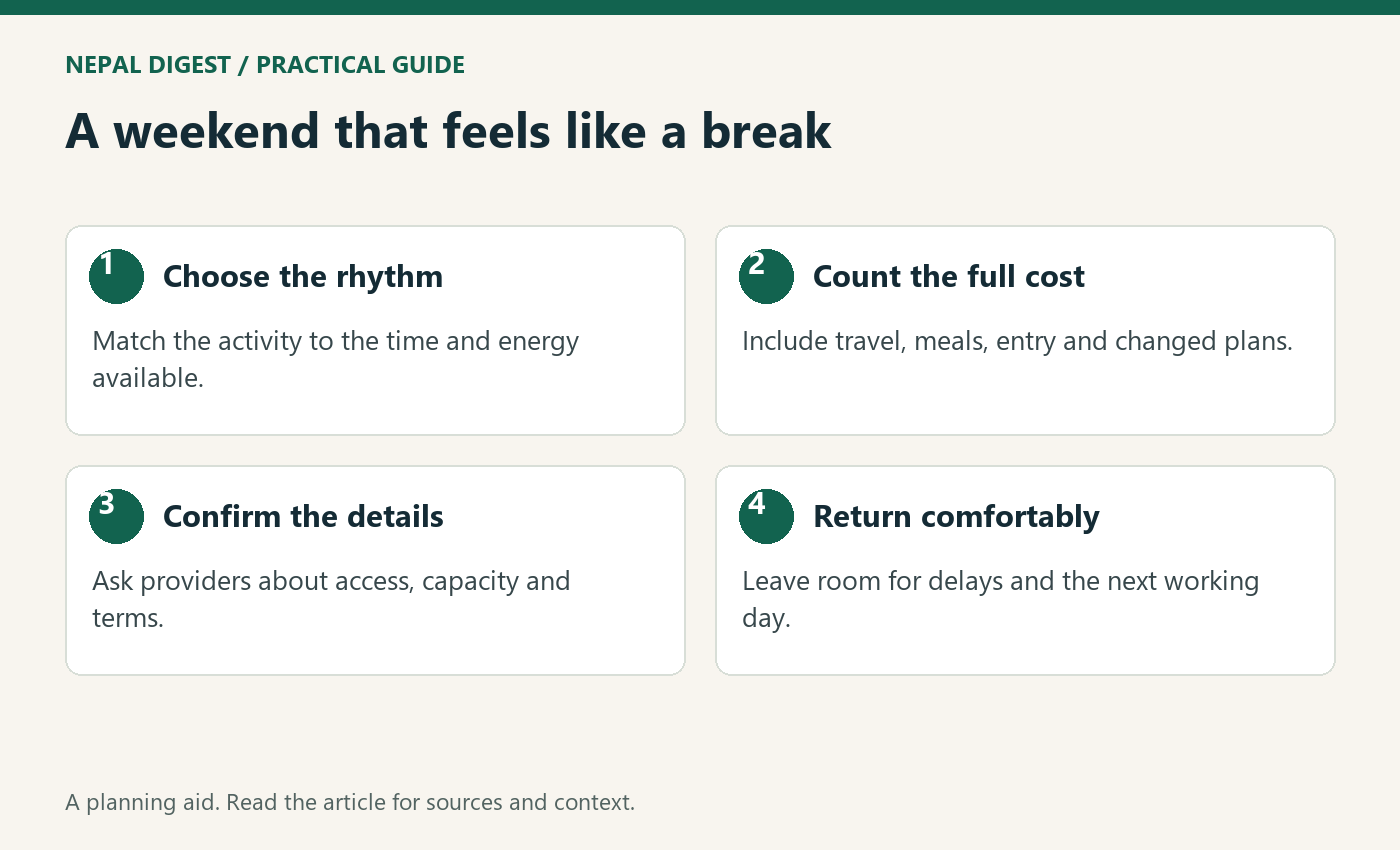
Table of Contents
A useful weekend begins with a realistic amount of time
A day away and an overnight trip are different commitments. Start by identifying when everyone can actually leave and when they need to be back. Include work shifts, school preparation, caring responsibilities and the time required to reach a departure point. A plan based on the most flexible member of the group can leave everyone else exhausted.
Choose an activity before choosing a distant destination. A long meal, a short heritage walk, time beside a lake and a demanding hike require different levels of energy, weather tolerance and transport. Deciding what would make the break worthwhile helps prevent the itinerary becoming a list of stops nobody has time to enjoy.
The weekend does not have to become another performance of achievement. One well-paced outing can offer more rest than several rushed attractions. Give the return journey the same attention as the outward one, particularly when the next working day begins early.
Nearby places can support a complete day out
Proximity is a useful advantage when time is limited. It makes it easier to change a plan, reduce transport costs and spend longer in the destination itself. For Kathmandu residents, this can mean exploring a neighbourhood or nearby town with more attention rather than assuming that a break must begin with a long drive.
Nepal Tourism Board’s 2020 announcement of Kirtipur’s “City on the Hill” identity explicitly discussed attracting both domestic and international visitors. That is a dated tourism initiative, not proof of current visitor growth, but it illustrates that nearby heritage places can be destinations in their own right.
Build the outing around a small area. Identify a public meeting point, a meal and a route that suits the group’s mobility. Check access to particular sites before promising entry. Homes, courtyards, religious spaces and working neighbourhoods should not be treated as scenery available without permission.
Hill trips need expectations that can survive the weather
The Tourism Board’s hill-station information includes Nagarkot, Dhulikhel, Daman and Kakani among destinations reachable from Kathmandu. A place appearing in a tourism guide does not establish today’s road conditions, transport timetable or visibility. Those details need to be checked for the actual trip.
A view-led weekend can become disappointing if the whole plan depends on a clear horizon. Include something enjoyable that does not require distant mountain visibility: a meal, time with companions, a suitable local walk or simply an unhurried morning. The point is to make the outing worthwhile under more than one set of conditions.
Ask accommodation providers concrete questions before paying. Clarify the room arrangement, meals, parking or access, cancellation terms and any assistance needed by members of the group. Confirm important details in writing. A photograph can show an appealing room while revealing little about the approach road or the steps required to reach it.
Count the whole cost before agreeing
Transport and room prices rarely describe the complete expense. Add meals, entrance charges where applicable, local transfers, equipment, additional activities and a margin for a changed return plan. A shared budget should make clear which items are optional and which everyone is expected to contribute toward.
Discuss money before the outing begins. A lower-cost choice can still be enjoyable if expectations are aligned. Friction often arises when one person assumes a restaurant, activity or vehicle upgrade is obvious while another has planned around a much smaller amount.
The same principle applies to booking packages. Ask what is included, who provides each service and what happens if the advertised activity is unavailable. Keep the booking confirmation and payment record. Avoid judging value only through the number of activities listed; time to use them matters as much as their names.
Local businesses benefit when the visit is deliberate
A short trip can support guides, cooks, small shops, drivers and accommodation providers. The distribution of spending matters, however. A visitor cannot assume that money stays in a community simply because an activity takes place there. Ask who operates the service and what the quoted price covers.
Buying directly can make the relationship clearer, but respectful behaviour still matters. Confirm a price, pay as agreed, ask before photographing a person at work and avoid blocking the entrance while deciding what to buy. A business is an operating workplace rather than a prop for a visitor’s story.
Consider timing as well. A group arriving together can create work that a small kitchen or family-run property cannot absorb immediately. Give notice, communicate dietary needs early and accept an honest limit on capacity. A better experience often comes from matching the visit to what the provider can reliably deliver.
Make a mixed group comfortable
A family or group of friends rarely shares one fitness level, appetite or idea of rest. Plan for the least flexible requirements first: medication routines, food needs, mobility, children’s rest and the ability to leave an activity. Nobody should need to apologise repeatedly for limits that could have been discussed in advance.
Agree on a meeting point and a way to reconnect if the group separates. Keep essential information available without relying on one person’s phone. If a companion is responsible for every booking, payment and direction, the trip may become work for that person while everyone else calls it leisure.
A useful division of responsibility is small and explicit. One person can confirm transport, another can check meals, and each adult can carry their own essential items. The arrangement should reduce friction rather than turn a short break into a complicated management exercise.
A heritage weekend plan for people who want less travel
Use this as a planning pattern rather than a promised itinerary. Choose one compact heritage area and make the visit long enough for a slow walk and a meal. Before leaving, check any site you particularly want to enter, the approach suitable for the group and where people can sit or meet if they separate. One confirmed activity is enough to anchor the day.
Kirtipur can be a starting point for this kind of outing, with the Tourism Board’s destination initiative providing background. The decision about what to do there should come from current local information. Ask a guide or host to explain which spaces are public and whether photography is appropriate. A quiet courtyard may be part of someone’s home rather than a place designed to receive a tour group.
Leave unallocated time after the main activity. Someone may want to browse a shop, another may prefer to sit, and children may need a pause. Agree on when to meet again and when to begin returning. A heritage visit becomes more attentive when the group is not constantly calculating how to fit another destination into the afternoon.
An overnight weekend plan when rest is the priority
Begin with the room and the practical conditions around it. Confirm beds, access, meals and the time at which the room will be ready. If a companion has a mobility need, explain the specific requirement instead of asking only whether the property is accessible. A direct description of steps, slopes and distances is easier to assess than a broad assurance.
Choose a nearby hill destination only after checking the journey and current conditions. Nagarkot, Dhulikhel, Daman and Kakani appear in the Tourism Board’s hill-station information, but a destination name is not a guarantee of a view or a convenient approach. Decide whether you would still enjoy the stay if the horizon were clouded. If the answer is no, another kind of outing may be a better use of the budget.
Keep the evening simple. A shared meal and enough time to talk may be the purpose rather than the gap before another activity. In the morning, allow time for breakfast, packing and a calm departure. Confirm the return arrangement before adding a walk, so that a pleasant extra does not become a rushed journey home.
A low-cost weekend plan without an overnight booking
Start with an amount everyone can comfortably spend and work backwards from it. Choose a place reachable without a costly private transfer, or make the main activity close enough that travel does not dominate. A market visit, a public-space outing or cooking a meal together after shopping can provide a change of rhythm without a room reservation.
Set a clear boundary around optional spending. If the group visits a café or shop, nobody should be obliged to purchase something simply to remain part of the outing. Choose a meeting arrangement that does not require everyone to sit in a business for a long period without ordering. Consider the needs of the business as well as the group.
The useful test is whether the plan remains enjoyable at the agreed budget. A supposedly inexpensive trip that depends on several unmentioned purchases can be uncomfortable for the person with the least spare money. Speak about the limit plainly before departure and make the main activity one everybody can take part in.
Questions to settle before the next weekend
Write down the departure point, the expected return window, the essential booking and the person responsible for confirming it. Add a contact who is not travelling if that would help your circumstances. Keep the information available to the people who need it, while avoiding unnecessary public sharing of home addresses or detailed travel movements.
Agree on a simple decision point for changing plans. This might concern transport availability, weather information or a provider being unable to supply an essential arrangement. The decision should be made before people feel committed by the cost or effort already spent. A revised local outing can still be worthwhile when the original trip becomes impractical.
After the outing, ask each person what they would keep and what they would change. The answers may differ: the driver may want a shorter route, the organiser may want shared responsibility and a younger companion may want more unstructured time. Use that information for the next plan rather than judging the success of the weekend only by how many photographs were taken.
Keep enough of the weekend to return well
Rest is affected by the ending of a trip. A late return, an unplanned extra stop or a long queue can turn a pleasant day into an uncomfortable night. Decide a sensible departure time and explain why it matters. Leaving a place before everyone is completely exhausted can protect the memory of the outing.
Afterwards, record the useful details: what the journey actually took, which booking information was accurate and what you would change next time. Treat a review fairly, distinguishing a provider’s conduct from weather or road conditions outside their control. Specific feedback is more useful than a dramatic verdict.
A country rediscovers the weekend through these ordinary choices: nearby places taken seriously, services delivered dependably and time that feels different from work. Explore Nepal Digest’s guides to weekends close to Kathmandu, local markets and Pokhara beyond Lakeside for related ideas.