

How a 1986 Eddie Murphy fantasy used real Kathmandu footage, Tibetan-Buddhist imagery and Hollywood special effects to create one of the strangest versions of the Himalayas ever put on screen.
In 1986, Eddie Murphy was one of the biggest stars in American cinema. He had transformed from television phenomenon to box-office force through films such as 48 Hrs., Trading Places and Beverly Hills Cop. His screen persona was fast, skeptical, urban and relentlessly verbal.
Then Hollywood sent that persona into a story of Tibetan mysticism, demons, sacred daggers and a child with supernatural powers.
The Golden Child, directed by Michael Ritchie and released by Paramount Pictures, is one of the strangest entries in Murphy’s 1980s career. Murphy plays Chandler Jarrell, a Los Angeles social worker known for locating missing children. He is told that he is the “Chosen One” destined to rescue a kidnapped mystical child whose survival is supposedly essential to the balance between good and evil.
The villain, Sardo Numspa, is played by Charles Dance. Charlotte Lewis plays Kee Nang, the woman who recruits Chandler into the supernatural mission. J. L. Reate plays the Golden Child. Victor Wong and James Hong appear in supporting roles.
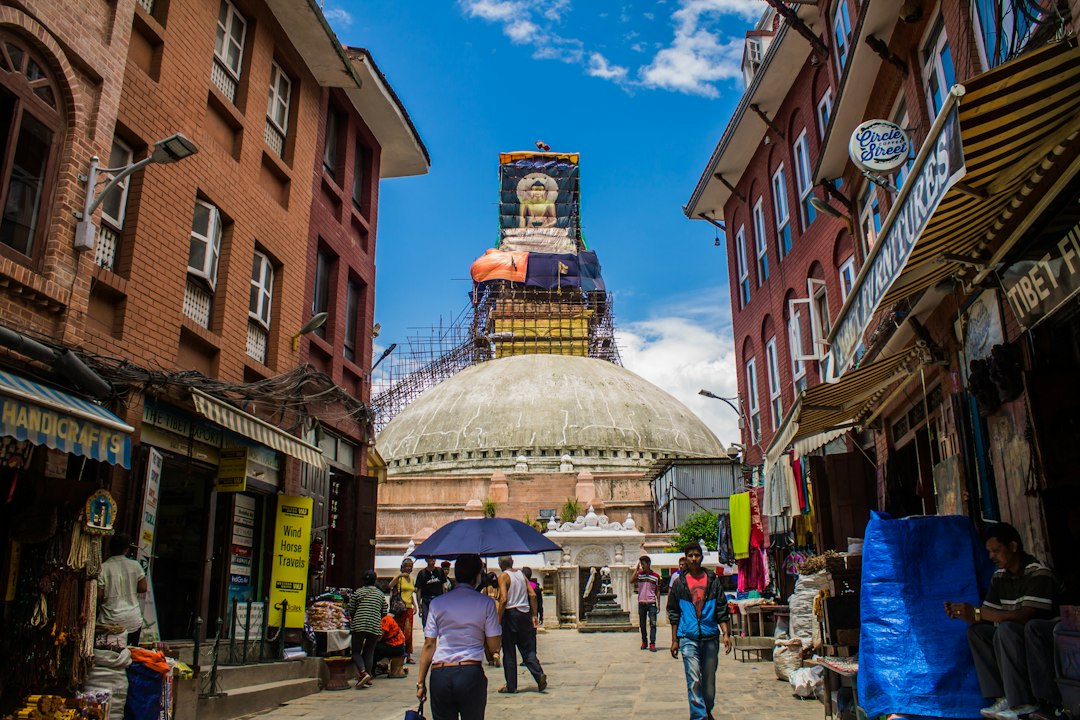
The movie is mostly a Hollywood studio fantasy. Yet Nepal is genuinely part of its production history. Nepal’s Film Development Board lists The Golden Child as a 1986 U.S. production shot in Kathmandu and at Tribhuvan International Airport. The American Film Institute adds an important qualification: most principal photography took place in the United States, while a second unit filmed in Nepal. Mammoth Mountain in California was used to recreate much of the Himalayan terrain.
This makes The Golden Child especially revealing. Hollywood wanted the authority of real Nepal, but only in selected pieces. The rest of its imaginary Himalayas were constructed elsewhere.
Watch the Trailer
The theatrical trailer shows exactly why the movie was difficult to categorise: Eddie Murphy comedy collides with dark fantasy, Buddhist imagery and 1980s creature effects.
Archival trailer upload for The Golden Child (1986). Paramount’s current film page also lists the theatrical trailer among official extras.
A Comedy Star Inside a Dark Fantasy
The film’s central creative problem is visible almost immediately. Eddie Murphy’s natural screen energy belongs to modern Los Angeles. The mythology surrounding the Golden Child belongs to a deliberately timeless, mystical Asia.
Rather than forcing Murphy to become solemn, the movie uses the clash.
Chandler Jarrell does not accept prophecy politely. He questions it, jokes about it and resists the idea that he has been selected by cosmic forces. His skepticism becomes the audience’s skepticism.
This is an old Hollywood device: place a modern Westerner inside an unfamiliar culture so the audience can discover it through him. The strategy makes fantasy accessible, but it also makes Asia something to be interpreted through a Western protagonist.
Nepal enters that system not primarily as itself, but as evidence that the supernatural world is geographically real.
What Was Actually Shot in Nepal?
The Nepal Film Development Board’s production record is concise: Kathmandu and TIA Airport. The AFI catalogue confirms that a second unit filmed in Nepal, while most of the film was shot on Paramount soundstages and American locations.
That distinction is important because The Golden Child is often remembered as a Himalayan adventure, yet much of its mountain imagery was manufactured in California.
Hollywood location filmmaking frequently works this way. A few real establishing images give geographic credibility to a much larger fabricated environment. The viewer sees Nepal, then unconsciously carries that authenticity into scenes shot thousands of kilometres away.
This makes the real Kathmandu footage disproportionately powerful. A short exterior can authenticate an entire fictional world.
Tibet, Nepal and the Hollywood Map of Asia
The story’s mythology is primarily Tibetan. The Golden Child is represented as a sacred Buddhist figure, and the film borrows broadly from Tibetan religious imagery. Yet the production used Nepal as one of the visual sources for this imagined world.
For Western audiences in the 1980s, the distinction between Tibet, Nepal, Bhutan and the broader Himalayan Buddhist world was often blurred in popular culture. Prayer flags, monasteries, mountains, monks and ritual objects became interchangeable symbols of “the mystical Himalayas.”
The Golden Child is a textbook example of that compression.
It is not useful to demand documentary precision from a supernatural comedy. But it is useful to see what the film reveals about its era. Hollywood did not require cultural specificity to sell Himalayan mystery. It required recognisable signs.
The Sacred Child as Fantasy Device
The Golden Child is not developed as an ordinary child with an ordinary social world. He is a symbol—pure, supernatural and spiritually powerful.
That construction draws loosely on Western fascination with reincarnate lamas and sacred children, but the film turns religious ideas into fantasy mechanics. The child can perform miracles. Evil forces want to corrupt or kill him. A chosen outsider must save him.
This is far removed from the comparatively careful religious engagement later attempted by Bernardo Bertolucci in Little Buddha.
In The Golden Child, Buddhism functions primarily as atmosphere and moral shorthand. Buddhist-looking spaces represent goodness, spiritual purity and ancient wisdom. Demonic forces represent corruption.
The simplicity makes the adventure easy to follow but leaves little room for actual Buddhist philosophy.
Eddie Murphy Changes the Tone
Without Murphy, the same screenplay might have become a conventional mystical adventure. His presence destabilises the genre.
Chandler’s humour constantly punctures the solemnity around him. That creates comic energy but also prevents the film from fully surrendering to its own exoticism. The protagonist is suspicious of nearly everything.
Yet the comedy does not remove the underlying structure. Chandler remains the outsider whose arrival resolves an Asian spiritual crisis.
This “Western chosen one” framework would later become the subject of much stronger criticism in Hollywood storytelling. The pattern appears across fantasy and martial-arts cinema: a local tradition may contain centuries of knowledge, but an outsider arrives and becomes uniquely central.
The Golden Child treats the device lightly, but the structure is unmistakable.
Charles Dance and the Evil of Sophistication
Charles Dance’s Sardo Numspa is effective because he is not visually chaotic. He is controlled, elegant and polite. Evil is presented through sophistication rather than barbarism.
This gives the movie a useful contrast. The sacred world is associated with simplicity and innocence; Numspa’s world is associated with manipulation, wealth and appetite.
Again, the symbolism is broad. But it explains why the film’s Asian spiritual imagery is important to the story: it is being used to represent an uncorrupted moral order.
Industrial Light & Magic and 1980s Fantasy Technology
The film also belongs to an important period in visual-effects history. The American Film Institute notes that Industrial Light & Magic used new live-action motion-control techniques in the production, particularly for demon sequences.
This places The Golden Child in the transitional era before digital visual effects transformed fantasy filmmaking. Creatures, optical compositing, practical sets and miniature work had to create phenomena that today might be built almost entirely in computers.
That gives the film a tactile strangeness. Its effects can look dated, but they also possess physical texture.
The Real Nepal Behind the Imaginary Himalayas
For a Nepal Digest audience, the most interesting question is not whether the fantasy is believable. It is why Nepal was useful to Hollywood in the first place.
In the 1980s, Kathmandu had already accumulated a powerful international identity. The hippie era had made it famous as an alternative destination. Mountaineering had linked Nepal to extreme adventure. Tibetan refugee communities and major Buddhist sites connected the Kathmandu Valley to Himalayan Buddhism. Western travel writing often added a layer of mysticism.
Hollywood could therefore use Kathmandu to communicate several ideas instantly: distance, spirituality, Asia, mountains and mystery.
That symbolic value is exactly what the film needed.
A Very Different Nepal From Caravan
The contrast with Caravan could hardly be greater.
In Caravan, Himalayan people possess internal conflicts, economic systems, leadership structures and competing ideas. The community is the subject.
In The Golden Child, Himalayan culture is largely mythology surrounding an American hero.
This does not make the movie worthless. In fact, the difference makes it valuable for understanding how Nepal and the Himalayas functioned inside American popular imagination.
One film tries to enter a Himalayan social world. The other borrows Himalayan signs to build fantasy.
The Airport as a Cinematic Border
The Film Development Board’s reference to Tribhuvan International Airport is more interesting than it first appears.
Airports often function in foreign films as transition points. The character leaves the familiar world and enters the unknown. Kathmandu’s airport became one of those thresholds repeatedly during the expansion of Himalayan tourism.
For Western travellers, arrival at TIA meant the beginning of trekking, mountaineering, spiritual travel or overland adventure. Film inherited that symbolism.
An airport scene can therefore do more narrative work than a mountain panorama. It announces that the normal rules are about to change.
Orientalism With a Punchline
The Golden Child is easy to criticise through the language of Orientalism. It combines Asian traditions, reduces religious imagery to mystical shorthand and centres an American chosen one.
All of that is true.
But the film’s comic tone complicates the reading. Murphy is constantly making fun of the seriousness around him. The movie is not presenting itself as an authoritative guide to Tibetan Buddhism or Nepal. It is presenting an intentionally absurd supernatural adventure.
That does not erase cultural simplification. It does change the degree of claim the film makes.
A useful critical approach is therefore neither outrage nor nostalgia. It is to understand the movie as a product of 1980s Hollywood, when cultural specificity was often sacrificed for instantly recognisable fantasy imagery.
Why the Film Still Matters to Nepal’s Cinema History
The actual Nepal footage may be limited, but the production belongs in Nepal’s foreign-film history because it demonstrates how early American studios used Kathmandu as a global cinematic sign.
Long before Marvel brought Benedict Cumberbatch to Patan, Paramount had already discovered the value of attaching genuine Nepal imagery to a fantasy narrative.
The scale changed. The technology changed. The representational problem remained surprisingly similar.
Foreign filmmakers come to Nepal because the country offers visual specificity they cannot fully fabricate. Yet the stories they build around those images often transform Nepal into something else.
From Eddie Murphy to Doctor Strange
Seen today, The Golden Child feels like an ancestor of later Hollywood mystical-Nepal films.
Its hero travels from modern rational life toward an Asian spiritual world. Sacred knowledge exists somewhere beyond ordinary Western experience. Nepal and the Himalayas help signal the transition.
Three decades later, Doctor Strange would use a more sophisticated version of the same structure. A brilliant American professional loses control of his life, travels to Kathmandu and discovers a hidden order of mystical knowledge.
The similarity is striking.
What changes is the production scale, cultural awareness and visual technology—not the basic Hollywood fascination with Kathmandu as a doorway between realities.
What Survives of The Golden Child
The Golden Child is not remembered as Eddie Murphy’s greatest film. It sits awkwardly between comedy, horror, fantasy and adventure. That awkwardness is exactly what makes it historically interesting.
It captures an era when Hollywood was experimenting with combining star-driven comedy and supernatural spectacle. It preserves a small piece of 1980s Kathmandu. It reveals how Tibetan Buddhism and Nepal could be combined into a generalized Himalayan fantasy for global audiences.
And it shows something that would become increasingly important: real Nepal adds cinematic credibility even when the story surrounding it is almost entirely invented.
For Nepal Digest’s series, that is the key lesson.
Foreign films do not simply show Nepal. They show what outsiders wanted Nepal to mean.
Further reading: Paramount Pictures: The Golden Child · Nepal Film Development Board: Foreign Films Shot in Nepal · AFI Catalog: The Golden Child