

The amount arriving in your bank account is only one part of your pay. Your payslip should help you see which period you were paid for, how the amount was calculated and what happened before the final deposit.
For a first job in Australia, read it with your roster or own record of hours beside you. Do not start by comparing your take-home amount with a friend's: their hours, employment arrangement and tax circumstances may be different.
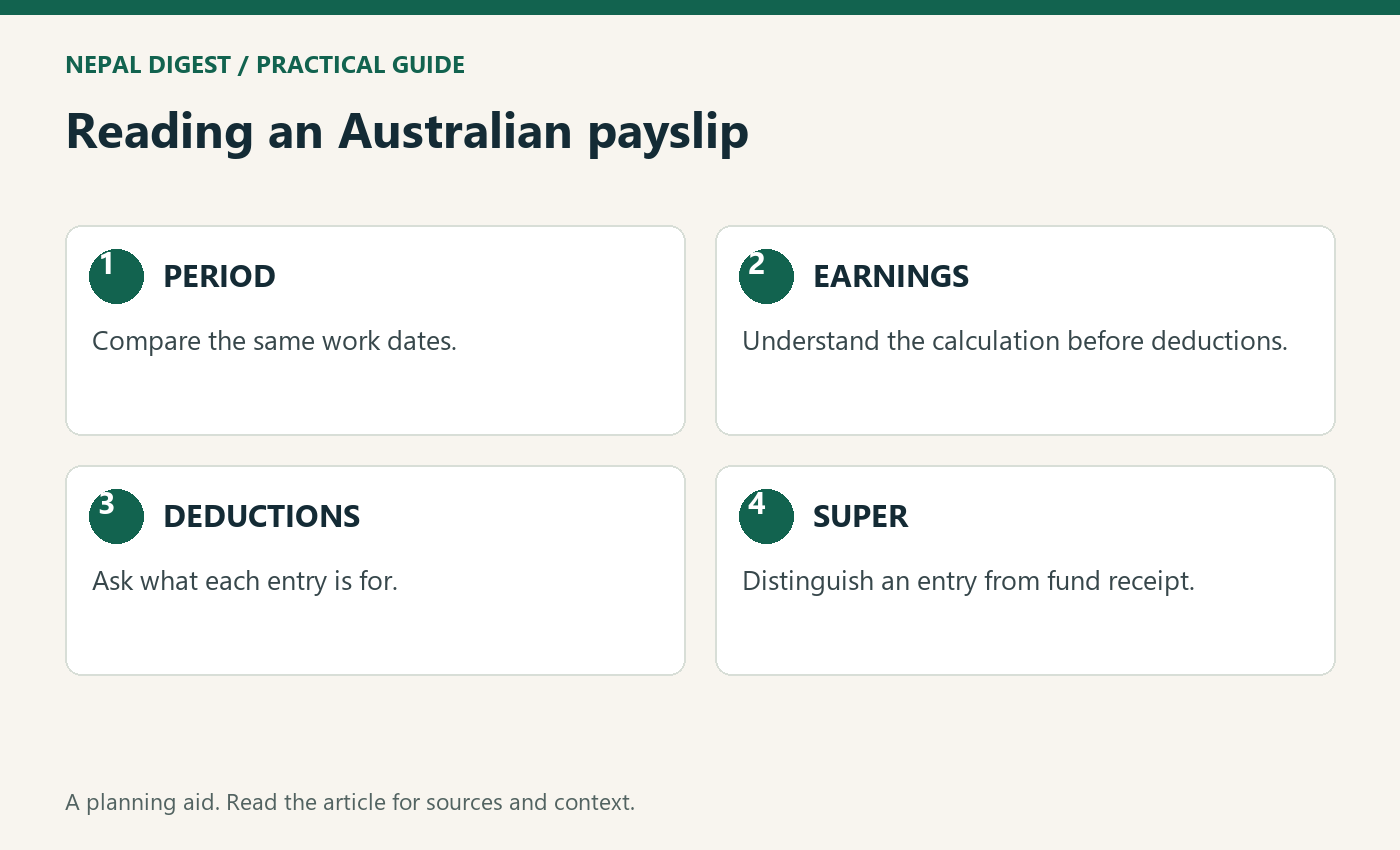
Table of Contents
Australian payslip: first, check the dates and names
Fair Work Ombudsman guidance says employees must receive a payslip within one working day of payday, electronically or on paper. Required details include the employer and employee names, the employer’s Australian Business Number (if applicable), the pay period, payment date, gross and net pay, and applicable information about rates, deductions and super contributions. For hourly employees, the ordinary hourly rate, hours at that rate and corresponding pay must appear. Fair Work payslip requirements
The pay period matters. A deposit received on Friday may cover an earlier week or fortnight. Check that you are comparing the same dates before concluding that a shift is missing.
Read this fictional payslip excerpt
The following numbers are invented solely to explain the arithmetic. They are not a real worker's payslip, a tax calculation, a legal minimum wage or a complete compliant payroll template. All amounts are Australian dollars.
- Ordinary hours: 20
- Illustrative hourly rate: A$30
- Ordinary earnings: 20 × A$30 = A$600
- Other earnings or allowances in this example: A$0
- Gross pay: A$600
- Illustrative tax withholding: A$100
- Other deductions in this example: A$0
- Net pay deposited: A$500
- Employer super contribution: A$72, assuming the entire A$600 is qualifying earnings and the 12% rate applies
The A$100 tax figure is deliberately hypothetical. Your correct withholding depends on your circumstances and the applicable tax rules; do not use this example to check it.
Gross is the pay before deductions. Net is what remains after them. Employer super in this example is shown separately from the A$500 bank deposit. Ask payroll to explain any unfamiliar label rather than assuming every line is extra cash you should receive today.
Check extra rates and deductions
Look for applicable loadings, allowances, bonuses and penalty-rate information. Fair Work's record-keeping guidance describes the information employers must retain and show, including relevant pay details and deductions. If you worked different kinds of shifts, ask how each was classified. Record-keeping and payslips
A deduction is not automatically lawful simply because it appears on a payslip. Fair Work explains that deductions are allowed only in specified circumstances. These include a deduction the employee authorises in writing mainly for their own benefit, one permitted by a law or relevant order, or one allowed by an award. A deduction allowed by a registered agreement also requires the employee's agreement. A signed employment contract alone does not make every deduction lawful. A deduction that benefits the employer and is unreasonable may still be unlawful even if an award, agreement or contract contains a deduction term. Ask what the deduction is for and what authorises it; seek advice if the answer does not resolve the issue. Fair Work deduction rules
Your payslip should identify the amount of each deduction and the fund or account it goes to. For super, it should show the contribution amount paid or intended and the fund details, subject to a limited exception for new employees whose fund details are not yet available. Fair Work’s field-by-field checklist
Super: check the fund as well as the line
As of this article's check on 17 October 2026, the ATO says Payday Super began on 1 July 2026. Employers must pay super guarantee on payday, calculated at 12% of qualifying earnings, with receipt by the fund generally required within seven business days. Extended timeframes can apply. For a new employee's first contribution, the receipt window can be up to 20 business days after the first payday. Check which deadline applies rather than assuming the longer window covers every contribution. Fair Work's explanation Do not rely on an old guide describing quarterly payments as the current general rule. ATO Payday Super
Qualifying earnings is the earnings base used for super guarantee. It includes ordinary time earnings and specified other payments, so do not assume that every item in gross pay has the same super treatment. ATO’s explanation of the current rules
A payslip entry and a contribution received by the fund are different records. Check both and ask payroll about a mismatch, allowing for the applicable timing rules.
A useful message to payroll
Suggested wording: “Could you help me understand my payslip for [dates]? My records show [hours or shift], but I cannot see how it appears. Could you explain the rate, any loading and the deduction labelled [label]?”
Keep the payslip, roster and response together. Use Fair Work's pay tools to investigate the rate applying to your work, and seek Fair Work or professional advice for an unresolved problem. For tax or unpaid super guarantee questions, the ATO is the relevant source of advice and the primary super guarantee enforcement agency. Where to get tax and super help This guide explains the document; it cannot decide your individual wage or tax entitlement.
Keep an Australian payslip comparison record
Create a small record for one pay period with four columns: your work dates, your own hours record, the corresponding payslip entry and any question. Keep the original payslip unchanged. A separate note makes it easier to explain a discrepancy without losing the document you are asking about.
For example, a shift near the end of a month may belong to a pay period that is paid later. First identify the period shown on the slip, then ask where that shift appears. This is a fictional organising example, not a conclusion about whether a particular employer has paid correctly.
Keep questions narrow enough for payroll to answer. Ask about one missing shift, unfamiliar deduction or rate calculation at a time, and attach only the information needed through an appropriate private channel. Avoid posting an unredacted payslip in a public group: it can contain identifying and financial details.
Record the response and any action promised, including when you should check again. If the answer remains unclear, the original payslip and your dated notes will give Fair Work, the ATO or an appropriate adviser a more useful starting point than a comparison between two unexplained bank deposits.
Related Nepal Digest guides: Why Nepal’s professionals are redefining ambition; Making Friends Abroad When Your Life Is Mostly Work.