
A Nepali family can change its address, working routines and division of responsibility while still wanting to remain close. The difficult part is that affection does not automatically organise the practical work of living. Someone still has to arrange meals, care, paperwork, visits and the next important conversation.
There is no single experience shared by every household. This guide looks at decisions a family can discuss when migration, work or a change in generations alters everyday life. Its focus is practical cooperation, rather than a claim that every older arrangement was harmonious or every newer one is better.
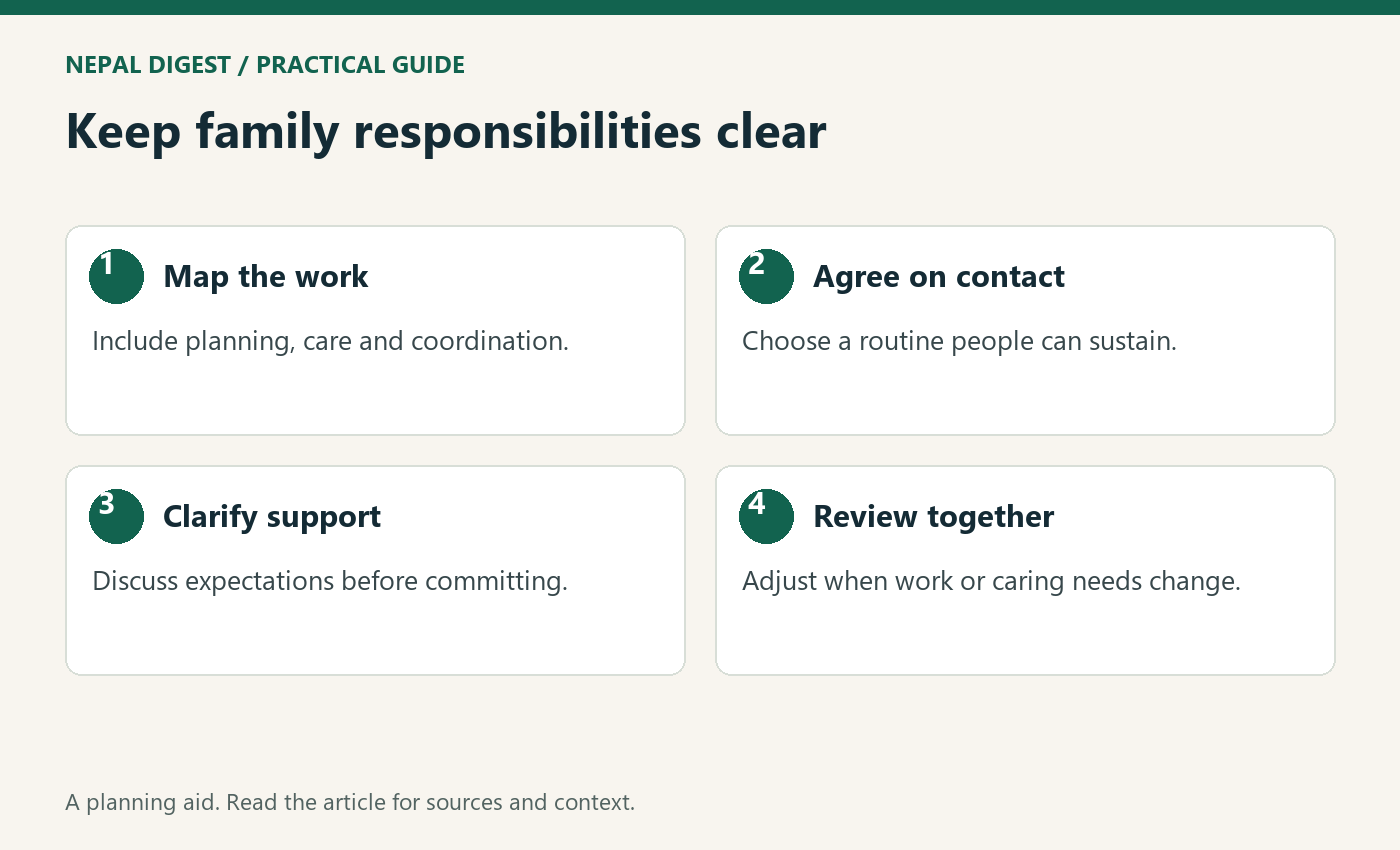
Table of Contents
A family and a household are different questions
People can belong to the same family without sharing an address. A parent may work abroad, a student may rent near a college and a grandparent may remain in the home where several generations once lived. These arrangements change daily responsibilities even when affection remains strong.
Nepal’s 2021 census data catalogue includes separate information on households, living arrangements, migration and absent members. Those categories help researchers examine where people live. They do not measure how close relatives feel, whether care is distributed fairly or how a particular family experiences distance.
A useful conversation therefore begins with the actual arrangement rather than an ideal picture. Who is present every day? Who contributes from elsewhere? Who needs assistance, and who can reliably provide it? Answering these questions makes the household visible without assuming that one living pattern is the proper form of family life.
Make the invisible work visible
Running a home includes remembering as well as doing. Someone notices that a school form is due, checks a bill, arranges a repair, plans a meal or follows up an appointment. These tasks can disappear from conversation because they are completed before anyone else sees the problem.
Try listing a normal week’s responsibilities without immediately defending who works hardest. Include planning, travel, cleaning, emotional support and coordination. A person sending money may not see the time required to turn that contribution into meals, paperwork and care. A person at home may not see the limits imposed by another relative’s working hours.
The purpose is to distribute responsibility more clearly. Agree on a small number of tasks that someone else can own from beginning to end. Helping only after repeated reminders can leave the original organiser doing most of the mental work. Review whether the arrangement is actually reducing that burden.
Distance needs a communication routine that people can sustain
A family chat can be affectionate and tiring at the same time. Different time zones, working hours and expectations can make a missed call feel like rejection when it was simply impractical. A routine becomes kinder when people understand what is possible before interpreting silence.
Agree on what belongs in a group message and what needs a private conversation. Routine photographs, a change in plans and sensitive news do not all require the same audience. Ask before sharing someone’s health information, a child’s image or another person’s disagreement beyond the people directly involved.
One dependable conversation may be more useful than continuous availability. If work changes, say so and revise the routine. For an urgent matter, identify a second contact rather than relying on one relative who may be asleep or unable to answer. Communication should support the relationship rather than become a test nobody can consistently pass.
Discuss contributions without making every exchange a judgement
Support can take several forms: money, a room, cooking, transport, administration or time spent with someone who needs company. Families can acknowledge that variety without pretending all contributions are identical or easy to measure. The important issue is whether expectations have been made clear enough to avoid repeated resentment.
A household discussion can distinguish regular costs from exceptional requests. Explain what is needed, when a decision must be made and who should take part. A relative should not discover after agreeing to one expense that it was understood as a permanent commitment.
Keep a simple shared record where appropriate, while respecting privacy. It can show an agreed household purchase or a recurring payment without turning every personal expense into an inspection. The aim is clarity and informed agreement. Specific legal, tax or financial questions require advice suited to the actual circumstances.
Give children and older relatives a voice in changing routines
A change that appears efficient to adults can feel abrupt to a child or an older person. Moving house, changing a caregiver or reducing visits can alter familiar relationships and daily confidence. Explain what is changing in language the person can understand, and make room for questions that may need to be asked more than once.
Ask about preferences rather than treating somebody only as the recipient of care. Which familiar routine matters most? Who do they feel comfortable calling? What would make a new arrangement easier? Listening does not mean every preference can be met, but it helps distinguish a genuine need from an assumption made on someone else’s behalf.
Relatives abroad should also coordinate with the person doing daily work. Promising a child an activity or an older parent a visit without consulting the local caregiver can create an obligation somebody else must fulfil. Agree together before turning an affectionate intention into a practical commitment.
Traditions can remain meaningful without becoming compulsory
Festivals, food, language and visits can give a family continuity across places and generations. They are most useful when people understand what the practice means to those taking part. Repeating the activity while ignoring its preparation, cost or emotional demands can leave someone feeling responsible for everybody else’s sense of belonging.
Choose what is manageable in the current circumstances. A shorter visit, a meal prepared together or a conversation about an older relative’s memories can preserve a connection without reproducing every detail of the past. Ask who wants to learn and who has time to teach.
Leave room for difference. A younger person may value a tradition while practising it differently, and a relative may need a quieter celebration during a difficult year. Respectful negotiation can become part of continuity itself. It allows the relationship to adapt without making every change a referendum on loyalty.
Review the arrangement before a crisis forces the conversation
Family routines often continue long after the conditions that created them have changed. Work becomes more demanding, children grow older and a caregiver becomes tired. A planned check-in gives people permission to raise these changes before frustration appears as a sudden argument.
Use three practical questions: what is working, what has become difficult and what can we change for the next month? Keep the first change small enough to carry out. A review is more useful when it produces a clear responsibility than when it ends with a general promise to be more considerate.
The centre of a family need not be one building or one person doing everything. It can be a dependable way of listening, deciding and sharing responsibility. Read Nepal Digest’s discussions of migration and the Nepali family, family group chats and planning care across distance for related perspectives.