
For expats, living in Nepal changes the questions a visitor needs to ask. A holiday can be organised around memorable experiences; a longer stay also depends on an ordinary working week, a suitable home, reliable information and relationships that do not revolve around being a guest.
Expats will learn different things depending on their location, circumstances and length of stay. This guide offers practical questions for moving beyond a visitor’s first impressions while respecting the people whose everyday lives make a neighbourhood work.
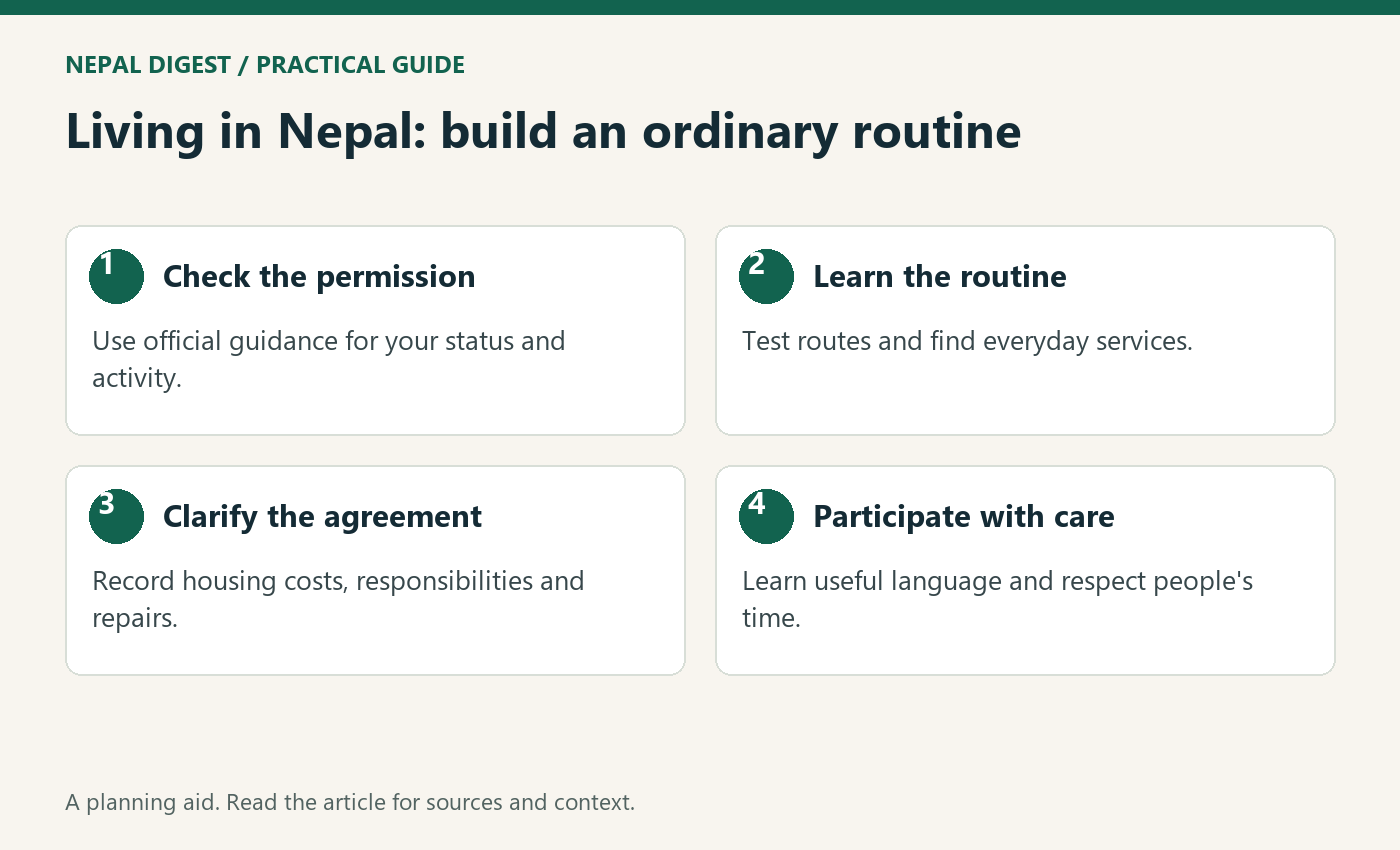
Table of Contents
Expats living in Nepal need the right permission for each activity
Before planning work or a long stay, check the requirements that apply to your nationality, status and intended activity. The Department of Immigration’s visa-information page distinguishes tourist and working categories and explains that employment requires the appropriate working permission.
Do not use a pleasant previous visit as evidence that a different activity is automatically permitted. A person studying, employed locally, joining family or staying for another purpose may face different requirements. Identify the actual situation and use the relevant official instructions.
Keep track of the documents, expiry dates and conditions that apply to your own stay. If something is unclear, ask the responsible authority about the precise activity rather than relying on a general assurance from someone whose circumstances may differ.
Learn the neighbourhood through ordinary routines
Start with the practical places you will use repeatedly: food shops, transport points, places to obtain basic supplies and the services relevant to your household. Learn how to describe your location clearly and keep important addresses in a form you can share.
Notice the difference between a route that looks short on a map and one that works for your routine. Traffic, walking conditions, weather and the time of day can change the experience. Try a journey before building a tight daily timetable around it.
Living in Nepal is also an opportunity to become more precise about place. Kathmandu, another city and a rural municipality should not be treated as interchangeable examples of one lifestyle. Describe what you actually know rather than turning one neighbourhood into a national verdict.
Make housing arrangements understandable
Before committing to a property, clarify the rent, deposit, notice arrangements and the responsibilities for bills and maintenance. Ask how a problem should be reported and who has authority to approve a repair. Retain the agreement and payment records.
Inspect the features that matter for your own needs rather than only the parts that photograph well. Consider access, noise at different times, available space and the practical arrangements for utilities. Confirm any important promise rather than assuming it is included.
This is a planning checklist rather than a statement that every tenancy follows one model. If a contract or dispute has legal consequences, obtain current advice appropriate to the actual arrangement. Clear expectations are useful before there is a disagreement.
Language learning can begin with useful exchanges
A few practical phrases can make everyday exchanges less dependent on someone else translating. Begin with greetings, numbers, directions and ways to ask politely for clarification. If a phrase is unfamiliar, ask someone willing to help how it is normally used in that situation.
Do not assume that one language covers every community or that every person wants to provide an impromptu lesson. Nepal’s linguistic diversity makes curiosity useful, but the interaction should remain considerate of someone’s time.
Let learning improve the conversation rather than turn it into a performance. Being able to ask a clearer question, understand a quantity or confirm a meeting point is a meaningful step. Fluency does not have to become a claim to know everything about the place.
Friendship requires being more than a temporary visitor
Repeated participation can create opportunities for relationships: a shared interest, a regular activity or a small responsibility people can rely on you to fulfil. An invitation is easier to sustain when expectations about time and cost are clear.
Be careful about treating every personal connection as access to local assistance. A friend may be happy to help with a question, but they are not automatically responsible for solving housing, paperwork or travel problems. Ask rather than assume.
Living in Nepal also means accepting that relationships are reciprocal. Learn what the other person enjoys, respect a refusal and follow through on commitments. Familiarity is built through ordinary conduct more than a declaration that a country feels like home.
Keep learning without turning every observation into a rule
An unfamiliar routine may have an explanation you have not yet heard. Ask how a process works before deciding that it is irrational or effortless. At the same time, a longer stay does not require pretending that every difficulty is charming.
Distinguish a personal experience from a wider claim. A delayed journey is something you experienced; an explanation of a national transport system needs more evidence. That distinction makes conversations and any later writing more useful.
For a wider discussion of long-term life, Nepal Digest’s feature on why visitors choose to live in Nepal considers community, work and practical expectations. Use it as another perspective rather than a template every newcomer must follow.
The most valuable lessons from living in Nepal may be modest: how to ask a better question, make a workable plan and participate in a place with more care. Those habits leave room for enjoyment and frustration, while keeping other people’s lives larger than the visitor’s story about them.
For expats planning a longer stay, a weekly notebook can reveal more than a list of sightseeing goals. Record which journeys were straightforward, which household arrangements needed clarification and which conversations you could manage without asking someone to translate. Choose one practical task for the following week. Expats sharing a home can compare these notes, because experiences may differ even within the same household. Ask neighbours before treating one experience as a local rule. Learning a place takes repeated attention, and the most useful progress is often ordinary: understanding a bill, recognising a familiar route or arranging a visit at a time that suits everyone.