

You ask a question in Nepali. Your child understands it and answers in English. Before treating that exchange as a rejection of home, consider a different starting point: the conversation is already working. The next step is to make speaking Nepali easier and more useful within it.
A child’s comfort can vary between languages and situations. The American Academy of Pediatrics and American Speech-Language-Hearing Association’s guidance for multilingual families explains that equal fluency is not a requirement for multilingualism. The language a child uses most can change, and their choice can depend on the person, place and topic.
That does not tell you exactly why your own child answers in English. It does give you a reason to be curious before being disappointed. This is a practical, source-led guide, with suggested family activities rather than interviews or promises of a particular outcome.
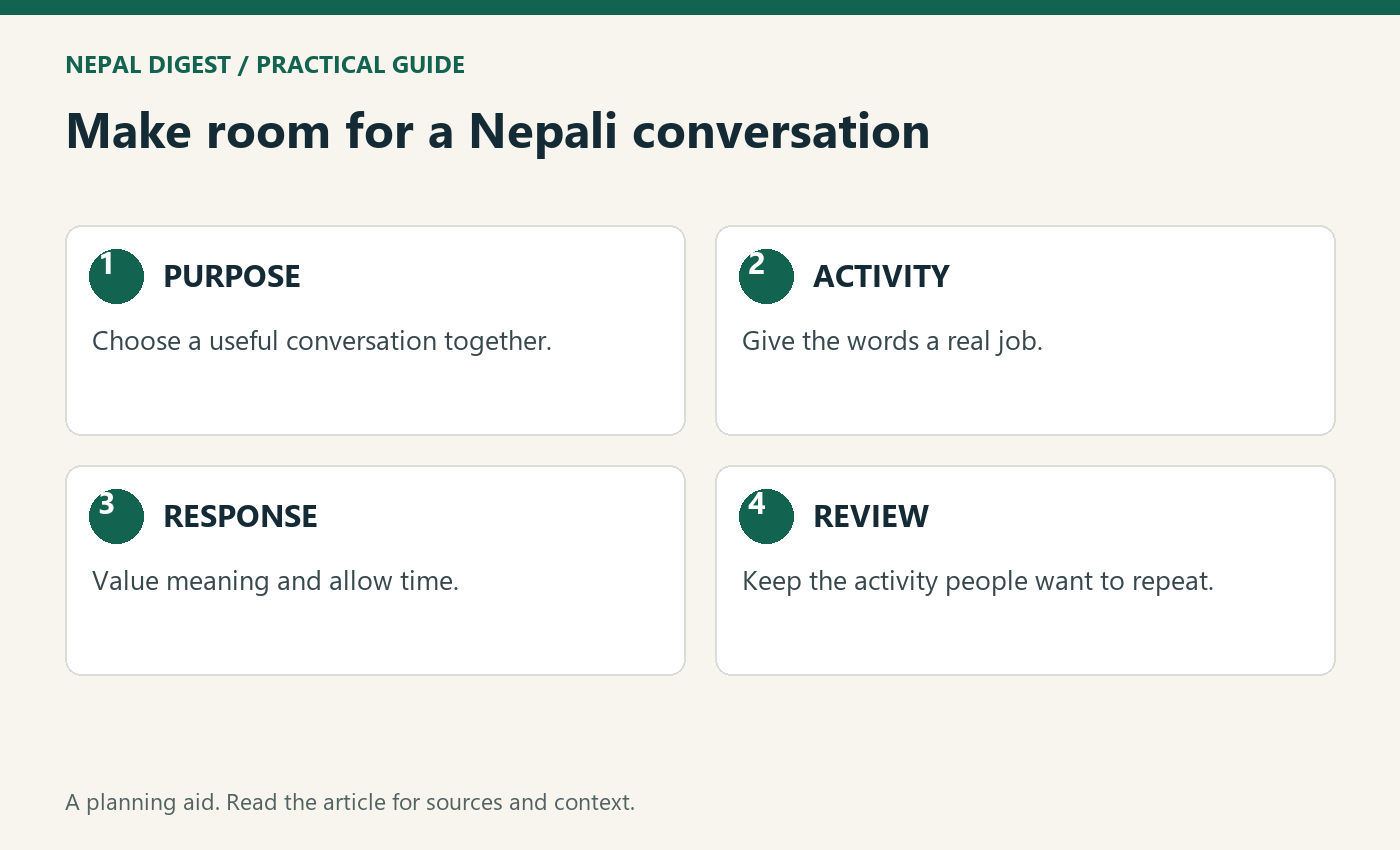
Table of Contents
Nepali: Ask what you want Nepali to make possible
“Speak Nepali properly” is a broad instruction. “Tell Hajurama one thing about your day” has a purpose. “Read a short message from your cousin” is another goal entirely. Speaking, understanding, reading and writing need not become one test of belonging.
Choose one useful goal with your child. Perhaps it is being able to join a family joke, explain a favourite game to a grandparent, order a familiar meal, or follow a song. For an older child, ask which situations actually matter to them. A teenager who wants to speak with cousins may need different practice from a young child learning the words for clothes and food.
Nepali also need not be the only heritage language in the household. If your family uses another language, include it in the conversation about what connection means. No single language performance can represent the whole of a child’s identity.
Keep the exchange going
ASHA’s advice on learning more than one language encourages caregivers to use the languages they are comfortable with, create daily opportunities for practice and value attempts over perfection. Mixing languages can be part of multilingual use; it is not, on its own, evidence of confusion. Books, songs, play and ordinary conversations all provide opportunities.
Here is one way to apply that advice. If your child says, “I want water,” you can reply naturally, “पानी चाहियो? ल, पानी।” The point is to supply useful Nepali while responding to the request. This is an example to adapt, not a script you must repeat or a treatment technique.
If a child is telling you something important, listen to the meaning first. You can return to a word later. Refusing to hear the story until every sentence arrives in Nepali risks turning a moment of connection into a language inspection.
Try one small routine, not a household overhaul
The following are suggested experiments. Pick one that fits your family, try it without a promised fluency deadline, and ask whether it feels enjoyable enough to repeat.
- A picture conversation: use a family photo and invite a description of one person or one memory. Offer a missing word if requested; let the story continue in either language.
- A kitchen choice: name two ingredients or dishes in Nepali while preparing food. Let the child choose, help or describe what happens next. The shared activity gives the words a job.
- A short voice message: help prepare a greeting and one piece of news for a relative. Listen together before sending so the child knows what is being shared.
- A familiar story: retell a known event using pictures, toys or gestures. Start with what the child already understands rather than testing unknown vocabulary.
- A child-chosen topic: ask them to teach you a game, sport or hobby. Find a few Nepali words together that help explain it.
Keep the routine small enough that nobody must negotiate an entire evening around it. If the chosen activity produces resistance, change the activity or timing. The goal is a repeatable opening for language, not proof that one parent has enforced the rules.
Bring relatives into the plan
Before a video call, you might tell a grandparent: “We’re practising a little at a time. Please give them time to answer, and it’s fine if some English comes in.” This is suggested wording, not a quotation from a family interviewed for this article.
Prepare a real subject for the call: a drawing to show, something cooked, an object found on a walk. A question with a visible answer can give everyone more to discuss than an unexpected performance request. Avoid comparing siblings or cousins in front of them; your family’s practical target is more conversation, not a ranking.
Do not blame bilingualism for a concern
The AAP–ASHA guidance says learning multiple languages does not cause a speech or language disorder. It also advises seeking an evaluation when there are concerns, with attention to the child’s languages and an interpreter where needed. English replies alone cannot diagnose a problem, and this article cannot assess an individual child.
If you are worried about communication, hearing or development, speak with your child’s health professional or a qualified speech-language pathologist. Explain what your child understands and says in every language, and where difficulties arise. Do not wait for Nepali to “catch up” before asking for help.
For everyday family life, a useful question at the end of the week is modest: did we have one more conversation that both of us wanted to continue? That gives you something to build on, whichever language supplied the first answer.
Review one activity with your child
After trying a routine, ask which part your child would like to repeat and which part felt awkward. Record the activity rather than a score for their Nepali. “We described a drawing together” tells you more about participation than counting every English word. If a relative joined, ask whether the pace and subject gave the child room to respond.
Change one part of the plan at a time: a shorter call, a more familiar subject or a different moment of the day. These are suggestions for family conversation, not a promise of language gains. The useful next step is one that your child can help choose and that the household can actually sustain.
Related reading: A Nepali Playlist for Three Generations to Build Together; Returning to Nepal With Children Changes the Homecoming.