

Before a phone could send a notification, a Kathmandu neighbourhood had another way to announce excitement. Somewhere above the rooftops, two kites crossed paths. Strings tightened, heads tilted upwards, and a familiar cry broke the afternoon: “Changa chait!” Someone had won a small battle in the sky. Someone else had lost a kite. For a generation of Nepalis, that shout belongs to the soundtrack of Dashain alongside family conversations, crowded buses, festive meals and the sound of swings moving through the air.
It is easy to make the kite itself the hero of this story. The more interesting subject is everything around it: the friendships, negotiations, rivalries, disappointments and improvised lessons that converted paper and string into a neighbourhood event.
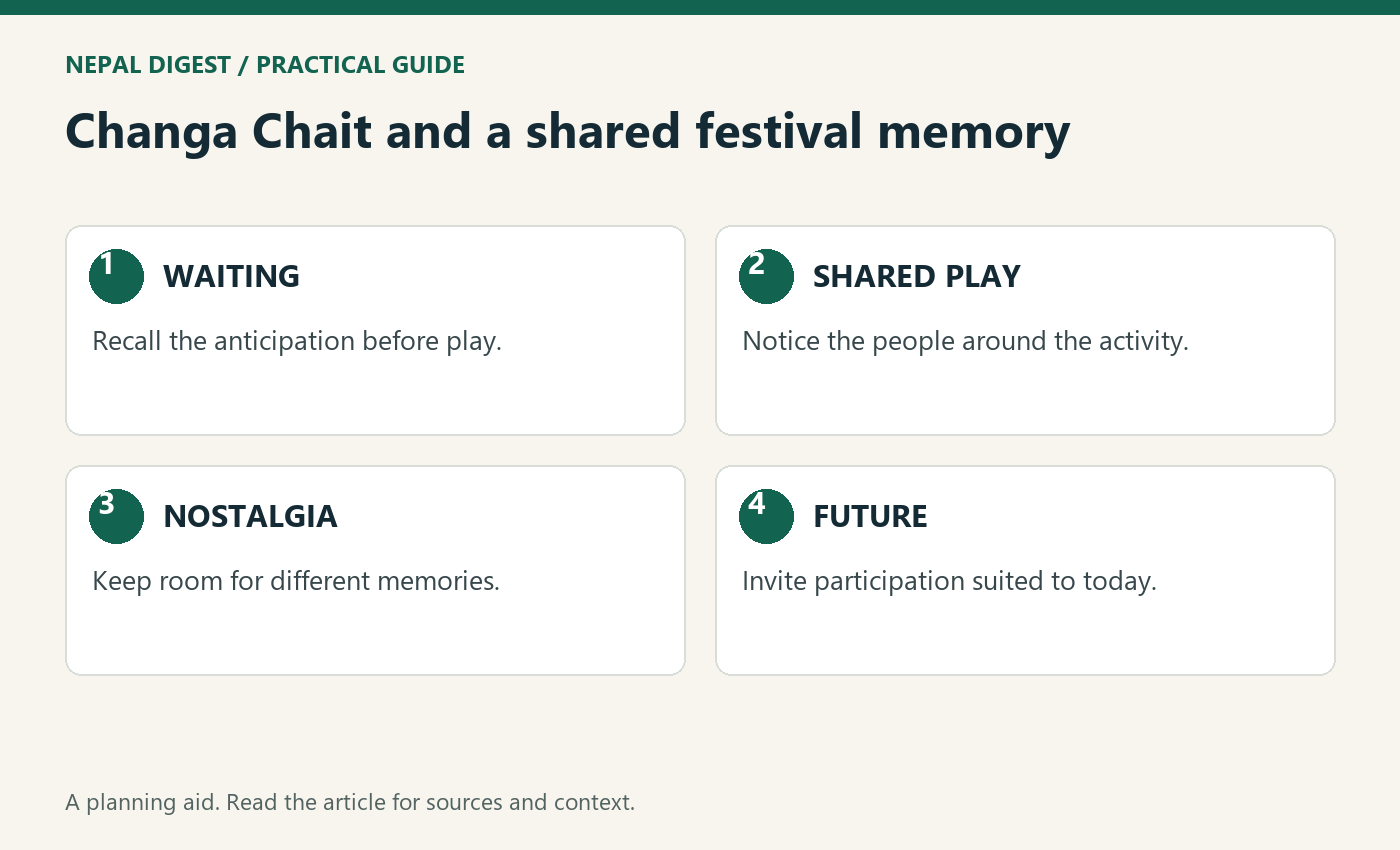
Table of Contents
Changa Chait: the wait before the first flight
For enthusiastic young flyers, the experience could begin long before Dashain. There was money to save, a shop to visit, a colour to choose and the important question of which reel to buy or borrow. In a 2017 reminiscence published by OnlineKhabar, a Kathmandu writer recalled the pull of kite shops in Asan and the intense competition of earlier childhood seasons. Other published accounts describe the area’s merchants, who supplied generations of families with colourful kites and spools.
The preparation was part of the pleasure. A new kite felt full of possibility. A familiar reel carried stories from previous seasons. Children compared supplies, exchanged advice, questioned one another’s flying skills and decided who could be trusted to hold the line. The equipment might have been simple, but ownership, experience and anticipation gave it a special importance.
A rooftop could become a whole world
Consider the mechanics of a good afternoon of flying. The person with the kite waits for a helpful breeze. Someone else watches the string and calls out suggestions. A hesitant launch fails; a second attempt works. The kite pulls upward and the reel slowly gives way. Before long, several homes are participating in the same improvised spectacle. People who might not otherwise have spoken have something to discuss.
That is one reason the memory has endured. A rooftop was not only an individual family’s private space. During festivals it could form part of a connected social landscape, with neighbours watching the same sky. You did not have to own the winning kite to enjoy the moment. Spectators learned the names of the strongest flyers and celebrated dramatic turns as if they were watching a local sporting event.
What the famous shout really celebrated
“Changa chait” is associated with severing another flyer’s kite line during a contest. The words suggest triumph, but the full experience had two sides. One child raised their arms in victory while another stared at a drifting scrap of colour. A lost kite might catch on a tree, vanish behind houses or travel farther than anyone expected. Winning taught confidence; losing taught the harder art of beginning again.
The contests also developed informal rules and reputations. Some children were patient, others reckless; some were skilled at handling tension and others won through chance. There was always an argument about whose line had crossed first. That unpredictability made each encounter different. It was a real-world game in which weather, timing, another person’s decisions and fragile materials could change the outcome at any second.
Why nostalgia can be both true and selective
People who remember these afternoons are not imagining that kite flying once mattered. Newspaper archives record its strong place in Kathmandu’s festive culture. Yet memory is edited by affection. It is tempting to remember only the blue sky and cheers, leaving out cut fingers, unsafe roofs, quarrels, ruined kites and parents worrying about children chasing them. A meaningful revival should preserve the excitement without restoring the dangers.
Nor was the experience universal. Some families had no safe flying space; some children could only observe; some places associated Dashain with other activities more strongly. The phrase “our childhood” can unintentionally erase those differences. The better way to celebrate this tradition is to share it with children who never inherited the same setting, rather than assume they have lost something by making different choices.
Can the sound return?
There are signs that it already does, at least in some places. In October 2026, The Rising Nepal described parents in Kathmandu teaching children to fly and a business organising a kite competition. The report also noted the frustrations of shrinking open space and digital distraction. That combination is revealing: fond memories alone will not bring the activity back, but adults making room for it can.
Start with a suitable ground or supervised, protected space. Introduce children to a basic kite, explain how to launch it, and let them practise without turning every flight into combat. Avoid dangerous abrasive or synthetic fighting lines; use safer ordinary string. Keep away from electricity wires, busy streets, roof edges and airports. The Civil Aviation Authority’s October 2026 warning about Tribhuvan International Airport is especially important for families near flight paths.
A festival memory that can belong to the future
What makes “Changa chait!” powerful is not simply that it recalls an older Kathmandu. It represents the moment when play was public, skill was learned from others and even strangers could join the excitement. A modern community need not reproduce every crowded rooftop to recapture those qualities. A school field, a neighbourhood gathering or a carefully organised festival session can offer its own version.
Years from now, today’s children may remember different buildings, different reels and a different view of the city. But they could still remember the first time their kite caught the breeze, rose above them and stayed there. The most valuable inheritance is not the shout itself. It is the opportunity to discover why someone shouted in the first place.
Related reading: A Kite, a Rooftop, and a Memory of Home: Dashain Through the Eyes of Nepalis Abroad; Why Do Nepalis Fly Kites During Dashain? The Story Behind Changa.
Sharing a Changa Chait memory works best as an invitation: ask another person what they remember, and allow their version to differ. Changa Chait can begin a conversation without requiring everyone to have had the same childhood.