

Nepali cinema is selling millions of tickets. That makes the uncomfortable question more interesting, not less: how well is the industry connecting with a generation raised on global streaming, social video and a different set of expectations about whose stories deserve the big screen?
A popular way to describe Nepali cinema’s future is to say that it has lost Gen Z. It is a punchy claim, but the available evidence does not establish it. A younger Nepali who does not buy a ticket for one film may turn up for another. Someone who loves a film’s music online may never watch the film. A diaspora viewer may be interested but unable to find a legal, subtitled screening nearby.
Those are different problems. Treating them as one supposed generational rejection gives the industry an easy explanation—and very little guidance on what to change. The useful question is not whether young Nepalis have abandoned Nepali films. It is what makes some Nepali films worth their time and money while so many others struggle to earn attention.
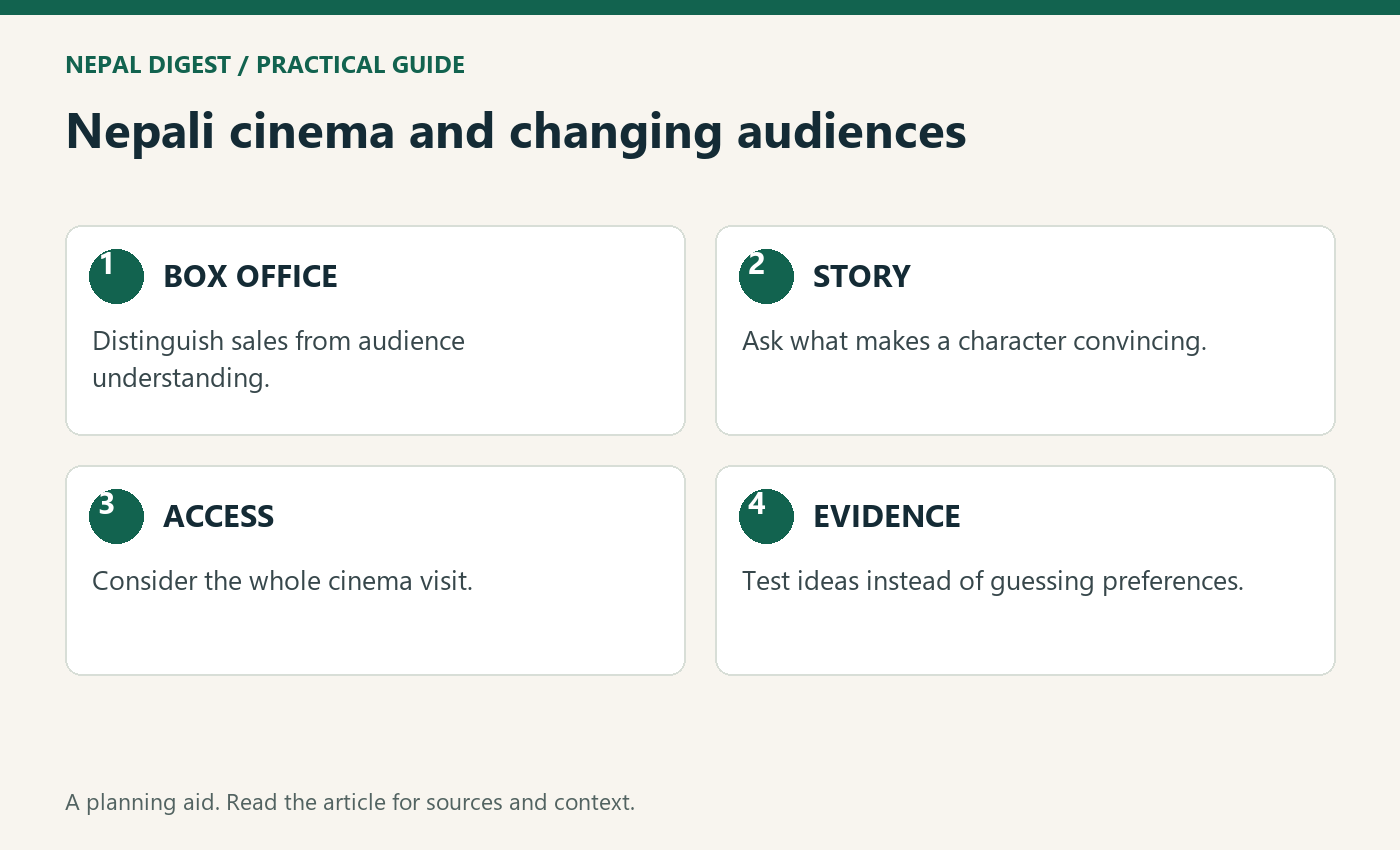
Table of Contents
Nepali cinema: first, the box office tells a story of growth—not abandonment
In a summary released on April 6, 2026, Nepal’s Film Development Board reported 3,781,544 admissions for domestic films and 3,322,757 tickets for foreign films during its stated Nepali-year reporting period. It recorded 56 domestic releases and 93 international releases. Local cinema, by this measure, was not an industry without an audience.
What the figures do not show is the age of the people who bought the tickets. Ticket admissions are not unique people, and overall grosses cannot establish whether viewers aged roughly in their teens and twenties are becoming more loyal, less loyal or simply more selective. There is no basis here to claim that the entire generation has stopped watching Nepali films.
Look at the appeal of Purna Bahadur Ko Sarangi, Kabaddi 4 and Jaari. Their commercial success challenges any claim that audiences have no appetite for Nepali-language stories, rural settings or culturally specific characters. Reporting in The Kathmandu Post has documented both the success of such productions and the difficulties faced by films that vanish after a few screenings.
The question, then, is about consistency. Can Nepali cinema build a wide range of films that younger people will choose deliberately—not only a few events that everybody feels obliged to see?
Gen Z is not a single audience
Imagine three prospective viewers: a university student in Kathmandu, a young worker in Pokhara and a Nepali professional in Dubai. They may be similar in age but have different incomes, languages, cinema access, schedules and emotional relationships with Nepal. Their tastes cannot responsibly be reduced to one label.
Nor should filmmakers assume that a young audience wants only fashionable urban romances or rapid-fire editing. Young viewers can be interested in grandparents, village life, migration, caste, history and family conflict. The difference may be whether those subjects are explored with convincing characters, moral complexity and a sense that the film is saying something beyond a familiar lesson.
This distinction matters. A film about rural Nepal does not become irrelevant simply because its setting is rural. And a film featuring smartphones and fashionable clothes does not become contemporary simply because its characters look young. Relevance is not the same as decoration.
The danger of repeating a successful formula
Commercial filmmaking is risky. When a particular mix of family sacrifice, broad comedy, romance and sentiment performs well, other producers have an obvious incentive to repeat it. Sequels offer recognisable brands. Tearful climaxes are easier to advertise than quiet, ambiguous endings. A star’s name can be a simpler sales pitch than an unfamiliar writer’s idea.
None of those techniques is inherently bad. Comedy can expose hypocrisy; melodrama can illuminate real suffering; a familiar character can grow across several films. Trouble begins when a genre becomes a shortcut around the difficult work of writing believable people.
In a September 2026 industry analysis, screenwriter Mukesh Khanal argued that pressure to reproduce proven genres, weak support for screenwriting and distribution problems limit experimentation. Those are his assessments, not a comprehensive statistical audit of every filmmaker. They nevertheless identify an important incentive problem: when original scripts seem commercially dangerous, producers can end up offering audiences variations of yesterday’s hit.
For younger viewers accustomed to discovering many kinds of storytelling, familiarity alone may not justify the price of a ticket. But the solution is not to eliminate emotion. It is to earn it.
What makes a character feel like someone from today?
Nepal’s younger generation lives with questions that could sustain compelling films: the cost of education; uncertain work; the expectation to migrate; the possibility of returning; changing relationships between parents and children; life across multiple languages and communities; gender expectations; and the gap between online identity and offline opportunity.
These subjects are not an instruction to turn every film into a social-issue lecture. A witty heist, a suspense story, an intimate romance or even a horror film can explore them more effectively than an earnest monologue. The test is whether characters make understandable choices under pressure.
Take migration. It is an established theme in Nepali storytelling, but young characters need not exist only to demonstrate the sacrifice of a parent or the tragedy of departure. What happens to their friendships when they leave? What does ambition cost someone who stays? What happens when the person who returns finds that home has changed without them? Those are cinematic questions, not simply topical slogans.
The strongest case against the claim that Gen Z wants something entirely different is that timeless stories already resonate across generations. A well-written film about a father and daughter can reach a teenager and a retiree. The industry need not abandon its cultural roots to become more imaginative.
A smartphone offers competition—not proof of a short attention span
Films no longer compete only with other films. A prospective viewer can spend an evening with a series, a football match, gaming, a creator’s livestream, short videos or a long-form documentary. The comparison is not always between one Nepali production and one Bollywood release. It is between going to a cinema and doing almost anything else.
DataReportal’s Digital 2026 report, using data largely from late 2025, estimated 16.6 million internet users in Nepal and 14.8 million social-media user identities. The latter are not necessarily distinct human users and do not constitute a survey of Gen Z’s film preferences. But they do show why digital discovery and online conversation matter to a film’s journey.
It would be simplistic to conclude that short-form video has destroyed young people’s patience for two-hour stories. Long series, intricate fictional worlds and substantial online videos show that audiences can commit considerable time when the experience feels rewarding. A better hypothesis is that the opening minutes, narrative momentum and payoff of a film face more competition for attention than before.
A trailer may persuade someone to tap ‘watch’. It does not guarantee that a cinema ticket feels worthwhile.
Marketing can create awareness; trust creates a ticket buyer
Nepali film promotion now travels through song clips, reaction videos, memes, interviews and influencer content. As The Kathmandu Post reported in May 2026, viral songs and unconventional publicity campaigns can generate curiosity, while theatre operators observe that word of mouth influences whether many audiences turn up after opening week.
That exposes a distinction the industry cannot afford to ignore. A popular promotional clip is evidence that a clip was popular, not that people loved the complete film. A film can generate enormous online noise and still disappoint on screen. Conversely, a relatively quiet release can build momentum when viewers begin recommending it.
The problem is not that marketing is dishonest by definition. It is that publicity and product quality are separate variables. Treating social-media engagement as a substitute for good writing risks teaching audiences to distrust the next campaign. Better trailers should make an honest promise about the film’s tone and subject, not simply collect the most sensational moments.
Not every empty seat is a rejection of the story
There is another blind spot in arguments about generational taste: people cannot watch what is unavailable, inconvenient or too expensive for them. Screening times, travel, household budgets, competing releases, access outside major cities and legal streaming options all affect whether interest becomes a ticket sale.
Distribution is contested terrain. Khanal’s September analysis criticised the treatment of domestic productions by multiplexes and the limited maturity of Nepali streaming distribution. These are industry arguments that merit scrutiny with screening and revenue records, but they cannot be reduced to audience preference alone.
The decision to see a movie is also social. Friends may be willing to attend together at one price and time but not another. Someone may prefer a legal home release or wait for a recommendation. Without separating availability, affordability and interest, a producer can misdiagnose a distribution failure as a failure of taste.
The diaspora complicates the picture further
Nepali cinema’s audience extends well beyond Nepal. Overseas demand, including from Australia and Gulf destinations, can be important to producers, and some films build international interest only after strong domestic word of mouth. That pattern is discussed in The Kathmandu Post’s September industry commentary.
For a young Nepali abroad, a film can be entertainment, a social gathering and a way of remaining connected to home. Yet reaching that viewer requires practical decisions: where and when a film screens, whether tickets are available, what language options exist, and how quickly an authorised digital release follows.
For second-generation viewers, subtitling is not a cosmetic extra. It can determine whether a film can be shared with friends, partners or children who do not speak Nepali fluently. Films can retain their linguistic identity while becoming easier to discover and understand. Nepal Digest’s introductory Nepali film watchlist also explains why checking the specific subtitle edition and legal release matters before recommending a screening.
Again, these are opportunities and barriers to investigate—not evidence that every diaspora Gen Z viewer behaves alike.
New voices need a real route to the screen
Asking why young people are not sufficiently represented also means asking who is allowed to write, direct, produce and finance stories about them. If production decisions depend on a narrow circle of established names and formats, a wide generation of experiences may struggle to reach cinemas.
There is no guarantee that a young director will make a relevant film or that an older director cannot understand young people. Talent is not issued by birth year. What matters is opening a credible route for varied writers, regional voices, women, creators from underrepresented communities and genre specialists to develop and test original scripts.
Script development is less visible than a star-studded launch, but it may do more to improve a film’s chances. Table reads, feedback screenings, careful rewrites and fair pay for writers are concrete steps. The goal should not be to obey every focus group. It should be to learn where a story becomes confusing, emotionally false or predictable before it reaches the audience.
What the industry could test instead of guessing
A serious answer to the Gen Z question starts with evidence. Producers, exhibitors and researchers could separate youth interest from actual admissions by collecting anonymous, consent-based age-band data and surveying viewers who attended and those who did not. They could test affordability, showtime preference, subtitle demand, discovery channels, genre interest and the reason someone chose a foreign film or stayed home.
They could then experiment with a diversified slate—thrillers, animation, documentaries, small-scale romances, science fiction and character-led comedies—rather than assuming one blockbuster formula is the whole market. Trailers could be measured not only for views but for conversion to advance bookings and later recommendations. Distributors could compare performances at equivalent showtimes instead of attributing every disappointment to the script.
Those experiments would not replace artistic judgment. They would reduce the temptation to blame a whole generation for problems that producers can actually measure and fix.
The real question is whether Nepali cinema will stay curious
Nepali cinema is not facing a simple choice between tradition and modernity. Its most distinctive advantage may be the depth of stories available in Nepal’s languages, families, regions and diasporas. Global entertainment cannot reproduce those experiences in exactly the same way. But cultural familiarity is not an exemption from narrative craft.
A stronger film industry would stop treating Gen Z as an impatient audience to be lured with a viral dance or lectured about respecting tradition. It would regard younger people as viewers capable of appreciating comedy, melancholy, complexity, invention and excellent storytelling—provided the film gives them a reason to care.
Until reliable age-segmented viewing evidence becomes available, the claim that Gen Z has deserted Nepali cinema remains unproven. The more defensible warning is this: a run of hits cannot substitute for creative renewal. The industry can celebrate its box-office growth while asking whether it is earning the next generation’s loyalty, film by film.
This is Nepal Digest’s analysis of publicly available industry data and published reporting, not a scientific survey of young filmgoers or a set of original interviews. The figures and industry assessments above come from the Film Development Board (April 6, 2026), The Kathmandu Post (May 16, 2026), The Kathmandu Post (September 28, 2026) and DataReportal’s Digital 2026 Nepal report. Opinions about what younger audiences might prefer are framed as editorial hypotheses, not measured facts.
Related Nepal Digest guides: A new wave of Nepali film finds its voice; Min Bahadur Bham: The Filmmaker Who Made Silence Speak.