

Nepali students preparing a UK Student visa application should review their savings plans before 30 November 2026. From that date, the monthly living-cost requirement rises to £1,570 for study in London and £1,203 outside London, for up to nine months.
For a UK Student visa applicant required to show nine months of maintenance, that means £14,130 in London or £10,827 elsewhere, before adding the relevant unpaid course fees. Families planning a UK Student visa application should check the amount, the application date and the period for which funds must be held. A bank balance that meets today’s threshold may be short for an application made after the change.
The Home Office announced the changes in Statement of Changes HC 584, published on 3 September 2026. The maintenance amendments take effect on 30 November. They are confirmed changes with a future start date, rather than a consultation or an increase already in force.
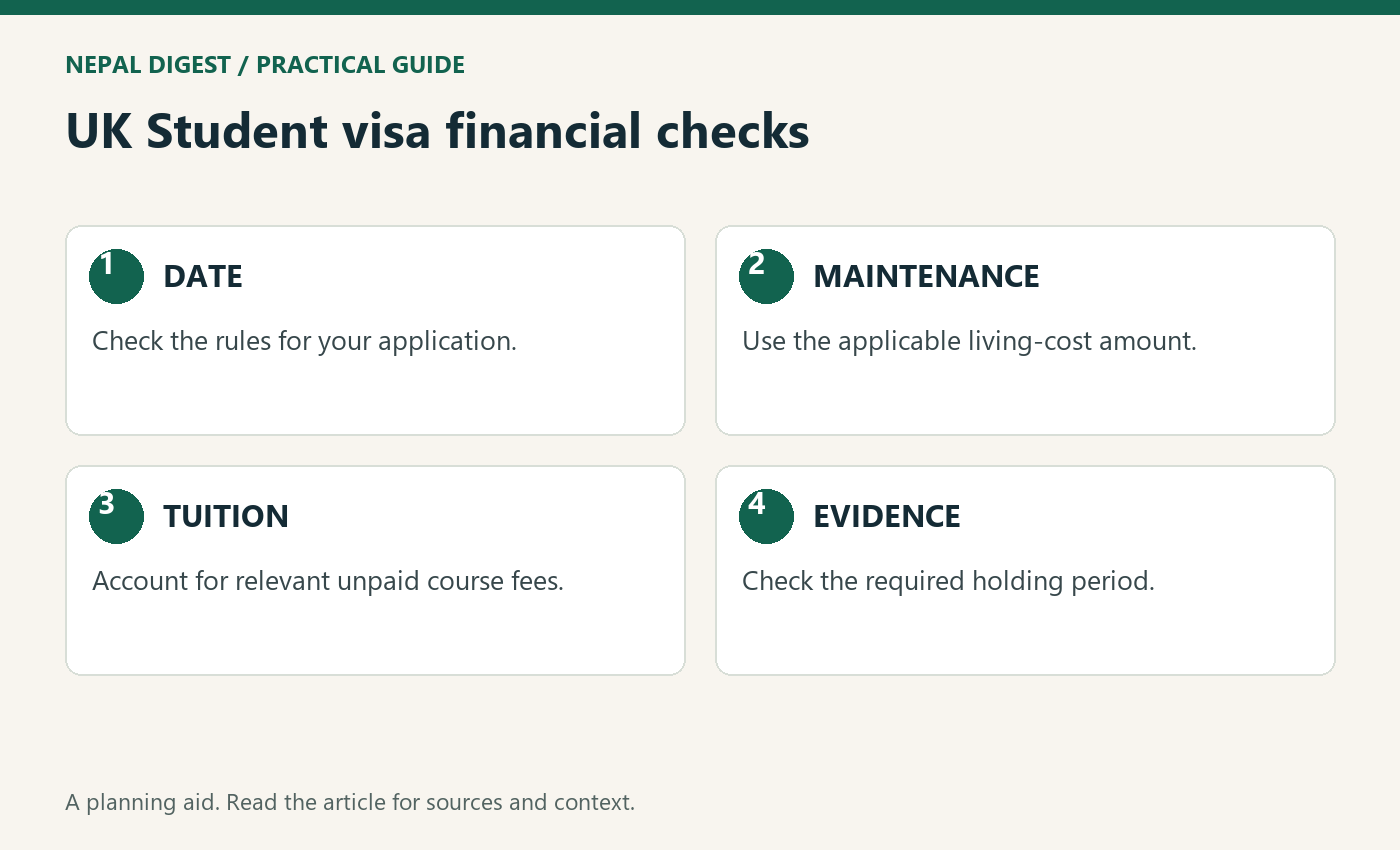
Table of Contents
UK Student visa: the old and new amounts
The current monthly figures are £1,529 for London and £1,171 outside London. The increase is £41 or £32 per required month respectively. The table shows living-cost funds only; it excludes tuition and other expenses.
| Study location / period | Before 30 Nov 2026 |
From 30 Nov 2026 |
Increase |
|---|---|---|---|
| London Monthly |
£1,529 | £1,570 | +£41 |
| Outside London Monthly |
£1,171 | £1,203 | +£32 |
| London Nine months |
£13,761 | £14,130 | +£369 |
| Outside London Nine months |
£10,539 | £10,827 | +£288 |
The additional maintenance for the full nine-month calculation is £369 in London or £288 outside London. These totals are arithmetic based on the published monthly rates. They are not a university’s estimate of the actual cost of living.
Nine months is the maximum maintenance period in this calculation, not an automatic requirement for every course. Under Appendix Student, a part of a course month is rounded up. Confirm the relevant duration and study location with the education provider, especially if a course has unusual dates or more than one campus.
The application date determines the cutoff
The implementation provision says applications made before 30 November will be decided under the rules in force on 29 November for these amendments. An offer letter, a Confirmation of Acceptance for Studies, or a planned arrival date does not by itself establish which maintenance rate applies.
This matters when planning a UK Student visa application for a later intake. A student may receive a CAS before the change but apply afterward. That student should budget for the new amount where the financial requirement applies. Conversely, the maintenance increase is not a requirement for every person who happens to arrive after 30 November.
The cutoff is useful for planning; it is not a reason to submit an incomplete application. Ask the university’s international student team to confirm readiness and the relevant application timetable. Saving a few hundred pounds in demonstrated funds does not resolve missing evidence or other unmet requirements.
Tuition is a separate part of the calculation
The GOV.UK Student visa money guide explains that applicants generally need funds for the relevant course fees as well as support costs. The CAS records the course-fee information. Check which fees remain unpaid and whether payments already made are properly recorded.
For an illustrative London applicant who needs nine months of maintenance after the change and has £8,000 in relevant unpaid tuition, the combined amount is £22,130: £14,130 plus £8,000. With the same hypothetical unpaid tuition outside London, the calculation is £18,827. These examples assume no exemption or permitted offset.
The £8,000 figure is invented solely to demonstrate the calculation. It is not a quote from a university, an average tuition fee or a recommended budget. Visa charges, healthcare charges, travel and other practical expenses need separate consideration when assessing the total affordability of study.
The 28-day evidence requirement still matters
For applicants relying on ordinary savings evidence, the required funds must be held for at least 28 consecutive days. The end of that period must be within 31 days of the application date. Reaching the correct figure only on the day a statement is issued does not demonstrate that it was maintained for the required period.
Families should therefore work backward from the intended application date. First establish the applicable amount, including unpaid tuition. Then identify the proposed evidence period and check the balance throughout it. Finally, check that the closing date remains recent enough when the application is submitted.
If an account dips below the required level during the proposed period, do not assume that a later top-up cures the earlier shortfall. Recheck the complete holding period with the university’s adviser. Keep records of tuition payments too, so that the amount being claimed as already paid can be reconciled with the documents.
Check whose money and which evidence you can use
The Home Office’s financial-evidence guidance describes acceptable routes, including eligible savings, qualifying student loans and official financial sponsorship. Loan and sponsorship evidence has its own requirements. An ordinary personal borrowing arrangement should not simply be labelled an approved student loan.
The guidance excludes overdrafts, cryptocurrency, stocks and shares, and pensions as evidence of the required funds. It also sets requirements for the financial institution. A large asset value or an available credit limit is not interchangeable with acceptable evidence of accessible money.
Parents’ funds can be used where the rules are satisfied. Appendix Finance requires proof of the parental or legal-guardian relationship and written consent to use the funds. Prepare those documents alongside the bank evidence. A family’s willingness to help should be translated into the particular evidence the application requires.
Rupee balances need an exchange-rate check
For foreign-currency funds, Appendix Finance generally uses the OANDA spot exchange rate on the application date, with specified exceptions for certain currencies. A fixed rupee conversion circulated weeks earlier should not be treated as a permanent equivalent of the sterling requirement.
For a family holding funds in Nepal, the practical implication is to monitor the sterling equivalent while preparing the application. A planning margin may help manage currency movements, but it is not a separate Home Office requirement for an extra fixed sum. This article gives sterling amounts because a rupee figure without a conversion date could mislead readers.
Keep the financial plan understandable to everyone contributing. Record the required sterling total, the currency held, the relevant account and the planned dates. That makes it easier to identify whether a problem concerns the amount, the evidence or the timing.
Which Nepali applicants are affected?
Nepal is absent from the nationality list for the Student route’s differential financial-evidence arrangement. A Nepali passport holder should not assume that residence in a listed country, such as the UAE, grants that nationality-based treatment. Check any claimed exemption against the applicant’s own circumstances.
There are separate exceptions. Appendix Student says a person applying for permission to stay who has been living in the UK with permission for at least 12 months on the application date meets the financial requirement without showing funds. That is a defined in-country provision; a previous period in Britain should not be treated as a blanket exemption for a new overseas application.
The maintenance amendments also raise the permitted offset for a deposit paid to the student sponsor for sponsor-arranged accommodation, up to £1,570. This is a limited rule, not permission to deduct every private rent payment. Confirm eligibility and the evidence with the sponsor before subtracting an amount.
Students planning to bring family members must check the separate dependant eligibility and financial rules. Raising the main student’s maintenance rate does not itself create permission to bring a partner or children.
What to do before applying
For the UK Student visa calculation, ask the university to confirm the course location, duration, unpaid tuition and any applicable exemption or offset. Use those answers to build a dated calculation, then check the account holder, supporting documents, exchange-rate exposure and full holding period. Keep a copy of the calculation with the application evidence.
As of 19 October, the general GOV.UK money guide still displays the amounts currently in force. The dated Statement of Changes establishes the future increase. Read the effective date alongside any figure, and recheck the official guidance immediately before submitting.
Rules checked on 19 October 2026. Individual eligibility and evidence depend on the application’s circumstances.
Related reading: Canada’s Express Entry Reset: A Guide for Nepali Applicants; The Cheapest Flight to Nepal May Not Be the Cheapest Journey.
Keep two calculations side by side in your UK Student visa planning folder. One records the financial evidence required under the rules applying to the application. The other records what the household expects the whole study plan to cost. They serve different purposes. Demonstrating the required maintenance amount does not establish that rent, travel and other actual expenses will fit the same total.
For each calculation, note the date, currency, study location and assumptions. Where an amount came from the university, keep its written explanation. Where a figure is your own estimate, label it as an estimate. If the application timetable changes, review the rule date before reusing the older sheet. This is an organisational suggestion, rather than a substitute for the university’s advice or the Home Office evidence requirements.
A five-month calculation to compare with the maximum
The nine-month totals above are useful reference points, but a calculation should use the maintenance period that actually applies. To practise the arithmetic, assume a hypothetical UK Student visa applicant has been told that five months must be counted under the new rate. This assumption is for the example; it does not determine the period for a particular course.
For London, five times £1,570 produces £7,850. Outside London, five times £1,203 produces £6,015. If this fictional applicant also has £4,000 in relevant unpaid course fees, the combined figures become £11,850 and £10,015 respectively. As in the earlier example, these totals assume no exemption or permitted offset. The invented tuition amount is not a quote.
There are two useful checks. First, multiplication should match the number of months used, rather than automatically copying the nine-month maximum. Second, tuition should be added once. If the course-fee amount changes after a payment, ask the university which unpaid figure and supporting record should be used rather than subtracting the same payment in two different places.
Keep the working visible: monthly maintenance rate, counted months, maintenance subtotal, relevant unpaid tuition and combined total. A parent helping with the budget can then check the arithmetic without guessing which number already includes another. If the course location or application date changes, start by checking the assumptions at the top of the sheet.
This worksheet does not establish whether the evidence meets the rules. For a UK Student visa, a correct total and acceptable financial documents are separate questions. The existing guidance on the account holder, holding period and evidence remains necessary. Ask the university’s international student team to review uncertainties before relying on a calculation.
The same distinction helps with affordability. A family might have enough money to demonstrate the required amount but still need a plan for later expenses. Alternatively, it might have a realistic long-term budget while the available documents do not yet support an application. Treat those as two planning problems, rather than assuming that solving one automatically solves the other. Record the next action beside each: clarify a fee entry, confirm the relevant period, or obtain the appropriate official instructions.
The difference between these five-month maintenance subtotals and the nine-month maximum is £6,280 for London and £4,812 outside London. That is simply four months at the new monthly rate. It is not a discount available by choosing a smaller figure: the relevant period must follow the rules for the actual application. Use the comparison to check arithmetic, not to choose which evidence requirement you prefer.