
For scientists in Nepal, the story is changing less through one spectacular breakthrough than through a slow expansion of who can ask questions, where research can happen and what institutions are expected to do with the answers. Universities are building more applied work around climate, agriculture, health, engineering and data; government has begun formalising grant programmes around science, technology and innovation; private companies are asking for technical skills that academic systems did not always prioritise; and Nepali researchers abroad remain increasingly connected to projects at home. The direction is promising, but the central problem remains institutional: how does a country turn scattered talent into a research system that works every year rather than only when one exceptional person pushes a project through?
The answer matters because Nepal’s hardest problems are unusually scientific. Mountain hazards, monsoon variability, air pollution, food productivity, infectious disease, water security, energy reliability and earthquake risk all require local evidence. Imported knowledge can help, but the final decisions often depend on conditions too specific for another country’s data to answer completely.
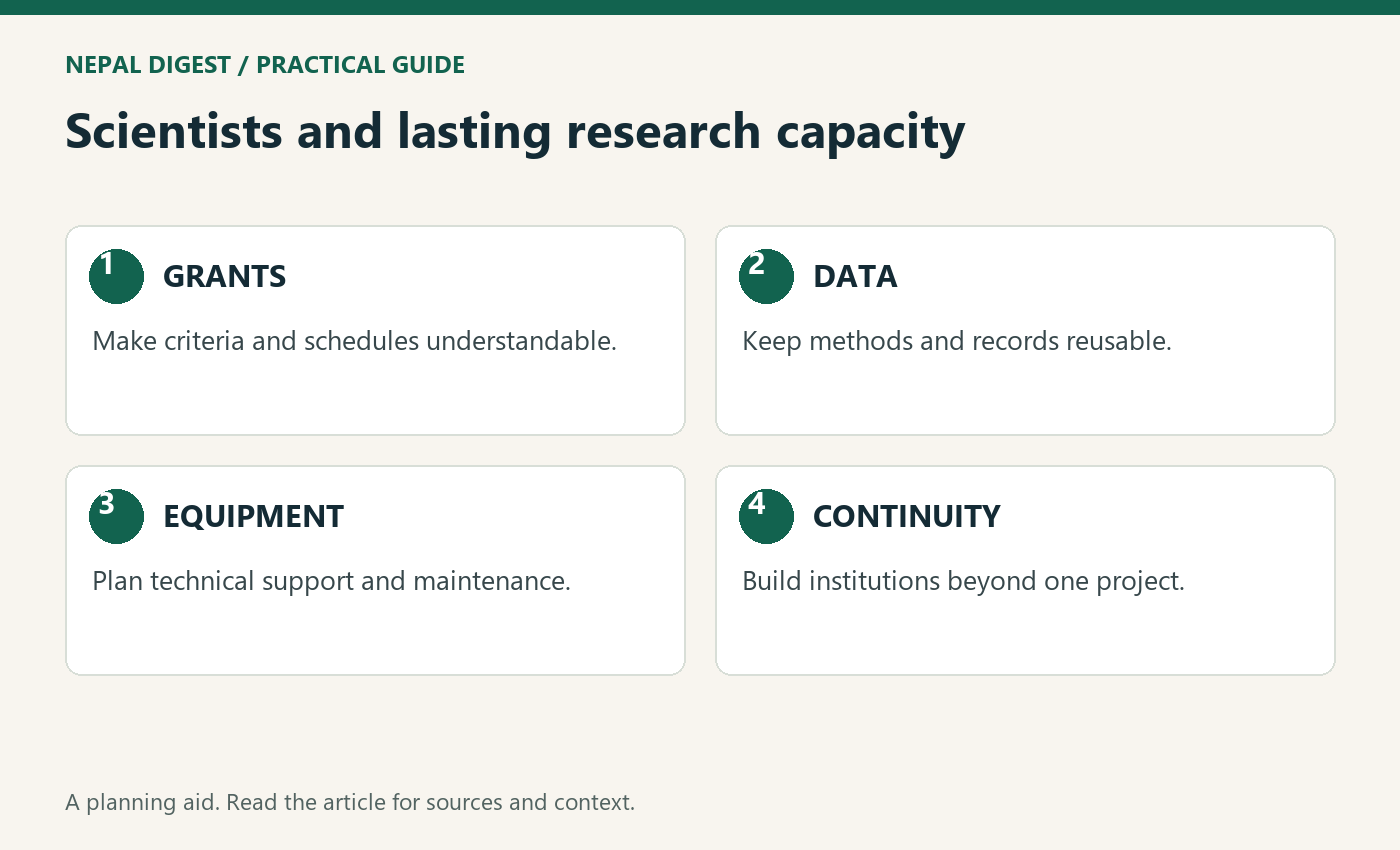
Table of Contents
Scientists need a policy system as well as an academic home
Nepal’s National Science, Technology and Innovation Policy, 2019 provides a policy starting point. The Ministry of Science, Technology and Innovation now publishes a 2083 grant-implementation procedure. These records establish formal policy and programme documents; their publication alone does not demonstrate sufficient funding, timely awards or successful research outcomes. The institutional discussion here is an analysis of what scientists need, not an evaluation proving that all those needs are met.
The important test is continuity. Policies are easy to publish and grant calls are easy to announce; laboratories, research careers and long-term datasets need budgets that survive political changes. Science works slowly enough that interruption can destroy more value than a weak first year.
The National Academy still matters
The Nepal Academy of Science and Technology remains one of the country’s central public science institutions, with a mandate spanning research, coordination, technology and scientific promotion. Its challenge is the same one facing many national academies in smaller economies: it must balance symbolic functions such as awards and conferences with the much harder work of enabling serious research capacity. Scientists need access to equipment, technical staff, reliable procurement and grant administration more than they need ceremonial recognition alone.
The Academy is also positioned between government and universities, which should make it a natural convenor. That role becomes valuable when several institutions are studying similar problems but collecting incompatible data or duplicating small projects without building a shared national resource.
Universities are where most scientific careers begin
Tribhuvan University, Kathmandu University, agriculture and forestry institutions, health-science academies and newer provincial universities provide the main route through which young Nepalis encounter research. Their laboratories range from internationally connected groups to departments operating with limited equipment and heavy teaching loads. The quality gap can be substantial even within the same institution.
This creates a structural problem for students. A talented undergraduate may discover advanced research only if one mentor happens to have an active project, while another equally capable student completes a degree without ever seeing how a real research question is designed, funded, measured and challenged.
The teaching-research balance
University faculty in Nepal often carry significant teaching and administrative responsibilities, leaving limited time for research. When promotion systems reward seniority or publication counts more clearly than research quality, academics can become pressured to publish without the support needed for strong work. That environment is vulnerable to weak journals, fragmented projects and a culture in which publication becomes a bureaucratic requirement rather than a contribution to knowledge.
Improvement therefore requires incentives as much as funding. Researchers need time, mentorship and evaluation systems that reward reproducibility, useful datasets and serious peer review rather than volume alone.
Climate science is no longer a niche field
The Himalaya makes Nepal one of the places where climate research has immediate public consequences. ICIMOD’s 2023 HI-WISE assessment examines connections among ice, water, ecosystems and society across the Hindu Kush Himalaya. Glacier retreat, glacial lakes, shifting snowfall, extreme rainfall and changing river timing affect hydropower, agriculture, settlements and disaster planning. These subjects require long-term observation, not one-season studies.
Nepali scientists increasingly work with regional and international partners because mountain climate systems cross borders and specialised instruments are expensive. The strongest collaborations are those in which Nepali scientists help shape the question and retain access to data rather than serving only as local field support for studies designed elsewhere.
Disaster science is becoming operational
Earthquake and landslide research in Nepal sits close to engineering and public safety. Hazard maps matter only if municipalities, road builders and housing systems use them. A technically excellent study that remains inside a report has little protective value.
This is where scientists increasingly have to communicate beyond academia. Engineers, planners and elected local officials need risk information in formats that can influence zoning, procurement and emergency planning, which requires another skill set beyond producing the analysis itself.
Public health research became more visible after COVID-19
The pandemic made laboratory systems, surveillance and health data part of everyday public conversation. Nepal expanded diagnostic capacity rapidly, and the experience exposed both strengths and weaknesses in procurement, coordination and local technical capability. Institutions that had previously been invisible to much of the public suddenly became central to national decision-making.
The challenge now is retaining that capacity for less dramatic needs. Epidemiology, antimicrobial resistance, maternal health, non-communicable disease and environmental health require sustained research even when no emergency dominates the headlines.
Genomics and molecular science are slowly expanding
Modern biology increasingly depends on molecular tools, sequencing and computational analysis. These fields are expensive because equipment, reagents and maintenance rely on international supply chains, yet they are essential for medicine, agriculture and biodiversity research. Nepal’s progress will depend partly on whether institutions can share high-cost facilities instead of each trying to build incomplete versions of the same laboratory.
Shared national platforms can make scarce equipment more productive. They also require transparent booking, trained technicians and clear rules around data and authorship so researchers trust the system enough to use it.
Agricultural research remains economically central
For Nepal, agricultural science is not a peripheral sector. The Nepal Agricultural Research Council’s programme description distinguishes basic, applied and agricultural-policy research. Crop productivity, seed quality, plant disease, livestock health, soil fertility and irrigation affect millions of households directly. Climate pressure makes the work harder because varieties and farming calendars that performed reliably in the past may respond differently under changing rainfall and temperature.
Research succeeds only when farmers can use the result. This means extension services, local trials and feedback from producers are as important as laboratory findings, especially in a country where altitude and microclimate vary sharply over short distances.
Local knowledge and formal science need each other
Farmers, herders, traditional healers and mountain communities often hold detailed knowledge built through observation across generations. That knowledge should not be romanticised as automatically correct, but neither should it be dismissed because it is not written in scientific language. It can reveal questions formal research has not considered.
The strongest approach tests local claims carefully and returns results in forms communities can use. Science becomes more credible when participation is not limited to extracting information from people who never see the outcome.
Engineering is becoming more applied
Nepal’s engineering schools increasingly produce work around renewable energy, electric mobility, low-cost medical devices, robotics and locally appropriate infrastructure. The country’s practical needs create a strong case for applied engineering because small improvements in repairability, energy use or terrain adaptation can have large effects.
The problem is moving from student prototype to dependable product. Demonstrations are common; manufacturing, certification, distribution and maintenance are much harder. Scientific and engineering education needs stronger links with companies capable of carrying an idea through those later stages.
Innovation centers are filling a gap
The rise of institutions such as the National Innovation Center reflects dissatisfaction with the distance between university research and practical production. Such centres offer workshop space, tools and an environment in which prototypes can be built without requiring a full company at the beginning. They are useful because they reduce the cost of trying.
The next challenge is professionalising the transition after a prototype works. Product testing, regulatory approval, intellectual property and market research cannot be solved permanently through improvisation.
Space technology is moving from fantasy to policy
Satellite information is already part of the research infrastructure available to scientists. ICIMOD’s glacier information resource, for example, describes data prepared using satellite imagery and states its observation period. The date and coverage of such a dataset matter: an old inventory should not be presented as a live measurement of present conditions.
The more useful long-term goal is not prestige through one satellite. It is developing enough technical expertise to use remote-sensing data routinely and train engineers who can contribute to regional and international space projects.
Data science is becoming a scientific infrastructure
Many modern research questions now depend on computation as much as laboratory equipment. Climate models, genomic data, satellite imagery and public-health analysis all require programming, storage and reproducible workflows. This creates an opportunity for Nepal because software capability can sometimes expand faster than physical laboratory infrastructure.
It also creates new risks. Poor data management, undocumented code or inaccessible datasets can make research impossible to verify later. Scientific computing needs standards, not only talented programmers.
The diaspora remains a major research resource
Thousands of Nepali scientists, doctors, engineers and academics work abroad in institutions with stronger research infrastructure. The old debate framed this mainly as brain drain. A more useful question is how Nepal can build sustained relationships with people who may not return permanently.
Joint supervision, visiting appointments, shared projects and remote collaboration can transfer knowledge without requiring a scientist to abandon an established career abroad. The goal should be circulation rather than guilt.
Return becomes possible when institutions are credible
Some scientists will return to Nepal if they believe they can continue serious work. Salary matters, but so do procurement, equipment maintenance, administrative autonomy and the confidence that a project will not be stopped because one signature is missing. Scientists are unlikely to return only for patriotic appeals if professional conditions make research impossible.
This is why institutional reform is part of talent policy. A country attracts scientists by making research feasible.
Grants are starting to look more structured
Recent government procedures around science, technology and innovation grants indicate an effort to make public research support more formal. Competitive calls can be valuable when criteria are transparent and reviewers have appropriate expertise. They can also become performative if funding amounts are too small, decisions arrive late or reporting demands consume more time than the project itself.
Good grant systems balance accountability with speed. Researchers need to know when money will arrive and what kinds of expenses are actually permitted before planning experiments.
Procurement can decide whether a project succeeds
Scientific work is unusually vulnerable to slow procurement because reagents expire, specialised parts come from abroad and one missing component can stop an entire experiment. General public-purchasing rules are often designed for routine goods rather than research equipment with narrow technical specifications.
Nepal’s scientific institutions need accountability without forcing every purchase through procedures that make timely experimentation impossible. Reform here could improve research productivity without increasing the total budget substantially.
Maintenance is the neglected scientific budget
Buying equipment is easier politically than paying to maintain it for ten years. Laboratories can therefore accumulate impressive machines that become unusable when service contracts, spare parts or trained technicians disappear. This wastes both donor and public investment.
A mature research system budgets the full life of equipment. Technical staff and maintenance plans should be considered part of the original purchase rather than emergency costs discovered later.
The private sector is asking different questions
Nepali companies increasingly need data analysis, cybersecurity, quality control, product testing and process engineering. These needs can pull scientific skills toward practical problems while giving graduates alternatives to academic careers. The relationship becomes productive when companies are willing to fund research rather than only recruit trained people away from universities.
Industry-university collaboration remains underdeveloped, but it is one of the clearest routes for converting research into economic value. Both sides need contracts and intellectual-property rules they can trust.
Scientific careers remain financially fragile
Many young scientists in Nepal move between short contracts, teaching jobs and project-based work. This makes it difficult to plan long experiments or build a research group. Talented students often leave not because they dislike Nepal, but because another system offers a clearer professional ladder.
Career stability does not mean permanent employment for everyone. It means predictable fellowships, postdoctoral positions, research-assistant roles and transparent competition for advancement.
Women in science face layered barriers
Women enter many scientific and health programmes in substantial numbers, but representation often thins at senior levels where leadership, research funding and long working hours become decisive. Care responsibilities, workplace culture and limited mentoring can make scientific careers harder to sustain even after academic success.
Gender inclusion therefore needs more than scholarships at entry. Laboratories and institutions have to become places where women can build long careers, lead teams and receive credit for their work.
Science communication is becoming essential
COVID-19, air pollution and climate change demonstrated how quickly technical issues become public controversies. Scientists can no longer assume that publishing a paper completes their responsibility. Public understanding affects behaviour, funding and trust.
Communication does not mean oversimplifying uncertainty. The strongest scientific voices explain what is known, what remains uncertain and what evidence would change the conclusion.
Journalists need stronger scientific habits too
Science reporting can become distorted when one small study is presented as a national breakthrough or when preliminary results are repeated without context. Journalists need to ask about sample size, peer review, funding and whether findings have been replicated.
Nepal’s scientific culture will improve when public attention rewards careful evidence rather than only dramatic claims. Media is part of that incentive system.
Federalism changes where research can happen
Nepal’s federal structure creates opportunities for provinces and municipalities to commission research around local problems, from agriculture and water to transport and health. This could reduce the concentration of knowledge production in Kathmandu if local governments learn to work with universities and technical institutions.
The risk is duplication and uneven quality. Local research spending needs standards strong enough that results remain useful beyond the immediate contract.
Regional laboratories could change access
Not every advanced laboratory needs to be in the capital. Regional hubs in cities such as Pokhara, Biratnagar, Bharatpur, Butwal or Nepalgunj could support agriculture, health, environment and engineering work relevant to surrounding provinces. Shared facilities would also allow students to remain closer to home.
Decentralisation works only when institutions have stable staffing and maintenance. Moving equipment without moving expertise simply creates another underused building.
Failure needs a legitimate place
Research fails regularly. Hypotheses are wrong, prototypes break and field experiments produce ambiguous results. A system that treats every failed project as evidence of waste will encourage researchers to promise safe, unambitious outcomes.
Accountability should focus on whether methods were sound and lessons documented. Productive failure is different from poor management, and policy needs to recognise the distinction.
Commercialisation is not the only measure
Governments increasingly emphasise commercialisation, but not all valuable science becomes a product. Climate datasets, disease surveillance, biodiversity records and earthquake models can create public value without generating direct sales.
Nepal needs room for both applied commercial research and public-good science. A narrow focus on startups would leave essential knowledge underfunded.
The scientific culture is the real infrastructure
Laboratories, grants and policies matter, but scientific culture determines how they are used. Researchers need to be able to question senior colleagues, report negative results and correct mistakes without treating disagreement as personal disloyalty. Institutions that punish criticism produce weaker science regardless of equipment quality.
Peer review, open data and reproducibility are therefore cultural practices as much as technical systems.
What is changing now
Nepal’s scientific ecosystem is not transforming uniformly, and no single institution can claim the change. The movement is visible in more formal grant procedures, applied innovation programmes, university projects, private-sector demand and scientists working across borders. Progress remains uneven and vulnerable to funding gaps.
Open data can multiply scarce research money
Research becomes more valuable when well-documented datasets can be reused. Climate records, biodiversity observations, public-health measurements and engineering tests often cost far more to collect than to analyse again, yet data can remain locked inside individual projects after publication. Clear privacy rules and shared repositories would allow one funded study to support several later questions.
Open data is not simply uploading spreadsheets. Researchers need metadata, consistent formats and rules explaining what may be reused and how contributors receive credit. Without those standards, openness can become another pile of files nobody trusts enough to use.
Nepali journals also need stronger standards
Domestic journals give researchers space to publish questions that international outlets may consider too local, which is an important function. Their credibility depends on serious peer review, transparent editorial processes and resistance to publishing weak work simply to fill an issue. Strong local journals help build a scientific community because scientists can debate evidence relevant to Nepal in venues that understand the context.
International indexing can be useful, but the deeper measure is whether scientists themselves trust the publication enough to cite, challenge and build on the work. Scientific culture grows when local evidence is treated as a foundation rather than a formality.
The system will still advance unevenly. Some laboratories will move quickly while others struggle with staffing, procurement or funding, and some promising projects will fail completely. The relevant test is whether Nepal becomes better at learning from those differences, preserving what works and allowing strong researchers to build careers without leaving simply because the institutions around them cannot keep pace.
That transition will not look dramatic from year to year. It will appear as grants arriving on time, equipment remaining functional and scientists choosing to stay because serious work is possible. Those are the ordinary signs of scientific capacity becoming real.
The most important shift is conceptual. Science is slowly moving from the idea of isolated brilliant individuals toward the idea of national capability. Nepal does not need one famous scientist to solve its hardest problems. It needs thousands of researchers, technicians, teachers and institutions able to keep asking better questions long after the headlines move on.
Related Nepal Digest profiles explore the work of Mahabir Pun and Sanduk Ruit.