

For returning migrant workers in Nepal, the journey continues after arrival: finding useful work, rebuilding everyday relationships and deciding what a good life at home should look like.
A return ticket can close a period of employment abroad. It cannot, by itself, settle everything that comes next. Where will the next income come from? How will a family share responsibilities again? What happens to experience gained overseas when an employer at home cannot see its value?
These questions deserve space in Nepal’s migration conversation. The familiar account follows a worker leaving, earning and sending money home. Return adds another chapter. It asks whether the person who helped sustain a household from a distance can build a satisfying place within it.
This is an explanatory feature based on published research and programme information. It does not present invented interviews or a single returnee’s experience as representative of everyone.
Table of Contents
There is more than one way to come home
Someone who completes a planned contract and returns with savings faces a different transition from someone whose job ends unexpectedly. Family responsibilities, health and conditions in the destination country can also shape the decision. The International Labour Organization’s 2024 study of labour-market reintegration explains why return requires responses matched to individual circumstances.
That distinction matters when judging success. The same offer will not suit a skilled worker seeking employment, a person considering a business and someone who first needs time and support to recover. A returnee should not have to perform a story of either triumph or failure to be taken seriously.
Experience needs a way to become opportunity
The ILO identifies recognition of skills acquired abroad as one part of reintegration support. Access to services and suitable employment also matters. A certificate, useful as it may be, cannot create a vacancy where no employer is hiring.
Consider a hypothetical worker who has maintained equipment overseas. A useful assessment would ask what machines they handled, what faults they diagnosed and what responsibilities they carried. The destination country and job title alone provide an incomplete picture. Employers could make that experience easier to evaluate through practical demonstrations, clear job descriptions and fair recruitment. The point is to discover what a person can do, then identify where that ability fits.
The household has been living its own life
Helvetas’s account of its work with returnees in Nepal describes family reconnection as part of reintegration and discusses the need for psychosocial support. Employment assistance alone cannot address every difficulty of coming home.
A household should make room for a conversation about what changed during the separation. A partner who managed school, bills and care deserves recognition for that work. A returning parent needs time to learn a child’s current routines. Decisions about money and responsibilities should be negotiated with the people who will live with them.
There is no need to turn every disagreement into a diagnosis. Equally, families should not treat asking for qualified support as a personal defeat. Reconnection is everyday work, and it is reasonable to need help with it.
A business should be an option, not an expectation
The appealing public story is easy to picture: a worker returns, opens a business and employs others. It is one possible future. It should not become a test that every returnee must pass.
As an editorial principle, Nepal Digest would favour giving people a genuine choice between employment, further learning and enterprise. Knowing how to perform a trade and knowing how to run a business involve different responsibilities. A good cook may want a dependable kitchen job; a technician may prefer employment to managing customers, purchasing and accounts.
For someone considering an enterprise, the useful questions are concrete. Who needs the service? What would make them choose this provider? Which tasks can the owner already handle, and which require support? An attractive idea deserves investigation before it becomes a public promise. A modest, stable livelihood should receive as much respect as an ambitious opening ceremony.
What Nepal’s reintegration initiatives illustrate
The Reintegration of Returnee Migrant Workers project, known as ReMi, offers an example of an organised response. Its published first-phase description identifies a Nepal–Switzerland initiative involving 20 local governments in Koshi and Madhesh, with technical assistance from Helvetas. Its intended beneficiaries included women and men returning primarily from Gulf countries and Malaysia.
The listed first phase ran from 16 July 2022 to 15 July 2026. Those dates matter: an older project page should not be read as confirmation that a particular service, intake or benefit remains available today.
Helvetas describes support for employment service centres to connect returnees with job searches, training, enterprise assistance and opportunities to certify existing skills. Anyone seeking help should confirm the current service area, eligibility and application process directly with the relevant local office or programme. A project’s published ambition and an individual’s actual access are different things.
Support works better when it follows the person
The EU–IOM Joint Initiative’s reintegration framework, developed for its own programme contexts, considers economic, social and psychosocial needs together. It describes individual plans shaped with returnees and cooperation with local services. It is a useful international reference, not a Nepal-specific entitlement.
The principle can be applied to a simple question: what would make the next step possible for this person? A referral should lead somewhere understandable. A worker should know whom to contact, what information to bring and what the service can realistically provide. Sending someone between offices without a clear next step is not the same as helping them.
Support should also leave room for people who do not match the most visible image of a returnee. Women, older workers and people with disabilities should be able to describe their own priorities rather than have an institution assume them.
Measure life after the programme
The OECD’s review of reintegration evaluation discusses measures spanning economic, social and psychosocial conditions. Examples include the reliability of income, food security and people’s assessment of their own circumstances. That approach looks beyond whether assistance was delivered.
For Nepal, the useful editorial questions follow naturally. Did training lead to work that used the skill? Could a participant reach the service without unreasonable difficulty? Was support useful several months later? Did the person feel heard?
Attendance totals have a place in administration, but they cannot answer those questions on their own. Programmes should listen to people whose plans did not work out as carefully as they showcase success stories. Otherwise, the most instructive experiences disappear from the public account.
A practical first month at home
A return plan can begin with a notebook rather than a business registration. The following steps are editorial suggestions, not conditions for a government scheme. Their purpose is to turn a large question—what now?—into a few decisions that can be revisited.
Start with a conversation at home. Set aside time to discuss what each person expects from the next month. Who will handle school visits, shopping and care? What needs immediate attention, and what can wait? Write down disagreements as questions to resolve together rather than treating the returning worker as the automatic decision-maker.
Make overseas experience visible. Gather employment letters, training records and references that can be shared appropriately. Prepare a short account of actual duties: the equipment used, responsibilities held and problems solved. Someone who supervised a shift should describe the work involved, rather than relying on a foreign job title to explain it. Do not include confidential material belonging to a former employer.
Explore more than one route. Contact potential employers, ask a local employment service centre about current assistance and investigate any training that fills a specific gap. Before making a long journey to an office, ask who handles returnee enquiries, what documents are needed and whether an appointment is required. Record the contact person and agreed next step.
Set a review date. After a few weeks, compare what was expected with what actually happened. Which enquiries received answers? What work appears available? Which household arrangements are helping? A plan that changes after new information is doing its job.
Different people need different next steps
Three hypothetical situations show why a single definition of reintegration falls short. A hotel worker returning after a planned contract may want help presenting their experience to employers. A parent returning unexpectedly may first need to reorganise family responsibilities before deciding about work. A technician considering self-employment may need conversations with prospective customers to understand what service is wanted locally.
These are illustrative situations, not reported personal stories. They should not be mistaken for evidence that one route produces better results. What they make visible is the importance of asking the person what they need before selecting the programme, course or business idea for them.
Families can help by making questions more specific. Instead of asking why someone has not yet become successful, ask which application, introduction or practical task would help this week. That gives a returnee room to act without requiring an immediate, impressive answer about the rest of their life.
Leaving again does not erase the value of returning
We should be cautious about declaring that a person has failed simply because they choose another overseas contract. A fairer public conversation asks whether the choice was informed, whether alternatives were meaningful and whether the person’s own priorities were respected.
Nor should staying be measured only through entrepreneurship or visible wealth. Being present for family life, finding suitable work, learning something new or rebuilding a routine can all matter deeply to the individual concerned. These are not outcomes an outsider can rank from an airport photograph.
Nepal’s returning workers deserve to be recognised as people with experience and preferences, not simply as former senders of remittances. Coming home becomes more hopeful when there is room to contribute without having to prove that every year abroad was a success. The journey deserves attention long after the suitcase has been unpacked.
Source review: 16 September 2026. Programme availability should be confirmed with the relevant provider.
A household worksheet for a return to Nepal
The following is a planning exercise, not an official programme or a timetable every returnee must follow. Write a proposed review date beside each task and agree who will do it. A person returning after injury, a worker whose wages remain unpaid and a professional choosing a new role may need very different sequences. The worksheet should accommodate those differences rather than turn return into a competition to appear settled quickly.
Begin with a conversation about what the household needs over the next three months in Nepal. Include income, care, school routines, health appointments and time to rest. Ask each adult what has changed during the absence. Someone who managed the household alone may have arrangements that work well and may not want them abruptly replaced. A useful plan recognises both the returning person’s experience and the work already being done at home.
Separate immediately available cash from the whole balance sheet
List cash that can actually be used, bills due, debt repayments and any money that is uncertain or restricted. An unpaid overseas wage is a claim to pursue, not cash available for this week’s groceries. Land owned by the family may be valuable, but selling it can take time and involves decisions that should not be assumed. Keep personal documents and account access secure while making the household picture understandable to the people sharing decisions.
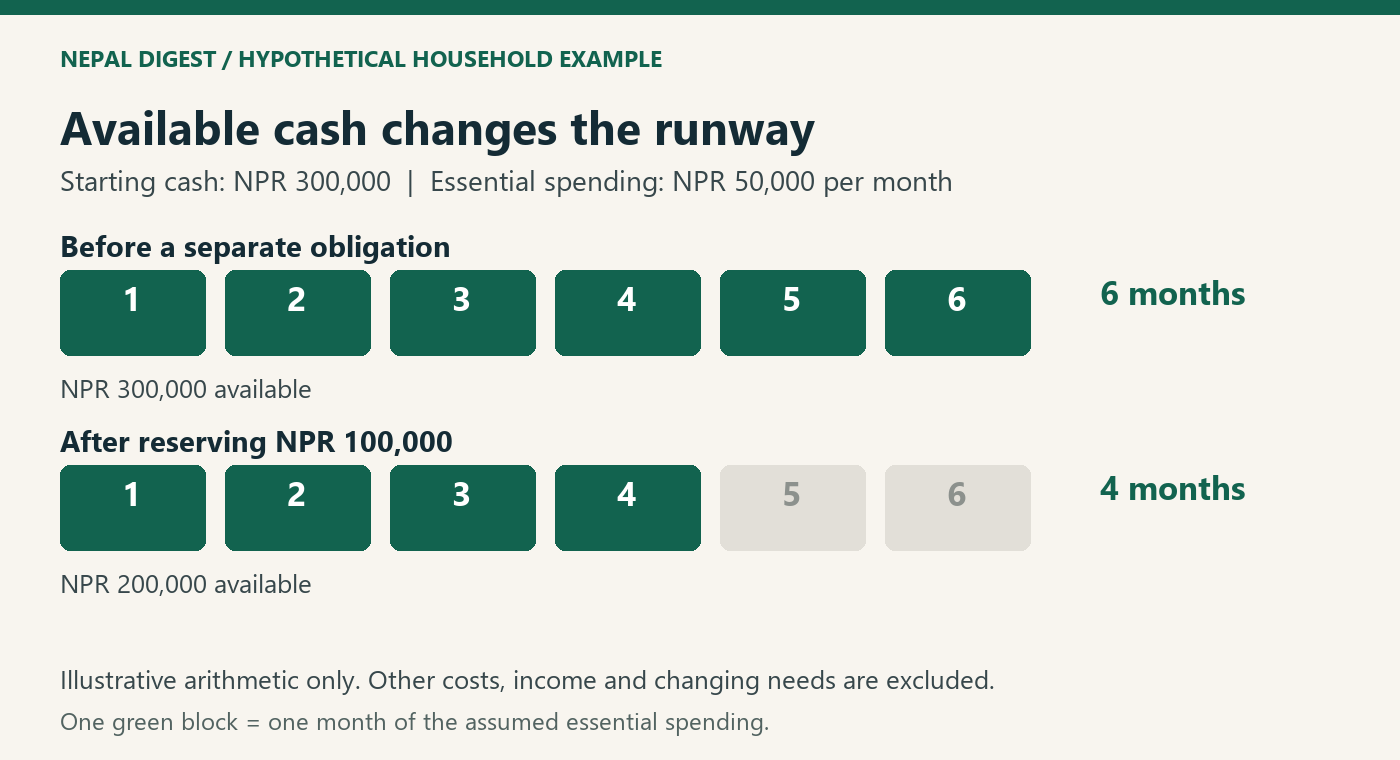
For a hypothetical example, imagine NPR 300,000 available cash and essential household spending of NPR 50,000 a month. Ignoring other costs, that covers six months. If NPR 100,000 is set aside for a known obligation, only NPR 200,000 remains for those expenses, covering four months. These invented amounts are arithmetic, not estimates of typical spending in Nepal. Adding an enterprise deposit, health bill or loan instalment changes the result immediately. Calculate with the household’s own figures before committing savings.
Turn experience into evidence an employer can assess
A job title alone may conceal a great deal of useful experience. Write down equipment operated, tasks completed independently, safety procedures followed, customers served and colleagues supervised. Describe the setting and period of work. If an employer letter or certificate is available, keep a secure copy and ask permission before sharing references. Do not publish another person’s phone number or private employment records on an open social profile.
Then translate that evidence into the requirements of a particular vacancy in Nepal. A worker may have experience maintaining equipment but need to demonstrate a specific technical skill. Another may have coordinated shifts without holding a formal supervisory title. The point is to explain the work accurately, without inventing qualifications or assuming an overseas certificate is automatically recognised. Ask the relevant provider or employer what assessment or recognition process applies before paying for training.
Use a small enterprise test to learn something specific
A business pilot should answer a question, not merely keep the returnee busy. For an imagined repair service in Nepal, the question might be whether enough customers will pay a price that covers parts, transport, time and repeat visits. Record enquiries, completed jobs, cash received, material costs and unpaid balances. A relative praising the idea is encouraging, but it is different from a customer paying the full price.
Agree in advance how much the household can afford to risk and when the experiment will be reviewed. Separate that money from essential living reserves. Include the owner’s labour when judging the result: cash left after buying materials is not automatically profit if it has to compensate a full month of work. If the test does not support expansion, ending it can protect savings and provide information for a different choice. It does not establish that the person has failed at returning.
Ask a support provider questions that can be answered
When contacting a municipality, employment service centre, training provider or reintegration project, describe the need and ask what is currently offered. Is the service open to a person with this return history and residence? What documents are required? Is there a fee? When does the next intake begin? Is assistance a referral, training place, loan, grant or counselling service? Those categories create very different expectations.
Keep the date, office name and answer in the household record. An older description of a Nepal programme can explain its purpose while remaining insufficient evidence of current eligibility or funding. Ask for an official notice or written instructions where available. A promise from an intermediary should not replace confirmation by the actual provider. If no service is available, record that clearly so the family can plan around the information it has rather than an assumed future benefit.
Make practical care and everyday time visible
Care arrangements can determine whether a work plan is feasible. Who accompanies an older relative to an appointment? Who collects children if a shift runs late? What happens if the person doing unpaid care becomes ill? Name an alternative contact and discuss availability before an emergency. The fact that a returnee is physically back in Nepal does not mean that person is always available, just as sending money from abroad did not settle every practical need.
Include the returning person’s own adjustment in this discussion. Rest, social contact and time to understand changed routines can be meaningful needs even when the household urgently wants income. Avoid treating distress as a moral failure or assuming that another contract abroad is the only response. Where specialist support is needed, confirm the appropriate local provider and arrangements directly. This worksheet identifies responsibilities; it does not diagnose a condition or prescribe treatment.
Review progress with a short set of household measures
At an agreed date, compare the plan with what actually happened. Did income become more dependable? Were necessary bills paid without repeatedly drawing down reserves? Did an application lead to useful feedback? Has a business test produced paying demand? Are care responsibilities more workable? Have household members had an opportunity to explain concerns without being accused of opposing the return? A useful review can contain mixed results.
Keep outputs separate from outcomes. Completing a training course is an output; using the skill in suitable paid work is a possible outcome. Registering a business is an administrative step; dependable earnings after costs are a different result. In Nepal, as elsewhere, the change that matters is whether the arrangement supports the person’s actual life. This distinction also makes it easier to explain to a support provider which part of the transition remains difficult.
If another migration becomes the preferred option
Before making another move, compare it with the revised plan at home using current documents and realistic costs. Confirm the employment offer, recruitment arrangements and required permissions through the appropriate official channels. Treat promised earnings and actual take-home pay as different quantities until deductions and terms are clear. Agree what happens to an unfinished enterprise, debt repayment or care arrangement in Nepal rather than leaving those questions for the household after departure.
A decision to leave again can reflect information learned during the return. It should not erase useful changes: better records, a repaired relationship, a tested skill, a clearer budget or a business idea shown to be unsuitable before more savings were spent. Likewise, deciding to stay is not proof that every difficulty has disappeared. The aim is a workable next stage that the household understands, with room to review it as circumstances change.
Keep one final distinction visible: the household review is a private decision aid, not a document that must be shared publicly. Use a secure folder for identity and employment records, and a separate task list for dates and responsibilities. Share only the information a genuine provider needs for a stated process. Returning to Nepal can involve several offices and unfamiliar contacts; keeping a record of why a document was requested helps the family avoid repeatedly sending sensitive material without a clear purpose.
Choose a next review date before closing the conversation. A plan remains useful when it can respond to new work, changed care needs or a different household budget in Nepal.