

A Nepali banknote offers a small reading lesson: the numerals tell you its value, the bank's name identifies the issuer, and some lettering is so small that it belongs to the note's security design. Start by separating those jobs rather than treating every mark as another number to decode.
This guide combines a Devanagari reading exercise with examples from Nepal Rastra Bank's official banknote-feature page, checked on 16 October 2026. It does not identify the year or signatory of a particular note, or determine whether one is genuine.
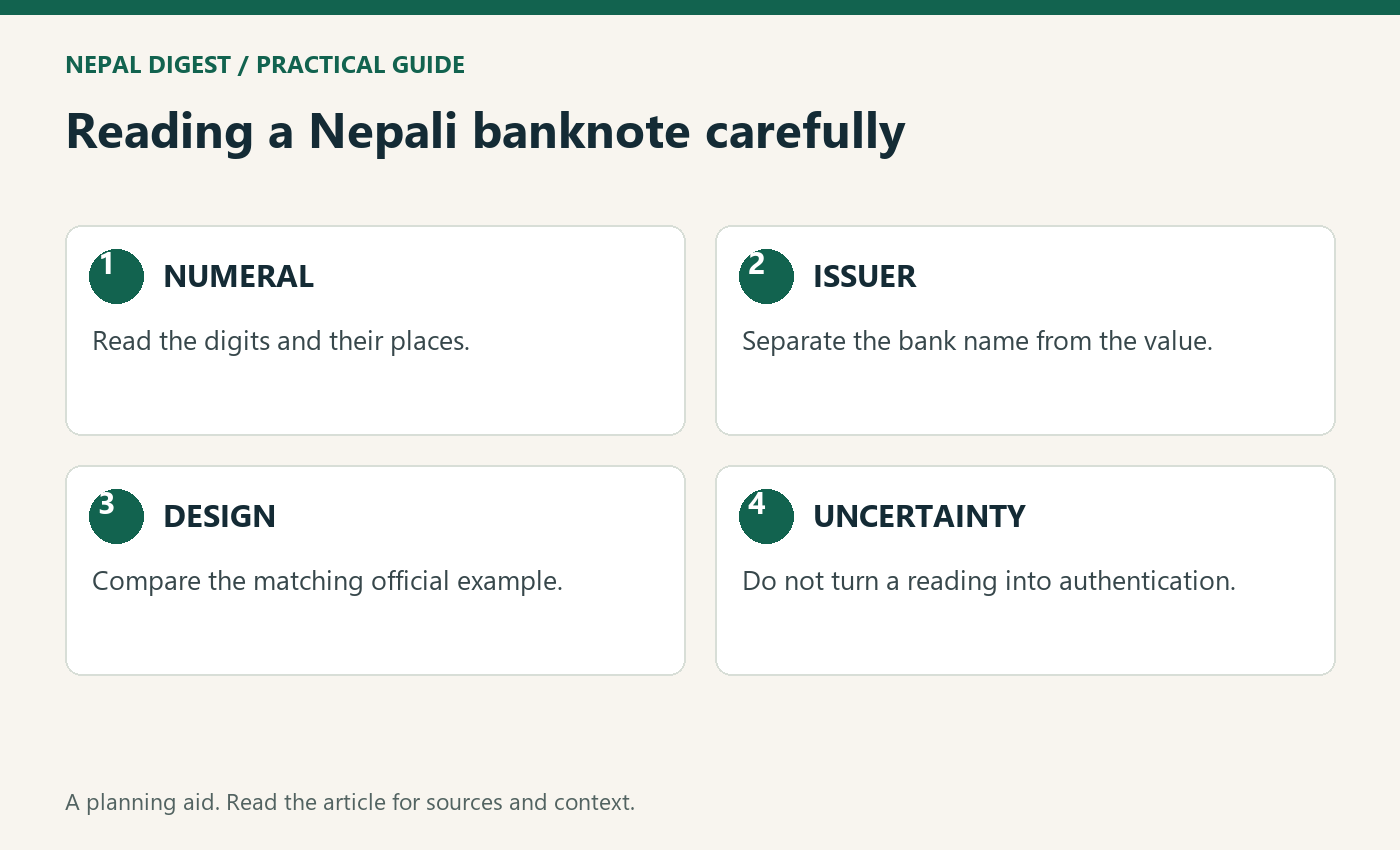
Table of Contents
Nepali banknote: 1. Match the design before following a description
NRB's feature page shows more than one Rs1,000 design. Select the pictured example that matches the note you are examining before using the accompanying explanation. A shared denomination is not enough to establish that two notes have identical details.
For the examples below, use the Rs1,000 entry whose numbered features include a security thread marked with the bank's initials and a microtext description. If your note differs, leave the comparison open rather than forcing a match. NRB's illustrated feature descriptions
2. Read the digits as a number
The Devanagari digits are ० १ २ ३ ४ ५ ६ ७ ८ ९. In the same order, they correspond to 0 1 2 3 4 5 6 7 8 9. The place-value pattern works the same way: १० is 10, १०० is 100, and १००० is 1000.
Try these two practice amounts on a separate sheet of paper:
- ५० = 50
- ५०० = 500
Ask a child learning Nepali to read the digits, say the amount aloud and explain what changed when another zero was added. Then find the denomination on a note together. Keep the exercise on ordinary paper; there is no need to write on, trace or copy the currency.
3. Distinguish the name from the value
NRB's description of one Rs1,000 design identifies tiny lettering spelling out “NEPAL RASTRA BANK”. That is the bank's name, not an additional amount. The security thread combines the initials “NRB” with “1000”: one identifies the institution, while the other repeats the denomination.
The same description explains that some apparent fine lines reveal microtext under magnification. This gives a useful answer to “Why is that writing so small?” Lettering can be part of a security feature as well as a way to communicate information. NRB: microtext and thread descriptions
4. Make a reading record with an honest blank
Use three headings on your sheet: “What I can read”, “What it means” and “What I still need to check”. Here is a suggested example, not a record of a note we inspected:
- १००० → 1000 → check that I read every digit correctly
- The bank's name → identifies the issuer → compare with the matching official description
- Tiny lettering I cannot resolve → leave blank → consult the feature explanation rather than guess
A signature needs a separate check. Its appearance alone does not tell you the person's name or when the note entered circulation. Likewise, a date found beside a web notice should not automatically be treated as a date printed on your note. Those are questions for documentation of the particular issue.
5. Keep reading and authentication separate
NRB's Rs1,000 description also covers a watermark, raised printing and colour-changing features. A recognisable word or numeral is only one observation; a photograph, spelling check or single feature cannot settle authenticity. If you are concerned about a note, ask a bank or NRB for guidance. Official security-feature reference
Finish by naming one numeral you read, one piece of lettering you understood and one detail that still needs checking. That is a useful lesson in both Nepali reading and careful observation.
A Nepali banknote reading exercise with ordinary paper
Prepare a small set of practice numbers on plain paper, separately from any currency. Write २०, २०० and २००० in one group, then ५०, ५०० and ५००० in another. Ask the learner to identify the first digit, count the following zeros and say the whole number. These are invented practice cards, not a claim that every written amount corresponds to a circulating denomination.
Next mix the cards and ask the learner to put them in increasing order. Invite an explanation of each choice. If two amounts are confused, compare their digits and positions rather than simply announcing which is larger. The point is to practise a reading method that can later be used with a real Nepali banknote.
Add a card that the learner finds less familiar, such as २५०. Read the digits in order and discuss their places. Keep the activity separate from prices, exchange rates and the purchasing power of the amount; those are different questions requiring context.
When returning to a real note, ask the learner to find the value without copying or marking the currency. Compare the reading with the appropriate official reference and keep any unresolved detail in the question column. A reading exercise should never become an improvised authentication test.
Explain what a photograph cannot settle
A photograph can make some lettering easier to discuss, but it also depends on focus, light, scale and the version of the note shown. If a detail is blurred, the correct answer may simply be that it cannot be read from this image. Do not turn a guessed character into a confident statement about the note.
Separate three records: the image you are examining, the official description of a matching design and your own observation. Name which record supports each statement. This makes it easier to correct an error later without implying that the central bank’s description itself changed.
If someone asks about a signature, issue date or another feature outside this guide’s scope, keep the question open until the relevant documentation is available. A clear limitation is more useful than a quick identification based only on resemblance.
The skill being practised is careful reading: recognise the numeral, distinguish an institutional name from an amount and explain why a tiny mark remains uncertain. That skill remains useful even when the final response is to seek guidance from a bank.
Related Nepal Digest guides: Nepal’s Flag: The Geometry, History and Meanings Behind Its Shape; Build a Nepal Quiz Night That Teaches Something New.