

Route record: Flydubai’s 25 September 2026 announcement confirms the inaugural 23 September flight and the announced daily service. This establishes the launch record; confirm present operating dates and the full fare conditions before booking.
Flydubai’s daily Dubai–Pokhara service is now operating, creating the first direct scheduled air link between the UAE and western Nepal. Its lasting value will depend on fares, reliable operations, repeat demand and what happens after passengers leave the airport.
For a Nepali returning home on a short holiday, the journey does not end when the international aircraft lands. There may still be another ticket to buy, luggage to move, a hotel to arrange or a road journey to complete. For someone whose family lives around Pokhara, reducing that final stretch can mean something more valuable than a convenient connection: another evening at home.
That is the human promise behind the proposed Pokhara–Dubai connection. The commercial promise is wider. A more direct journey could help hotels sell shorter stays, give tourism businesses a new audience and make it easier for people working abroad to maintain relationships with western Nepal. None of those outcomes is automatic. An airline can open a route; building a dependable travel market requires many other businesses and public services to work together.
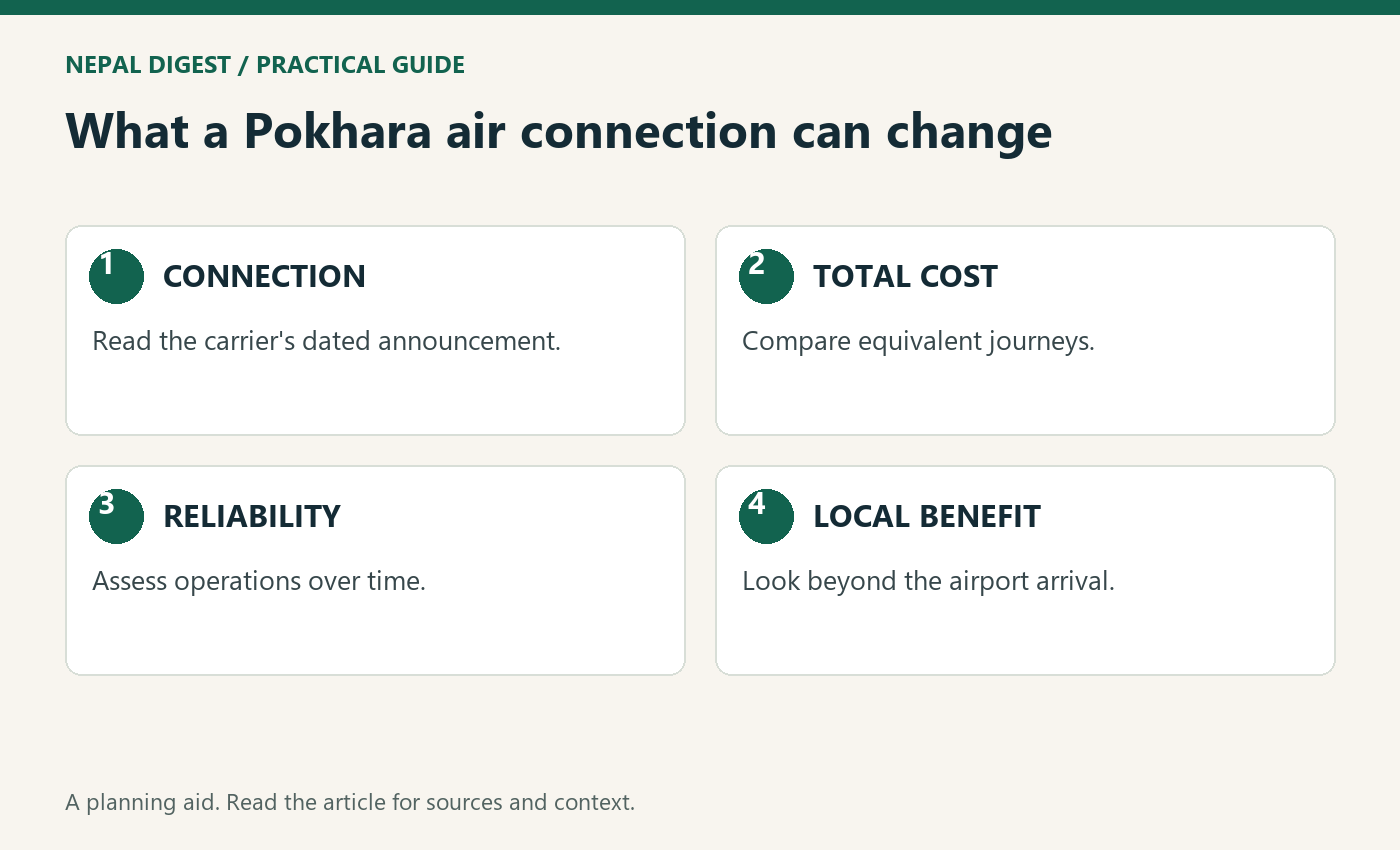
Table of Contents
The route has now launched
Flydubai’s inaugural scheduled flight reached Pokhara on 23 September 2026, and the airline confirmed the start of daily non-stop service between Dubai International and Pokhara International Airport. The route operates from Dubai’s Terminal 3 under flydubai’s codeshare partnership with Emirates.
The airline said Pokhara is now its second Nepal destination after Kathmandu, bringing flydubai’s total weekly frequencies to Nepal to 35. Through the Emirates partnership, travellers can connect onward through Dubai on a single ticket with through-checked baggage where the itinerary qualifies.
| Direction | Flight | Published departure | Published arrival |
|---|---|---|---|
| Dubai to Pokhara | FZ 1165 | 12:00 | 18:15 |
| Pokhara to Dubai | FZ 1166 | 19:15 | 22:00 |
All times are local, from the airline’s launch announcement. Travellers should confirm their specific date, terminal and operating schedule before paying.
The household calculation goes beyond the airfare
Consider an illustrative traveller working in Dubai whose family lives in Pokhara. The relevant comparison is the complete cost of reaching home through either airport. A cheaper international ticket through Kathmandu may still be attractive. But its advantage can shrink once onward transport, meals, an overnight stay and the time spent transferring are included.
Suppose, purely as a budgeting example, that the direct itinerary costs AED 250 more, while the alternative requires AED 180 in additional transport and accommodation. The remaining premium is AED 70. A traveller with limited leave might happily pay that difference. Another travelling with several family members might decide otherwise because the airfare premium multiplies across every ticket. These are hypothetical amounts, not observed fares or promised savings.
Luggage can change the answer again. Flydubai’s published fare comparison lists checked baggage as an extra charge on Economy Lite, with allowances included in Value and Flex, subject to route conditions. A returning worker carrying gifts should compare equivalent baggage allowances, not simply the first price on a search screen. Change and cancellation conditions also matter when leave dates remain uncertain.
The practical lesson is straightforward: compare two complete itineraries on the same dates, including the final journey home. There is no single airport that will be best for every household in western Nepal.
Pokhara could sell a different kind of holiday
The Nepal Tourism Board’s Pokhara guide presents a destination combining Phewa, Begnas and Rupa lakes with access to the Annapurna region, boating and other outdoor activities. That variety matters commercially. A visitor does not need to undertake a long trek to have a reason to come.
One possible product is a short, comfortable stay for a UAE resident with limited annual leave: an airport pickup, time beside Phewa Lake, a local food experience and a mountain-view excursion when conditions allow. Another is a family visit combined with a few hotel nights. These are proposed business opportunities, not evidence that either market has already expanded.
There are real attractions around which businesses could build such offers. Annapurna Cable Car, for example, promotes access to Sarangkot and its mountain and city views. A hotel could coordinate an excursion with a licensed local operator while keeping weather alternatives clear. The opportunity lies in making an existing experience easier to book, understand and enjoy.
A short-break package needs disciplined planning. If guests spend too much of a three-night stay waiting for pickups or resolving booking confusion, an easier flight will not rescue the holiday. Clear arrival instructions, a realistic itinerary and a transparent total price may matter more than another dramatic promotional video.
A connection to Dubai is also a distribution opportunity
The significance of the route extends beyond passengers who live in the UAE. The airline’s announced Emirates arrangement offers a way to sell connecting journeys through Dubai. Whether a particular connection is convenient, protected on one ticket and available at an acceptable price must still be checked for each booking.
For a Pokhara business, access to a wider audience creates a practical question: can that audience buy its services? A hotel that answers enquiries slowly, provides unclear cancellation terms or cannot confirm a transfer may lose customers even when the flight is convenient. International access raises expectations as well as possibilities.
Small operators do not need an elaborate technology project to respond. They can begin with accurate room information, clear photographs, reliable contact details, a simple confirmation process and written terms. A trekking company can explain what happens when an arrival is delayed. A transport business can identify the driver and pickup point before the passenger lands. These ordinary details turn a destination into a service people can trust.
More passengers do not necessarily mean more local income
A busy arrival hall would be an encouraging sign, but passenger numbers alone cannot measure the route’s economic contribution. Some travellers may simply switch from another airport. Others may visit relatives and spend little on commercial accommodation. Some holiday spending may be captured by intermediaries outside the region.
For local businesses, the useful questions are more specific. Are visitors staying additional nights? Are they booking local guides? Are restaurants buying more from nearby suppliers? Are small enterprises receiving repeat customers? Those measures would show whether improved access is creating fresh activity or mainly rearranging existing journeys.
Imagine a small hotel responding to stronger enquiries. It could immediately borrow to add rooms, or first test packages using its current capacity. The second approach would reveal who actually books, what they spend and whether demand persists beyond the initial excitement. That is a business-planning example, not an investment recommendation or a forecast of occupancy.
Similar caution applies to land prices and speculative development. An announced flight does not establish the future income of a property. The benefits of aviation are most credible when they can be traced to actual customers, delivered services and repeat purchases.
The airport is only one part of the journey
An international arrival creates a chain of small obligations. Passengers need to collect their bags, understand onward transport, contact relatives or accommodation providers and obtain help when something goes wrong. A poor experience at any point can undo much of the convenience gained in the air.
The published evening arrival makes coordination especially useful. Accommodation providers could confirm late check-in arrangements and transfer contacts in advance. Travellers continuing beyond the city should assess whether to stay overnight rather than build an ambitious onward plan around an arrival time that may change.
Accessibility deserves attention too. Older passengers, families with children and people who need assistance can experience the same itinerary very differently. Clear signs, understandable information and dependable support are part of the economic infrastructure of a route, even if they attract less publicity than an aircraft arriving.
Local authorities and businesses should also consider the places visitors have come to enjoy. More activity creates demands on transport, waste collection and public space. Protecting the lakeside experience and managing traffic are commercially sensible priorities as well as public responsibilities.
Coordination need not begin with a large campaign. Hotels, transport operators and guides could agree on shared contact procedures, clear pickup instructions and a practical response when a flight is late. A family waiting outside the terminal should know whom to call. A guest arriving after dinner should know whether food is available. These arrangements are inexpensive to describe but require someone to take responsibility for delivering them. They also provide a useful test of readiness: if businesses cannot reliably manage one arriving group, attracting several more will magnify the weakness rather than solve it.
Why a daily schedule changes business planning
A once-weekly or seasonal international flight can be useful without becoming dependable enough for many businesses to design around. Daily frequency is different. Hotels can build short-stay packages around predictable arrival patterns, transport operators can schedule transfers more confidently and diaspora travellers gain more flexibility around leave and family events.
The value of frequency is not only convenience. It reduces the cost of a missed travel day because the next scheduled service is closer. That matters to people with limited annual leave and to businesses selling time-sensitive itineraries.
The route gives Pokhara direct access to Dubai’s hub
Dubai is not only a destination for Nepali workers and tourists. It is one of the world’s major international connecting hubs. Flydubai’s codeshare relationship with Emirates gives Pokhara access to a much larger network through a single transfer, potentially including cities across Europe, North America, the Middle East and Asia.
This can make Pokhara easier to sell internationally without requiring every visitor to route through Kathmandu first. The commercial opportunity is strongest for travellers whose primary interest is western Nepal or the Annapurna region.
Western Nepal gains a different international gateway
The route also changes the journey for families living beyond Pokhara. Travellers heading toward Baglung, Parbat, Syangja, Myagdi and other western districts may find Pokhara a more logical gateway than Kathmandu depending on their final destination.
This does not mean the direct flight will be cheapest for every household. It means travellers can compare an additional full itinerary rather than accepting Kathmandu automatically as the only international arrival point.
Diaspora travel may be more stable than leisure demand
Tourist demand can change sharply with season, weather and global travel trends. Family travel is often more persistent. Workers return for festivals, weddings, funerals, school holidays and ordinary visits regardless of tourism marketing cycles.
That diaspora base could become important to the route’s durability because it gives the service a reason to operate beyond peak trekking seasons. The strongest international routes often combine leisure, family, business and connecting traffic rather than depending on one segment alone.
Cargo could matter quietly
Flydubai has also described the new route as adding passenger and cargo capacity. Cargo will never receive the same public attention as the inaugural passenger flight, but regular belly-hold capacity can create new options for time-sensitive goods and small commercial shipments.
The opportunity will depend on handling systems, customs efficiency, price and consistency. Air freight makes sense only for goods whose value or urgency justifies the higher transport cost.
Pokhara’s airport now has to prove the ground experience
An international route is only as useful as the passenger journey around it. Immigration, baggage handling, taxis, hotel transfers and clear information all shape whether passengers remember the arrival as easy or confusing.
This is especially important for first-time international visitors who do not have family waiting outside the terminal. The airport and tourism sector are now selling not only access to Pokhara but confidence that the first hour after landing will work smoothly.
Evening arrivals create a clear hospitality opportunity
The scheduled 18:15 arrival makes the first night predictable: most visitors will want transport, dinner and a smooth check-in rather than major sightseeing. Hotels can build around this with fixed-price airport pickups, late dining information and simple arrival instructions sent before departure.
These details may sound small, but international visitors judge destinations through them. A beautiful city does not compensate automatically for uncertainty around basic logistics.
Short breaks become easier to sell
Direct access changes the economics of a four- or five-night holiday because travellers no longer need to allocate as much time to a Kathmandu connection. That creates a market for UAE residents who want a compact mountain-and-lake break without committing to a long Nepal itinerary.
Pokhara’s strongest product for this audience may be simplicity: one hotel, a few local excursions, comfortable food and enough open time to enjoy the setting rather than racing through a checklist.
The Annapurna region could benefit beyond Pokhara hotels
International arrivals may spend first or final nights in the city before heading toward trekking routes and rural tourism businesses. Guides, transport operators, equipment shops and lodges can all benefit if the route produces genuinely new visitors rather than simply rerouting existing ones.
The important measure is additional local spending, not airport passenger numbers alone.
Reliable operations will matter more than launch publicity
Air routes become economically important only when passengers trust them enough to plan around months in advance. Repeated cancellations or large schedule changes would push travellers back toward more established alternatives even if the direct flight is theoretically attractive.
The first year will therefore be about operational confidence. Airlines, airport systems and local tourism businesses all contribute to that confidence in different ways.
Fares will decide how much traffic shifts from Kathmandu
A direct route can save time and still lose customers if the price premium becomes too large. Families buying several tickets are especially sensitive because a modest per-person difference multiplies quickly.
Travellers will compare complete costs: airfare, baggage, domestic connections, hotels, food and road transfers. Pokhara does not need to be cheaper in every case; it needs to be valuable enough to justify the difference when it costs more.
Local businesses should measure rather than speculate
The new route will generate claims about land values, hotel demand and investment opportunity. Businesses should resist making large decisions based only on launch excitement. The first months can reveal who actually travels, how long they stay and what they spend.
Testing packages within existing capacity gives operators real data before they borrow heavily or expand. Sustainable growth begins with customers rather than assumptions.
Tourism growth needs public-space management
If international access increases visitor numbers, Lakeside traffic, waste and pressure on public space can rise as well. The route’s economic success should not be measured only through hotel occupancy.
Pokhara’s competitive advantage is closely tied to landscape and livability. Protecting those assets is part of the business case for tourism, not an environmental concern separate from it.
How to judge the first months
The strongest test will come after the launch publicity. A useful assessment would track operated flights, cancellations, the range of fares available, passenger feedback and the ease of onward journeys. Tourism businesses could compare bookings and average stays with the same season previously, while recognising that other events also influence demand.
Travellers can make a simpler assessment. Before booking, check the operating date, the complete baggage allowance, change conditions, airport transfer and arrangements if the journey is disrupted. Use the airline’s current route booking page for availability rather than treating an advertised starting fare as a quotation for every date.
Success will look different to different groups
For the airline, success is sustained demand and viable fares. For the airport, it is reliable international operations. For hotels, it is more room nights and better occupancy. For diaspora families, success may be measured more simply: fewer transfers and more time at home.
These measures should not be confused. A route can be commercially successful for the airline while producing only modest tourism growth, or valuable to families even if leisure travel grows slowly. Evaluation becomes clearer when each stakeholder identifies the outcome that actually matters.
The first year should be treated as a learning period
Businesses around Pokhara do not yet know exactly how the route’s passenger mix will evolve across Dashain, winter trekking, spring tourism and ordinary work travel. The sensible response is experimentation rather than overbuilding.
Hotels can test airport packages, guides can track enquiry patterns and transport companies can measure demand before expanding fleets. One year of real passenger behaviour will teach more than speculation before launch ever could.
Reliability can create repeat behaviour
Travellers become loyal to routes when they trust schedules, transfers and service enough to stop reconsidering the entire journey each time. This is particularly important for diaspora passengers who may travel repeatedly for family reasons.
If the Dubai–Pokhara connection becomes habitual, its economic value will compound gradually through repeat customers, word of mouth and businesses learning how to serve the market better.
The route can change Pokhara’s planning horizon
Regular international connectivity gives local government and businesses a stronger reason to think about airport-area transport, signage, waste, visitor information and late-evening services together rather than as separate issues. Aviation can therefore expose urban weaknesses as quickly as it creates tourism opportunities.
The most useful response is coordinated improvement, not one large promotional campaign. A destination becomes internationally competitive through the accumulation of small reliable systems.
The route’s promise is substantial because the problem it addresses is ordinary: getting people closer to where they actually want to be. A worker wants time with family. A visitor wants more holiday and less transfer. A business wants customers who can arrive without an exhausting sequence of arrangements.
If the scheduled service operates reliably and the region makes those journeys straightforward, Pokhara could gain more than another destination on an airline map. It could become easier to choose, easier to revisit and easier to do business with. The decisive work will continue long after the first aircraft lands.
The real milestone will come when the route no longer feels new. When families book it without explanation, hotels understand the arrival pattern and international visitors treat Pokhara as a normal gateway rather than an experimental one, the economic meaning of the connection will have become much deeper than the inauguration ceremony.
That normality is what infrastructure ultimately aims for. The best transport link eventually disappears into routine: people trust it, businesses plan around it and the airport becomes one more reliable part of how western Nepal connects with the wider world. Pokhara’s new Dubai service is now at the beginning of that longer test. The inaugural flight proved the route could begin; the coming months will show whether passengers, businesses and the wider tourism economy can turn it into a dependable part of western Nepal’s transport network reliably.