
Nepali startups are most interesting when the problem is easier to explain than the pitch. A household needs a workable way to pass recyclable material to a collector. A shop needs a reliable payment record. A customer needs a service that works outside a demonstration.
These are questions about time, trust and coordination. A new app may help, but software alone does not complete a collection, resolve a failed transaction or make a customer return. The useful test is whether a venture improves a specific everyday process and can keep doing so.
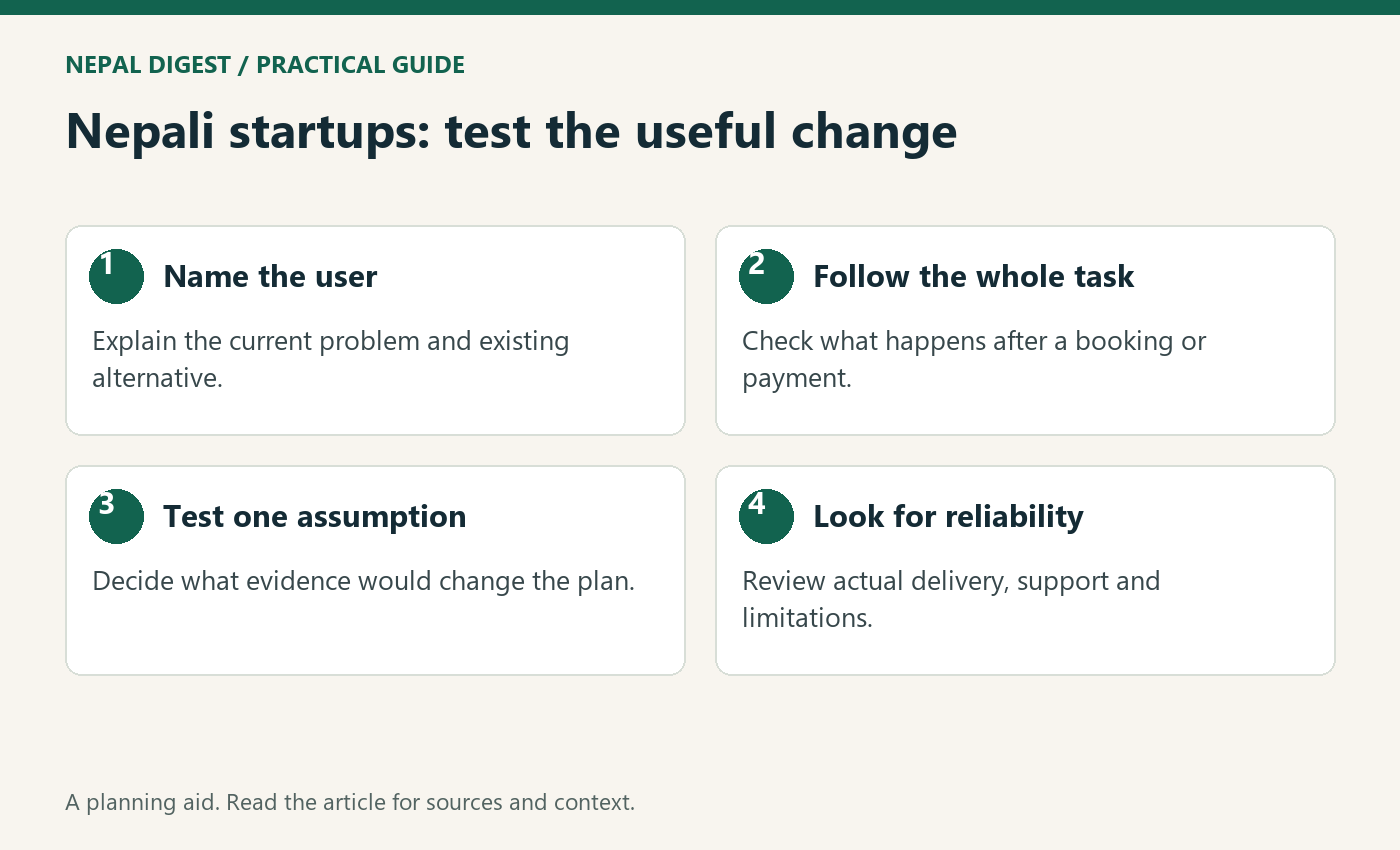
Table of Contents
Start with the problem Nepali startups are trying to solve
Define the user before describing the technology. Who experiences the difficulty, how often does it occur and what do they do now? A founder who cannot explain the existing alternative may be solving an inconvenience that customers do not consider worth changing.
A concrete problem also makes an idea easier to test. Instead of promising to transform an entire sector, a team can check whether one group of users completes a task more reliably. The relevant evidence might be completed collections, fewer failed orders or the time needed to obtain support.
None of those measures should be invented for a company profile. Ask for the period covered, the method used and the difference between registrations and actual use. A large sign-up figure cannot by itself show that a recurring problem has been solved.
Recycling makes the coordination problem visible
Khaalisisi’s own explanation places recyclable collection and the work of its collecting partners at the centre of its service. It is an example of a business built around a physical process, not merely an online listing.
The general lesson for Nepali startups is to follow the whole transaction. Someone has to identify acceptable material, arrange contact, reach the location and complete the exchange. A clear website can reduce confusion, but it still depends on people and operations.
Before using a collection service, confirm its current coverage, accepted material and collection conditions directly. A company’s stated mission explains what it is trying to do; it does not guarantee that every address, material or requested time can be accommodated.
Payments show what happens after an idea grows
eSewa’s service FAQ lists uses including utility payments, mobile recharge, merchant payments and transfers. It illustrates how a locally relevant digital service can become part of many ordinary tasks. An established business should not be described as a new startup simply because its origin involved innovation.
For a customer, the important questions concern completion and evidence: did the intended recipient receive the payment, what reference identifies it and what happens if the balance changes but the service is not delivered? A useful product has to make those questions manageable.
Founders in other sectors face an equivalent challenge. The transaction is not finished when a customer presses a button. It is finished when the promised outcome occurs and both sides have a clear record of what happened.
Incubation can support the work without proving the outcome
Idea Studio Nepal describes programmes that support ideas through incubation, mentorship and connections. Such organisations can provide an entry point for founders who need feedback or help turning an idea into an operational plan.
Participation in a programme is not independent proof of profitability, product quality or future success. Nepali startups still need to establish that customers want the service, that they can deliver it and that the costs make sense over time.
Useful mentoring should sharpen those questions. Ask which assumption the next experiment will test, what evidence would disprove it and how the team will respond if the result is disappointing. A programme is most valuable when it improves decisions rather than simply producing a certificate or public appearance.
Reliability is part of the product
Consider a clearly hypothetical service that attracts many first-time bookings but repeatedly misses agreed delivery windows. Its marketing has created demand, yet the customer’s original problem remains. Adding more advertising would increase the scale of the operational failure.
A better response is to identify the constraint. The team might need a smaller service area, clearer scheduling, a backup supplier or a more honest promise. This example does not describe any named company; it shows why the quality of execution belongs in the business model.
Customers can apply the same discipline when evaluating Nepali startups. Look for clear terms, identifiable support and a sensible explanation of what the service can currently do. Avoid treating confidence, celebrity endorsement or a crowded launch event as substitutes for that information.
A useful business should make its evidence clearer
The strongest local-business story is specific about the change. It explains the customer’s previous difficulty, the service now offered and the limitations that remain. It distinguishes a company’s own claims from information checked through records or direct experience.
For the wider conditions faced by founders, read Nepal Digest’s analysis of Nepali entrepreneurs building beyond Kathmandu. Location, infrastructure and access to customers can affect whether an apparently simple solution is practical.
Nepali startups do not have to solve every problem to be useful. A reliable improvement to one repeated task can matter. The challenge is to demonstrate that improvement honestly, operate it consistently and allow customers to judge the result.