
Nepali brands can make a product recognisable through a name, a pattern, a material or a story about where it comes from. The harder task is to make that identity meaningful after the first purchase, when fit, durability, repair and customer service become more important than a striking campaign.
Looking local can therefore mean more than attaching a familiar symbol to an ordinary product. It can involve a relationship with a place, a manufacturing history or a design tradition. The useful question is how clearly a brand explains that relationship and how well the product supports the explanation.
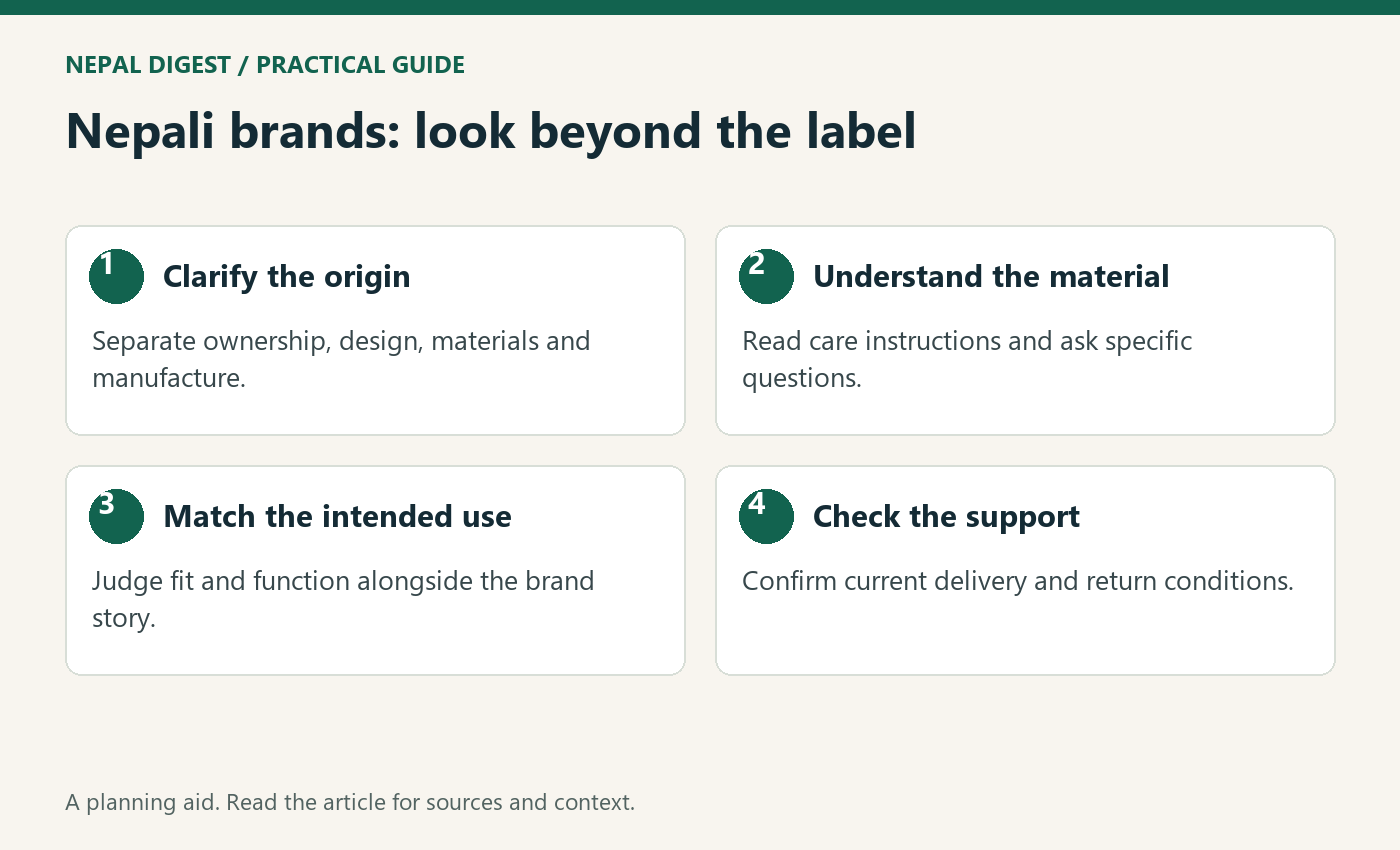
Table of Contents
What local identity can mean for Nepali brands
Separate several claims that are often placed together. A business can be owned in Nepal, design in Nepal, manufacture in Nepal or use materials associated with a particular community. These are different descriptions, and one does not automatically establish the others.
A clear product page should help a buyer understand what is actually being claimed. If a company describes a fabric as local, ask which part of the material’s journey that covers. If a pattern has a cultural meaning, look for an explanation rather than assuming that every traditional-looking motif has the same origin.
That precision can strengthen a brand. A modest, well-supported statement is more useful than a sweeping claim about authenticity that cannot be checked. It also gives customers language to describe the product accurately when recommending it to someone else.
Goldstar connects identity to a manufacturing story
Goldstar’s own account links the footwear brand to Kiran Shoes Manufacturers and Modern Slipper Industries. It presents a story rooted in footwear production and describes a range spanning shoes and slippers. Those are company statements, not an independent assessment of every product’s performance.
The example is useful because it makes local identity partly about making and distribution, rather than decoration alone. A buyer can ask where a particular model is made, what material it uses and how to choose an appropriate size. The answers matter more than treating the brand name as a guarantee that every pair suits every purpose.
Nepali brands with a long manufacturing story can also face a design challenge: how to remain recognisable while meeting new expectations. That is a question to evaluate through actual products and customer experience, not a reason to assume that either an older style or a new launch must be better.
DOCHAA makes the heritage reference explicit
DOCHAA’s brand history explains that its name refers to handmade footwear associated with Nepal’s Indo-Tibetan belt. The company presents heritage as part of its identity. A reader should distinguish that stated inspiration from any separate claim about the material, production method or origin of an individual product.
A heritage reference can create an invitation to learn. It becomes more informative when the brand identifies the tradition, explains its adaptation and acknowledges the people whose knowledge gives the reference meaning.
It should not be read as evidence that a contemporary shoe is an unchanged historic object. Design can be a reinterpretation. Being clear about that relationship allows Nepali brands to experiment without asking customers to confuse inspiration with preservation.
Judge the product after the story has been told
Start with use. A shoe bought for a daily commute may face different demands from one chosen for a particular event. A bag needs a suitable capacity and comfortable straps; a garment needs an appropriate fit and care routine. A strong local story cannot answer those practical questions on its own.
Read care instructions before buying, especially when the appeal rests on a distinctive textile or finish. Ask how the item should be cleaned, whether colour or texture may change and what support is available if a component fails.
For an online purchase, check the current size guide, delivery arrangements and return conditions directly with the seller. Do not assume that a policy described in an old review still applies. Keep the order record and the product description that informed the purchase.
Local recognition should include the people doing the work
A product’s identity becomes richer when makers and contributors are visible. Designers, production workers, craftspeople, photographers and shop staff can all help create its value. Recognising that contribution is more meaningful than using a community’s visual language as an anonymous decorative resource.
Claims about fair employment, environmental benefits or community income require their own evidence. A label saying local does not establish wage levels, working conditions or the full environmental cost of production. Ask what the claim measures and whether the supporting information can be read.
The same discipline applies to brand coverage. Nepali brands deserve detailed reporting, including their limitations, rather than a choice between uncritical celebration and dismissal. A company’s own history can establish how it presents itself; other claims may require records, interviews or product testing.
Buying local can begin with a better conversation
A practical approach is to ask four things: who made or designed this, what is it made from, how will it perform in my intended use and what happens if something goes wrong? The questions can be friendly and specific. Their purpose is understanding rather than catching a seller out.
Nepal Digest’s guide to visiting local markets offers a related approach to quantities, materials and considerate shopping. The same attention is useful whether a purchase happens at a counter or through a polished website.
Nepali brands have room to express an identity that is contemporary and rooted in place. The strongest version of that identity is supported by clear provenance, thoughtful design and dependable service. Looking local creates interest; giving the customer something worth using is what can turn that interest into trust.