

Nepal’s time zone puts its clocks five hours and 45 minutes ahead of Coordinated Universal Time, or UTC. When it is noon at UTC, it is 5:45pm in Kathmandu. The familiar quarter-hour difference is a national time standard, not a problem with your phone.
There are two questions hiding inside that unusual number: what changed on the clock, and why that particular offset was chosen. The first is well documented in the time-zone records used by computers. The second needs more care than a good story about mountains or national pride usually receives.
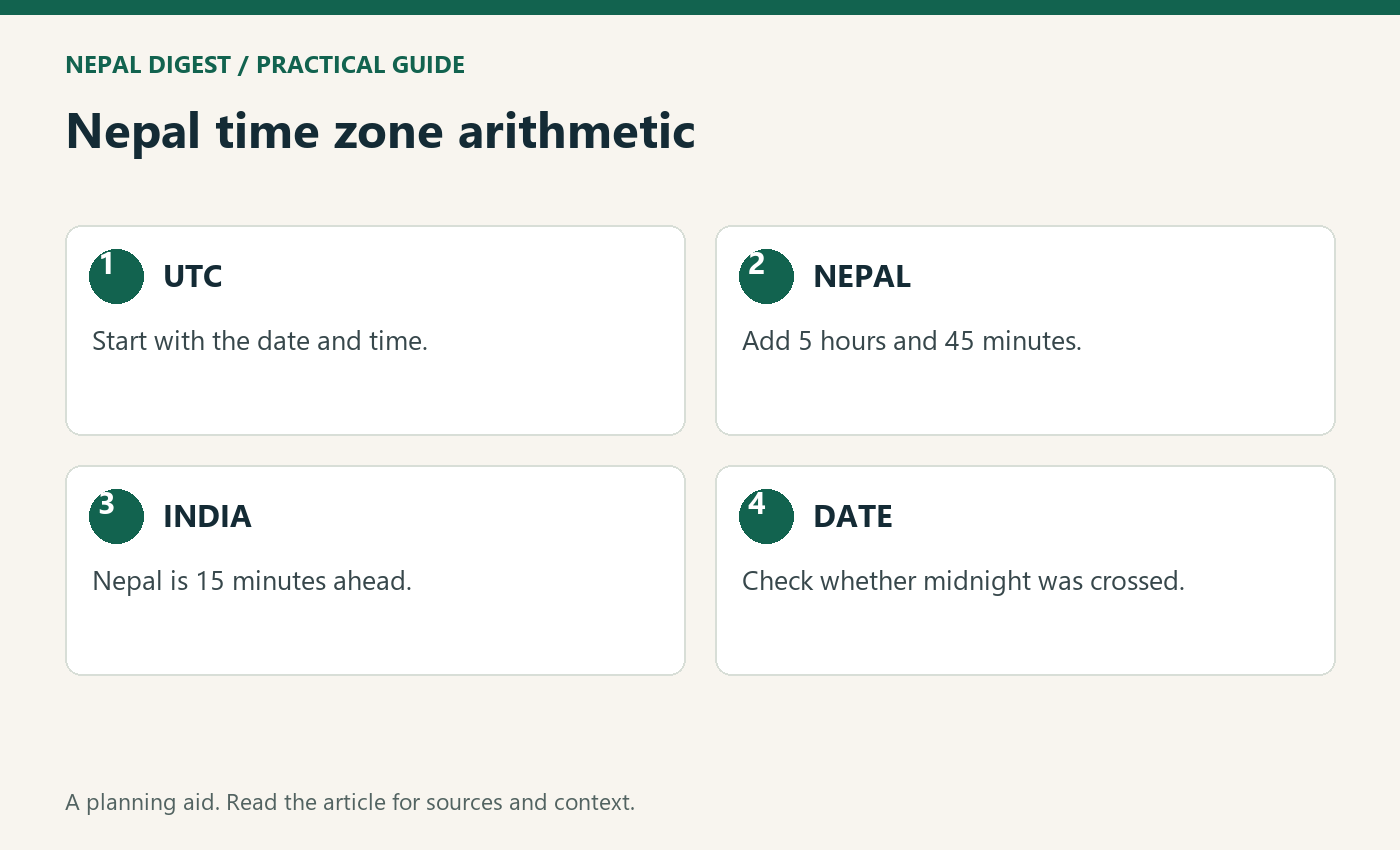
Table of Contents
time zone: The change was 15 minutes, not 45
The IANA Time Zone Database’s Kathmandu entry records three periods: local mean time at UTC+5:41:16 before 1920; UTC+5:30 until 1986; and UTC+5:45 thereafter. The 1986 change therefore moved the clock forward by a quarter of an hour. It did not move Nepal 45 minutes ahead of its previous time.
That distinction also explains a common misunderstanding about India. India uses UTC+5:30, so Nepal is 15 minutes ahead of India, not 45. A meeting at 10am in Delhi is at 10:15am in Kathmandu. “Forty-five minutes” describes the minutes component of Nepal’s offset from UTC.
IANA is a maintained technical record, not the original Nepali government order introducing the change. Its historical entries are useful evidence for clock conversion, but they do not, by themselves, establish the political reasoning behind a decision.
What the longitude arithmetic explains
The Earth turns through 360 degrees in roughly 24 hours. In the simple mean-solar-time calculation, that is 15 degrees per hour, or four minutes per degree. Five hours and 45 minutes corresponds to 86 degrees 15 minutes east longitude.
This makes a quarter-hour offset perfectly intelligible geographically. Time zones need not be whole hours apart. Civil time, however, is an agreed standard used across a territory; it is not a separate solar clock for every town. Sunrise and solar noon still differ between places within Nepal.
Popular accounts connect Nepal’s standard time with Gaurishankar and national distinctiveness. The time-zone entry establishes neither a mountain-based legal definition nor a decision-maker’s motive. Without an original order or another reliable historical record supporting those explanations, they should not be presented as a proven reason for the 1986 change. The reliable answer is narrower: Nepal adopted the UTC+5:45 standard, and the resulting offset is consistent with the longitude arithmetic.
The harder part is calling home from abroad
Nepal does not currently move its clocks for daylight saving. Other countries do. That means the gap between Kathmandu and your overseas home can change even while Nepal’s clock stays put.
Here is a worked example for Friday, 16 October 2026, at 7pm in Nepal. These are date-specific conversions, not a year-round schedule:
- Dubai: 5:15pm on Friday
- Doha: 4:15pm on Friday
- Delhi: 6:45pm on Friday
- London: 2:15pm on Friday
- New York: 9:15am on Friday
- Sydney: 12:15am on Saturday
The Sydney example is the easy one to miss: a Friday evening call in Nepal has already become Saturday in Sydney. A family group message that says only “Friday at seven” leaves both the time zone and the date open to misunderstanding.
For Britain, the clocks go back on 25 October 2026. After that change, 7pm in Nepal corresponds to 1:15pm in London rather than 2:15pm. In Sydney, New South Wales began daylight saving on 4 October 2026; its next clock change is 4 April 2027. Do not apply Sydney’s offset to every Australian city.
A small habit that prevents missed calls
Write the full agreement once: “Friday 16 October, 7pm Kathmandu; Saturday 17 October, 12:15am Sydney.” If that is too late, choose a different time together rather than assuming one household can stay awake.
For recurring calls and remote-work meetings, put the event in a calendar using the city time zone, such as Asia/Kathmandu, rather than entering a fixed offset from memory. Then check the next occurrence around daylight-saving changes. Choose whether the meeting should stay anchored to Nepal’s time or to the overseas participant’s time; both cannot necessarily remain unchanged throughout the year.
The quarter hour is easy once it is written down. The real trick is remembering whose date, whose clock and whose evening you are planning around.
A recurring-call example across a clock change
Suppose a family wants to keep its call at 7pm in Kathmandu throughout the year. That is the chosen anchor. The London participant’s local time can change when Britain changes its clocks, even though the family in Nepal has changed nothing. If instead the agreement is to keep the same London afternoon time, the Kathmandu time must be checked again. Both are valid choices; the ambiguity comes from never choosing.
Put the anchor in the invitation itself, and let the calendar display the corresponding local time for each participant. Before the next clock change, open the occurrence after that date and read it rather than relying on the first invitation. A recurring event can look familiar while its local display has moved.
For a call that crosses midnight, include both dates in the message. Also check whether an overnight shift, a school morning or a weekly day off makes the converted time impractical. Correct arithmetic only establishes when the call occurs; it does not establish that everyone is available.
Practise the quarter-hour calculation
To move from UTC to Nepal time, add five hours and 45 minutes and then check the date. Starting at 8:30pm UTC gives 2:15am in Kathmandu on the following day: five hours reaches 1:30am, then 45 minutes reaches 2:15am. This is an arithmetic exercise, not a meeting proposal.
For India, adding 15 minutes gives the equivalent Nepal time because the two offsets differ by that amount. Starting at 11:50pm in Delhi therefore reaches 12:05am in Kathmandu on the following date. That small example shows why writing only the hour and weekday can still cause trouble even between neighbouring countries.
For places observing daylight saving, use the city and the actual date in a maintained calendar or time-zone tool. Do not turn a remembered winter difference into a permanent rule. The goal is a repeatable check: identify the anchor, convert the date as well as the time, and confirm the next occurrence with everyone involved.
Related reading: Your Checked Bag Didn’t Arrive: What to Record Before Leaving the Airport; Lost Your Phone Abroad? Protect Your Accounts and Recover Access.