

A good Nepal quiz leaves people with something to talk about after the score is counted. This ten-question Nepal round mixes places, wildlife, food and language. Each answer has a source, so the host can explain it rather than simply announce a winner.
The questions have been desk-checked against the linked sources. Difficulty has not been tested with a group. Treat this as a flexible family or community activity, not a measure of how “Nepali” anybody is.
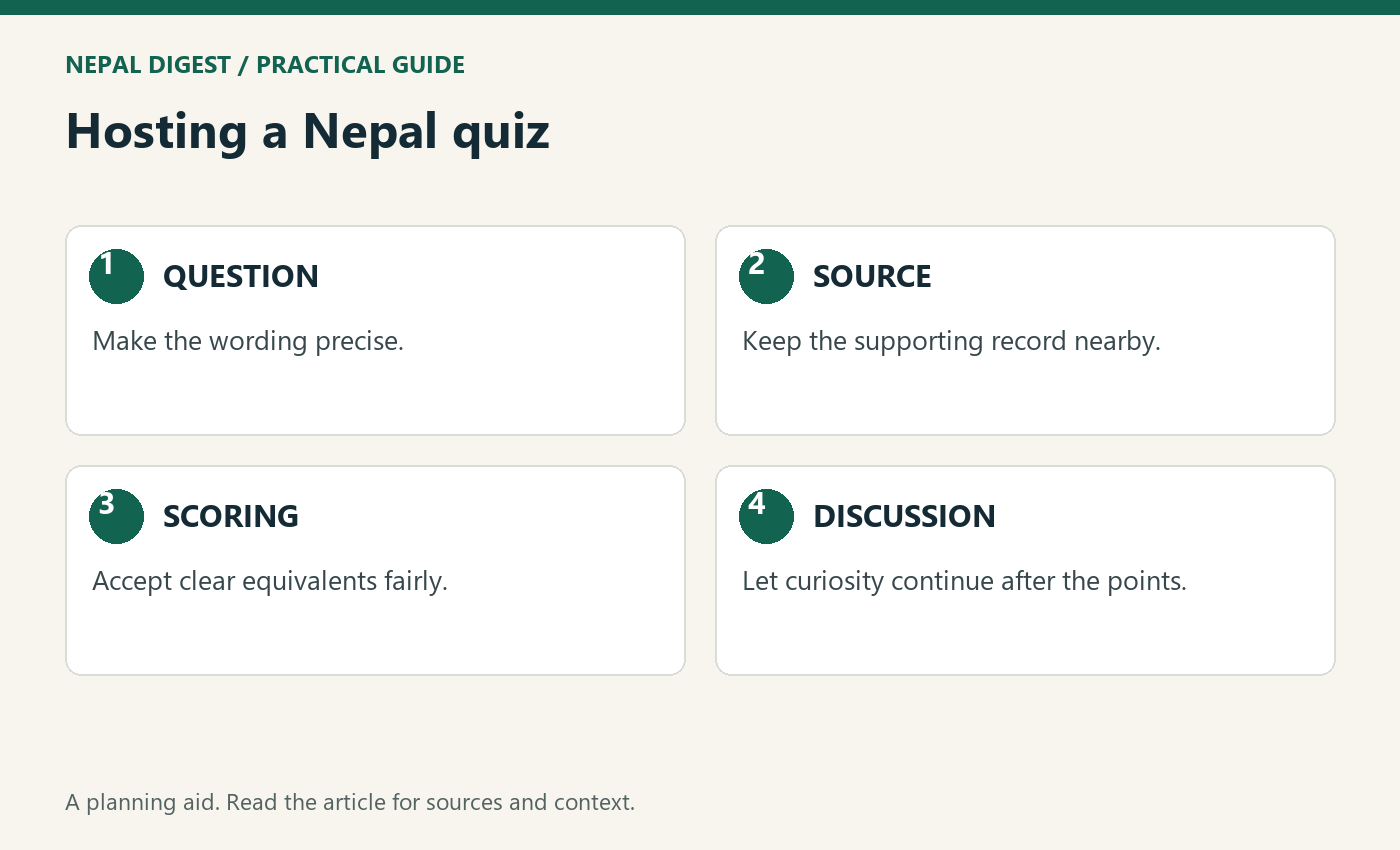
Table of Contents
Nepal quiz: set up the round
Choose a host to read the questions and keep the answers out of view. Play individually or in small teams. A scrap of paper and a pencil are enough; people can also give answers aloud in turn.
Award one point for each correct answer, for a total of ten. Accept clear equivalents in Nepali or English and reasonable spelling variations. Do not award extra points for an explanation unless you agree to that before starting. If there is a tie, share the win.
Allow discussion within teams. After revealing the answers, invite each person to name one fact they found interesting. Keep personal memories as conversation, rather than scoring them as historical evidence.
The ten questions
- How many Monument Zones make up the Kathmandu Valley UNESCO World Heritage property?
- Which emperor erected the famous commemorative pillar at Lumbini?
- Which Nepalese national park contains Mount Everest?
- What is the Nepali name of Nepal's national bird?
- In which year was Chitwan National Park inscribed on UNESCO's World Heritage List?
- Which painting tradition is closely associated with Janakpur and its surrounding cultural region?
- What flour forms the outer covering of a yomari, according to Nepal Tourism Board's description?
- Which cooking method does that description give for yomari: steaming, deep-frying or baking?
- Article 7(1) of Nepal's Constitution names Nepali written in which script for official business?
- Does Article 6 recognise only Nepali, or all mother tongues spoken in Nepal, as languages of the nation?
Pause here if you are playing. The answer key follows.
Answers, with something to learn
1. Seven. These include three Durbar Square zones and four religious ensembles. The number refers to the zones within this particular World Heritage property, not to all heritage places in the Valley. UNESCO: Kathmandu Valley
2. Ashoka, also spelled Asoka. UNESCO identifies the Mauryan emperor with the pillar and its inscription. Accept either spelling. UNESCO: Lumbini
3. Sagarmatha National Park. UNESCO's description includes Mount Everest within the property. This question asks for the park, so “Everest” alone is not the complete answer. UNESCO: Sagarmatha National Park
4. Danphe. Nepal Tourism Board identifies the national bird as the Danphe, or impeyan pheasant. Accept the Nepali spelling डाँफे or a clear Roman-script equivalent. Nepal Tourism Board: bird watching
5. 1984. This is the World Heritage inscription year. It is a different question from when the national park was established. UNESCO: Chitwan National Park
6. Mithila painting or Mithila art. Janakpur is associated with this tradition. The answer does not imply that the art is practised only in Nepal; Nepal Tourism Board also describes its practice in India. Nepal Tourism Board: Janakpur, Mithila art
7. Rice flour. The tourism board describes yomari as a steamed dumpling with a rice-flour covering. Household fillings and shapes can vary. Nepal Tourism Board: Yomari Punhi
8. Steaming. The cited description calls yomari a steamed dumpling. This question concerns the preparation described by the tourism board, rather than a claim about every modern adaptation. Nepal Tourism Board: Yomari Punhi
9. Devanagari. The question concerns the constitutional provision for official business, not every language or script used in Nepal. Constitution of Nepal, Article 7
10. All mother tongues spoken in Nepal. Article 6 and Article 7 answer different questions: recognition as languages of the nation and language of official business. Constitution of Nepal, Article 6
Make the next round together
Ask each team to suggest one new question with a source. Check that the wording leads to a clear answer and that the answer does not depend on an unstated year, region or recipe. A short, well-sourced round is more enjoyable than a long argument over a question nobody can settle.
Run a Nepal quiz round that welcomes different knowledge
Before the evening, read every question aloud once. Check that the host knows which detail makes the answer precise: a World Heritage inscription year, for example, is different from a park’s establishment year. Keep the source and a short explanation beside each answer so that the reveal does not depend on memory.
Agree how names and spellings will be handled. A team may recognise a place in Nepali while another knows its English name. Accept clear equivalents where the question permits them. The aim of a Nepal quiz is shared learning, not rewarding only the spelling or language most familiar to the host.
Give people a way to participate without speaking in front of the whole room. Small teams can discuss quietly and nominate a reader. Someone who prefers to listen can help check the answer explanations or propose the next round. Participation should not require proving a particular kind of national identity.
When an answer is challenged, pause the scoring and check the wording against the cited source. If the question was ambiguous, acknowledge that and adjust the score fairly. Do not defend a flawed question merely because it appeared in a prepared answer key.
Turn the answer reveal into the next activity
After the points are counted, ask each team to choose one answer they want to understand better. They might look at the relevant heritage description, compare a language provision or learn how a food is described in its source. Keep this discussion outside the scored round so that curiosity does not become another competition.
For the next Nepal quiz, give each team one responsibility: write a question, supply a source and explain why the wording leads to one answer. Ask another team to test it before the event. This small review often catches an unstated date or a name that could refer to more than one thing.
Keep a record of corrections and useful alternate answers for the next host. A reusable round improves when the group learns from it, rather than when the same uncertainty is repeated every year.
Related Nepal Digest guides: Nepal’s Flag: The Geometry, History and Meanings Behind Its Shape; Nepali food finds a new audience.