

Nepal's flag looks simple enough to draw from memory: two pointed sections, a blue border, a moon and a sun. But its distinctive outline follows a construction that belongs in a geometry lesson. The Constitution describes how to build the shape rather than merely telling a designer to copy a picture.
Understanding it becomes easier when we separate three questions: what the official specification requires, what historical documents show and what people read into the symbols.
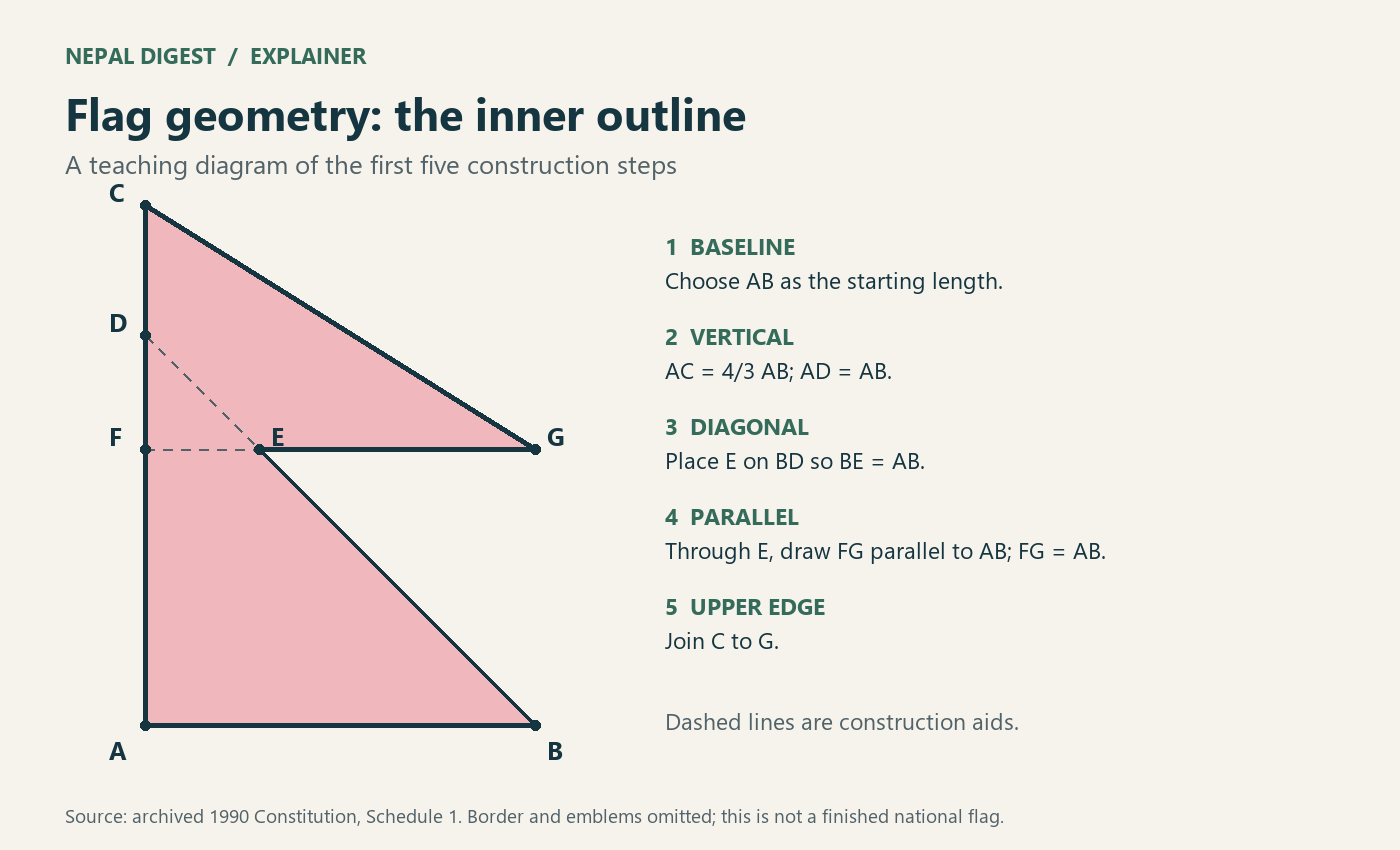
Table of Contents
Flag: what the Constitution specifies
Article 8 describes a crimson field, deep-blue borders and two adjoining triangular figures. The white moon emblem sits above the white sun. It specifies eight visible moon rays out of sixteen and a twelve-rayed sun, while Schedule 1 gives the construction method. The government's District Administration Office in Dhanusa reproduces these constitutional details in its flag-use notice. Government notice
The Constitution's instructions go beyond the outline. They locate the moon and sun through intersections, arcs and circles, and derive the border width from the construction. The working lines are not printed on the finished flag. Constitution of Nepal, Article 8 and Schedule 1, archived translation
A shape built from relationships
The first five steps establish the red field inside the border. Choose a horizontal baseline, AB. The vertical line AC is one-and-one-third times that length. A second point, D, lies on AC at the same distance from A as B does. Further points on the diagonal and a parallel line determine where the upper pennant meets the lower one.
Our accompanying diagram shows that initial construction only. It deliberately leaves out the blue border and the celestial emblems so you can follow the outline without mistaking a simplified sketch for the finished national flag. The same initial relationships appear in the archived 1990 constitutional schedule. 1990 Schedule 1
One easy mistake is to call the complete flag “4:3” because AC is four-thirds of AB. That relationship describes two lines used for the inner red field. The blue border is added outside it, so that shortcut does not specify the finished flag's overall proportions.
What the historical record can establish
An archived text of the 1962 Constitution already describes the two-part crimson-and-blue flag and its moon and sun in Article 5. Its first schedule begins the geometric construction. The 1990 Constitution also contains a flag-building schedule, while the 2015 Constitution places the national flag in Article 8 and Schedule 1. 1962 text · 1990 text · 2015 text
This documents continuity across constitutional texts. It does not, by itself, establish the earliest origin of every element or prove a particular story about who first joined the pennants. A construction rule answers how to reproduce a design; an origin story needs historical evidence of its own.
Meaning is a different kind of claim
Interpretations of national symbols can carry emotional weight without being construction instructions. For example, the US Library of Congress's 2005 country profile associated the blue border with peacefulness and the red with energy. That is an attributed interpretation in a dated reference work, not language defining those meanings in Article 8. Library of Congress, 2005 profile
When explaining the flag to a child or a friend abroad, start with what can be checked: its shape, colours and emblems. Then identify a symbolic explanation as an interpretation and say where it comes from. The geometry is remarkable enough without turning an uncertain origin story into a fact.
Read the flag construction diagram as a sequence
The accompanying illustration is a teaching diagram of the inner outline, based on the first five steps in the archived 1990 Schedule 1. It shows labelled points and working lines. It is deliberately not a finished national flag: the border, moon and sun require the rest of the specification.
Begin by locating A and B, then follow the vertical from A towards C. Read the relevant instruction before looking for the next point. The purpose of the labels is to connect a sentence with a visible construction, rather than to encourage copying a silhouette by eye.
Distinguish a working line from the edge that remains in the completed outline. A dashed line can help explain how a point was found without becoming part of the final boundary. Ask which lines you would keep and which you would remove if you were moving from a construction exercise to a finished design.
This is also a useful way to discuss scale. A learner can choose a convenient starting length for a classroom sketch, then compare relationships between lengths. The exercise concerns the inner construction only. It should not be used as a shortcut for ordering an official flag without following the full current specification.
Use three questions for a flag lesson
First ask an observation question: what can you see in the diagram or finished flag? Keep the answer descriptive. Second ask a construction question: which instruction establishes the point or line being discussed? Third ask a historical or symbolic question: which source supports the explanation? Separating these questions prevents a confident story from being mistaken for a geometric rule.
For a family activity, let one person read a step and another identify it in the diagram. A third person can explain in their own words what the step accomplishes. If there is disagreement, return to the wording and labels instead of deciding by who remembers the most familiar picture.
Keep a short list of questions that the diagram does not answer. It does not date the earliest pennant, establish every popular symbolic interpretation or explain the whole history of the state. Those are legitimate questions, but they need their own historical sources.
End by asking each learner to name one relationship they can explain and one detail they would still need to check. Understanding the national flag does not require pretending that every origin story is settled. It can begin with careful observation, an identifiable rule and an honest boundary around what the evidence establishes.
Related Nepal Digest guides: Build a Nepal Quiz Night That Teaches Something New; How to Read Nepali Banknote Numbers and Tiny Lettering.