
The monsoon is easier to describe after a season than to plan around during it. A national rainfall total, a local downpour, a river warning and the water needs of a field tell different stories. Treating them as interchangeable can make an already difficult decision harder.
This guide explains how to read those signals and where to find the official information. It does not infer a uniform rainfall trend from one season or provide a live forecast. The practical aim is to make uncertainty visible enough that households, travellers and institutions can prepare for more than one outcome.
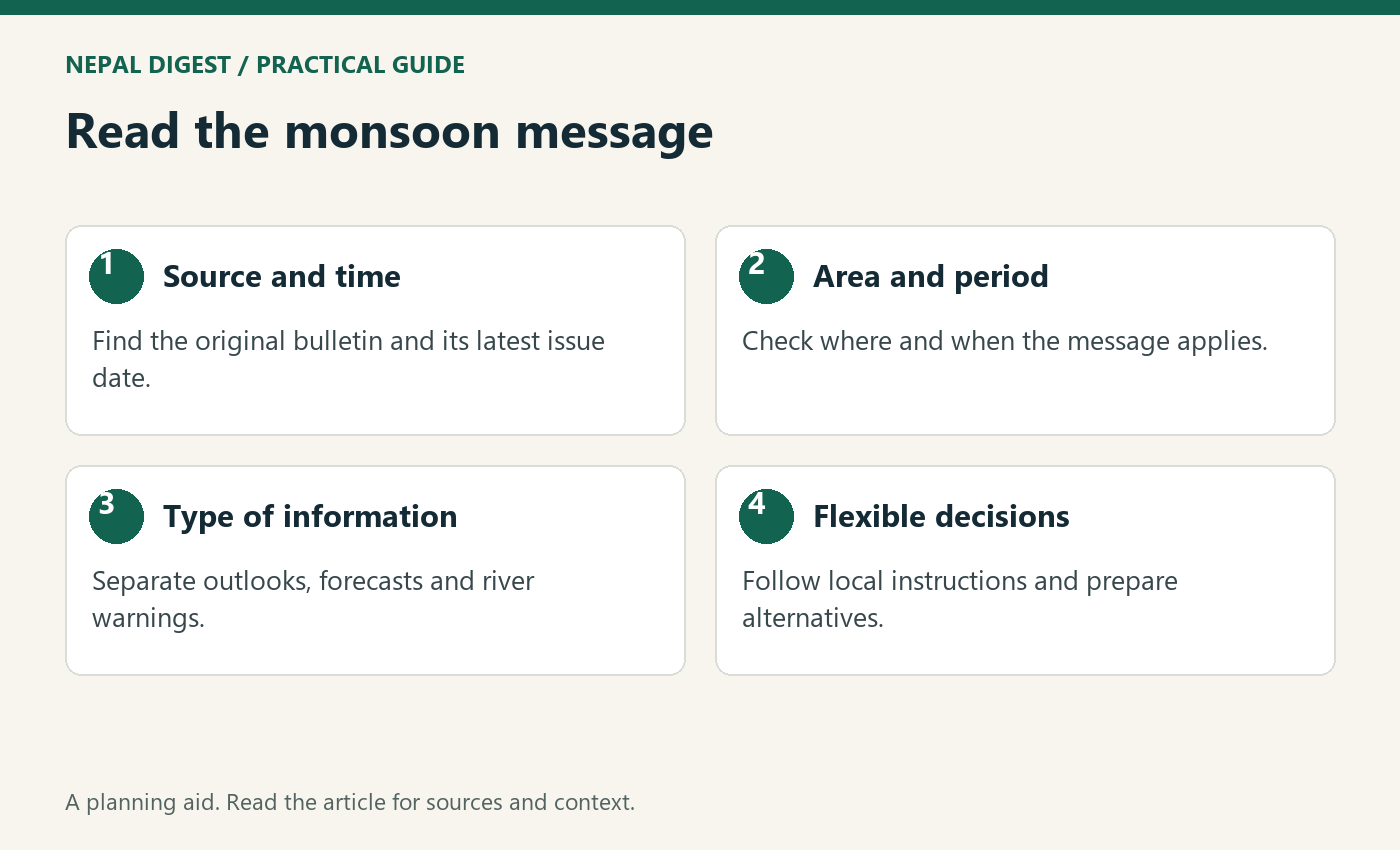
Table of Contents
A monsoon total is different from a daily forecast
A season can receive plenty of rain while leaving a farm short of water at an important moment. The total does not reveal whether rainfall arrived steadily, fell in a few intense events or missed one valley while reaching another. Decisions about planting, travel and drainage depend on timing and location as well as the eventual sum.
Nepal’s Department of Hydrology and Meteorology publishes seasonal outlooks separately from shorter forecasts and warnings. Its archive includes an initial June–September 2026 monsoon outlook and a June update. Those are different releases, so a screenshot without its issue date can leave readers working from information that has since changed.
An outlook should therefore be read for the period and geographical scale it describes. It cannot be turned into a promise about the weather at a particular field on a particular afternoon. The first useful question is what decision the information can support, rather than whether the forecast offers a single reassuring answer.
Read a weather message before forwarding it
A useful weather message needs an issuing organisation, a publication time, a valid period and a named area. A map without its legend or a paragraph cut away from the bulletin can lose the part that explains uncertainty. Before forwarding a warning, check the original page and preserve that context.
The DHM homepage provides separate routes to weather forecasts, special forecasts, rainfall information and flood bulletins. A weather forecast and a river warning answer related but different questions. Rain at your location is not the only information needed to understand conditions farther along a route or downstream.
During the monsoon, make checking the issue time a habit. A message that was appropriate yesterday may have been replaced. For weather and flood information, DHM currently lists the toll-free number 1155. Use current official instructions for the relevant place and do not treat a saved article as a live warning.
Farm decisions need local observations as well as forecasts
A household planning farm work needs more detail than a broad seasonal label. Soil condition, access to irrigation, the crop stage and the ability to postpone a task all affect what an outlook means in practice. The same forecast can lead two neighbouring farms to different decisions without either household misunderstanding it.
A practical approach is to keep a simple dated record of rainfall observations and the tasks they affected. Note a missed irrigation opportunity, a field that drained slowly or a period when access was interrupted. Over time, the record can support better questions to agricultural advisers. It is not a substitute for professional crop guidance.
Local experience also has limits. One difficult season does not establish a long-term trend, and one older person’s memory does not describe every district. Combining local observations with measured records makes the discussion more useful than asking farmers to choose between experience and scientific information.
Travel planning should leave room for a changed decision
A monsoon itinerary becomes fragile when every connection assumes the previous one will run on time. A delay can create pressure to continue because a hotel, ticket or work commitment is already booked. Building room to stop or change plans reduces the temptation to treat an unsafe situation as merely an inconvenience.
Before departure, check the latest weather information and seek current route information from the relevant transport operator or local authority. Conditions can differ between an open road at the starting point and the route beyond it. A photograph or social post showing vehicles moving is an observation from a particular place and time.
Discuss alternatives before travelling. Identify whom you will contact, how you will communicate a delay and which bookings can be changed. Follow closures and local instructions. Do not attempt to cross floodwater or approach unstable slopes to obtain a better photograph or assess a situation yourself.
Drainage and maintenance deserve attention before the rain
Public discussion often focuses on the moment a road or settlement floods. Preparation starts earlier, with drainage inspections, maintenance responsibilities and accessible ways for residents to report a blockage. The usefulness of such work should be judged by whether a problem is resolved, rather than by the number of inspection visits announced.
A neighbourhood can document a recurring concern without claiming to be an engineering team. Record the location, the date, what was observed from a safe position and which authority received the report. Keep copies of replies. This gives a later discussion about maintenance something more reliable than an argument over whose memory is correct.
Responsibility also needs to be clear across institutions. A newly surfaced road, an unfinished utility trench and a drainage channel may involve different contractors or public bodies. Residents should be able to find out who must act and how an unresolved complaint will move to the next stage.
Use the monsoon record to ask better questions
After a season, DHM’s seasonal reports offer a different kind of evidence from a forecast. They describe observations and summaries rather than predicting the coming days. Read the period, method and coverage before comparing one report with another or drawing conclusions about a particular community.
The best public questions are specific. Was the warning understandable? Could people receive it in time? Was the route closure communicated? Did repairs address the location that failed previously? These questions examine institutions and decisions without demanding that a forecasting service remove every uncertainty.
Understanding the monsoon does not mean finding a date after which the weather becomes simple. It means combining appropriately scaled information, local observations and plans that can change. For wider context, read Nepal Digest’s coverage of climate change, mountains and rivers and its discussion of climate risk and the economy.