
Nepali food finds a wider audience when a meal tells a precise story: who grows an ingredient, who prepares it and why a particular household or community values it. A familiar dish can open that conversation, but it should not become a substitute for the country’s many regional food traditions.
This guide explores how cooks, customers and food businesses can introduce that variety thoughtfully. It is a practical interpretation of documented crop diversity and the opportunities around traditional ingredients, rather than a claim that a national restaurant boom has been measured.
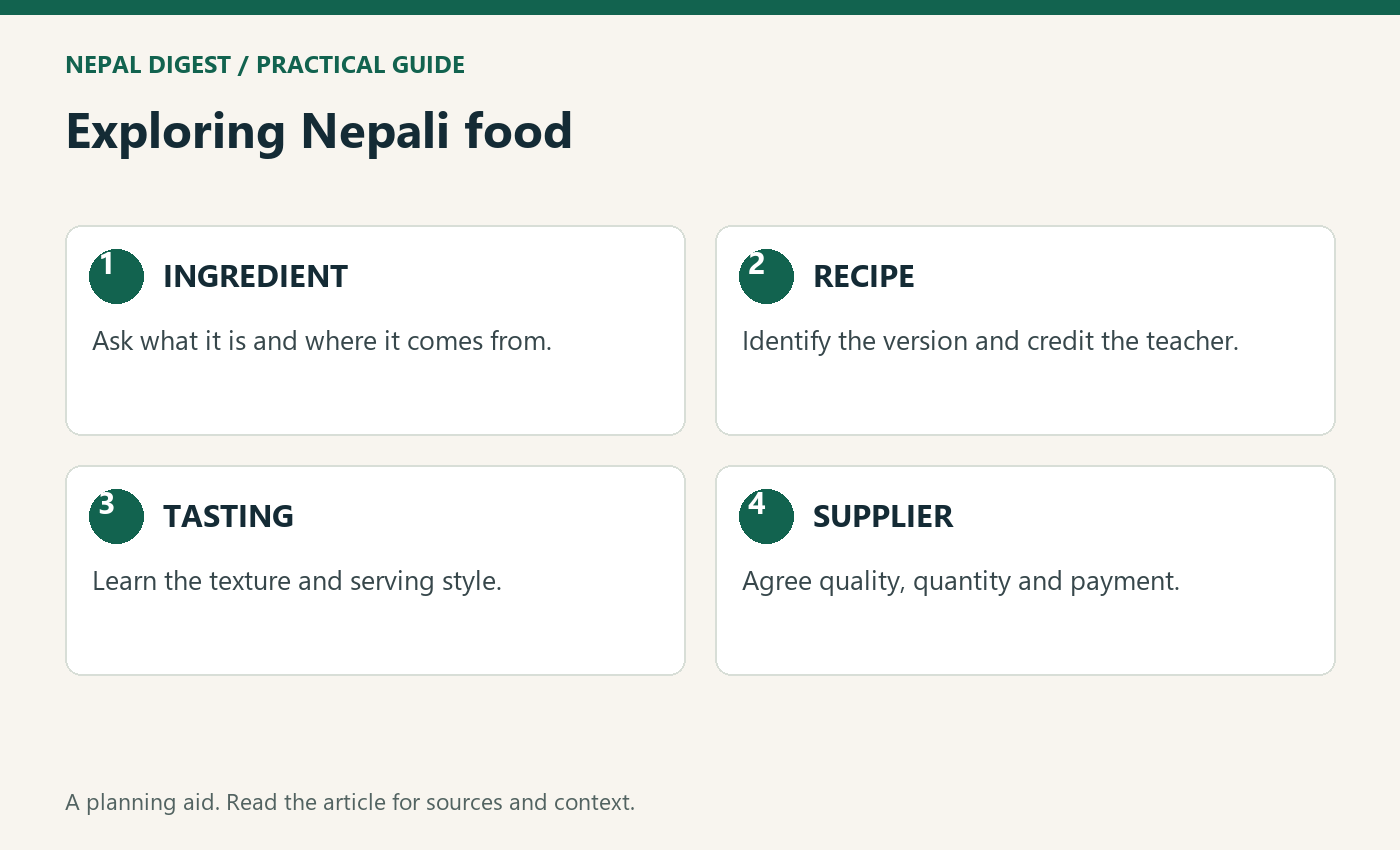
Table of Contents
Food diversity starts with the ingredient
A 2019 publication catalogued by the FAO Global Information System describes underused crops in Nepal’s mountain food systems, including barley, buckwheat, beans, amaranths and several millets. Its research covered households in Jumla, Humla, Lamjung and Dolakha. That geographical scope matters: it is evidence about particular mountain settings, not a complete description of every Nepali kitchen.
For a cook introducing an unfamiliar grain, a useful starting point is its role in an actual meal. Explain its texture, preparation and the foods usually served with it. A customer can understand a soft staple, a crisp bread or a warming bowl more readily than an abstract promise about heritage.
An ingredient’s local name also needs context. Ask the supplier which crop or variety they mean rather than assuming that similar names always describe the same thing. Record the place of production when it can be verified, and distinguish that from the place where it was purchased.
Explain the dish without flattening its history
A menu description should identify the version being served. A household recipe, a restaurant adaptation and a festival preparation may share a name while differing in ingredients, technique and purpose. Describing the particular version is more informative than announcing that it is the single authentic national form.
The person who taught a recipe deserves recognition when they want it. Ask permission before publishing their story or photograph, and agree how their contribution will be credited. Some knowledge is shared freely at the table; other knowledge belongs within a family or a specific community setting.
Translation can help a new audience without replacing the original vocabulary. Keep the dish name and add a short explanation of its main ingredient, texture and serving style. If a technique has been changed for a different kitchen, say what changed. Curiosity is easier to build when the explanation is candid.
Traditional crops need workable markets
The FAO’s International Year of Millets material identifies processing and market development as opportunities to connect millets with urban consumers, young people and tourists. It also notes Nepal among the countries growing finger millet. This establishes an opportunity, not proof that every new product or restaurant is commercially successful.
A food business considering a traditional grain should begin with a small, repeatable order. Ask about seasonal availability, cleaning, milling, storage and delivery. A striking launch dish is difficult to sustain if the supplier cannot provide the same usable product next month or the kitchen cannot prepare it consistently.
Fair purchasing depends on practical details as well as praise. Agree a quantity, quality description, delivery arrangement and payment date. If a buyer requests extra sorting or special packaging, discuss who will do that work and how it will be paid. A heritage story should not conceal additional unpaid labour.
A simple trial can reveal more than a large promotional event. Prepare a small batch, note the usable yield and record how much preparation time it takes. Offer a clear description and ask diners what they understood before tasting. Review leftovers and repeat orders as well as compliments. Those observations help a business decide whether to adjust the portion, explanation or preparation method before making a larger purchasing commitment.
Make a first tasting easy to understand
A first introduction can be modest: one dish with a clear explanation, served alongside something the diner already understands. Describe the expected flavour and texture before it arrives. Explain whether accompaniments are intended to be mixed, tasted separately or added gradually, while leaving the customer room to choose.
Ask about dietary restrictions and ingredients directly. A traditional label does not tell a diner whether a preparation contains dairy, eggs, meat, nuts or another ingredient they avoid. The kitchen should answer from the actual recipe and preparation process, rather than guessing from the dish’s reputation.
Avoid promising that a particular traditional food treats a condition or is suitable for everyone. An appealing meal does not need a medical claim. Describe the ingredients honestly, offer an appropriate portion and let a qualified professional address individual dietary needs when necessary.
A practical way to explore an unfamiliar menu
Before ordering, choose one question that will help you understand the meal. You might ask where the main grain comes from, which part of the dish is prepared in advance or what makes this kitchen’s version distinctive. A focused question is easier for a busy cook or server to answer than a request to explain an entire cuisine.
During the meal, notice texture and balance as well as heat. Which accompaniment changes the main dish? What becomes clearer after the second mouthful? These observations make a more useful personal record than ranking a dish against an unrelated restaurant or declaring it representative of the whole country.
Afterwards, write down the dish name, the place and the explanation you were given. If you share the experience publicly, separate the kitchen’s account from your own opinion. Mention that you tried one version. This gives the next reader a starting point without turning a single visit into a sweeping cultural judgment.
If you want to recreate the meal, begin by asking whether the cook is comfortable sharing a method. A published recipe or an agreed lesson gives you a better basis than trying to extract instructions during service. Buy a small quantity of the unfamiliar ingredient first, label it clearly and follow the supplier’s storage guidance. Keep a note of what you changed so that an adaptation is not later presented as the teacher’s original preparation.
New audiences should support the people behind the food
A successful introduction invites a return visit and creates reasons to value the work behind a meal. For a restaurant, that can mean training staff to explain ingredients accurately, keeping supplier information current and adjusting a menu when a seasonal item is unavailable. Consistency should come from good practice, not from pretending that every ingredient is available throughout the year.
For a home cook, learning one preparation carefully can be more valuable than collecting many names. Ask a willing teacher to explain the stages that are easiest to get wrong. Record the quantities and the signs they use to judge readiness, then acknowledge their help when you pass the method on.
Food reaches a new audience through trust: a clear description, a well-made dish and a fair account of its origins. Continue exploring with Nepal Digest’s guides to local markets and traditions and the next generation. Different meals and different communities deserve their own careful attention.