
Nepal’s languages enter the digital age through many kinds of work: typing a message, describing a manuscript, recording a speaker or testing whether software recognises a sentence. These activities are connected, but they solve different problems. A scanned page is not automatically searchable text, and a research model is not automatically a reliable public service.
The useful question is what a person can actually do in their language. Can they write, find, listen, learn and correct an error? Two documented projects offer starting points for a practical discussion of access and community participation.
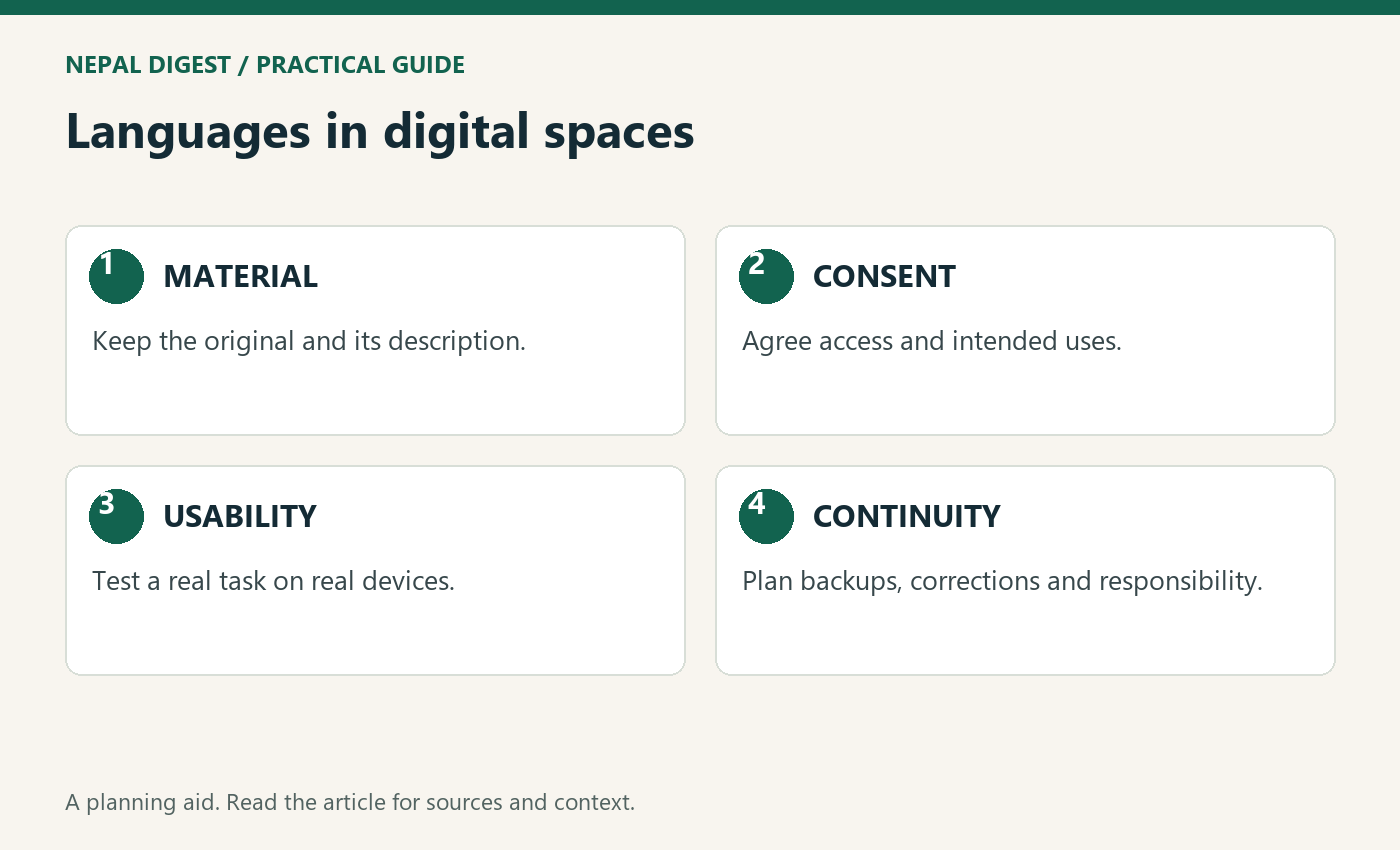
Table of Contents
Languages need usable material as well as visibility
In a September 2026 project account, UNESCO described digitisation, cataloguing, transcription and translation work on Newa manuscripts. The account identifies collaboration with custodians and community participants, and describes access through Archive Nepal and Wikimedia-related platforms.
These are distinct stages. Photographing a page preserves an image of it. Cataloguing helps someone understand what it is. Transcription makes the writing available in another form, while translation creates an interpretation in another language. Each stage needs checking and should retain a connection to the source.
For a reader, the difference determines what an archive can offer. A clear image may allow a specialist to examine handwriting, but a learner may also need a transcription, an explanation of unfamiliar terms and a way to ask about a doubtful reading. A useful archive makes those layers understandable.
Speech tools depend on carefully prepared data
A 2026 research paper on Nwāchā Munā presents a manually transcribed 5.39-hour Nepal Bhasha speech corpus and experiments in automatic speech recognition. The authors report a benchmark using Devanagari transcription and compare approaches to adapting models. It is evidence of a specific research resource, not proof of complete digital support for the language.
A speech system needs more than a convincing demonstration. Ask which speakers, recording conditions and kinds of language were included in evaluation. A model that handles one prepared recording may perform differently with background noise, a different accent or a spontaneous conversation.
Communities should be able to examine how a tool represents them and report mistakes. A correction process needs a responsible person or organisation, a clear way to submit an example and an explanation of what can be changed. Collecting complaints without a route to review does little to build confidence.
Separate language, script and keyboard
A language is not the same thing as a script or a particular keyboard arrangement. A person may know how to speak a language while needing help to read a historical script, and two people using the same language may prefer different ways to enter text.
A practical digital project should therefore state what it supports. Does it provide a keyboard, a font, a dictionary, a transcription method or a translation? A screenshot can demonstrate appearance, but users also need to know whether the text can be selected, copied, searched and displayed on another device.
Test an ordinary task from beginning to end. Ask someone to enter a short message, send it to another device and search for a word from it later. Where the process breaks down, record the exact step. This produces a clearer requirement than a general claim that a language is missing from technology.
Community consent belongs at the beginning
Before recording a story or uploading a document, agree what the material will be used for and who can access it. Permission to preserve a recording does not necessarily include permission to publish it widely or use it to train a model. Explain the intended uses in language the contributor understands.
Discuss attribution and access separately. Some contributors may want their name attached; others may prefer anonymity or a restricted audience. A community archive may contain material that should not be made public simply because the technical platform allows it.
Record the agreement alongside the material and provide a clear contact for questions. If the project changes direction, review whether the original agreement covers the new use. Respect for contributors is an ongoing part of maintaining a collection, rather than a form signed once and forgotten.
Make a small collection useful before expanding it
A school, family group or community organisation can begin with a manageable collection: a few short texts, an agreed vocabulary list or recordings made with willing participants. Define the audience and purpose before choosing the platform. A reading resource and a research dataset need different preparation.
For each item, record who contributed it, when it was prepared, the language or variety identified by the contributor and any access conditions. Keep the original and the edited version distinguishable. If a word is uncertain, mark that uncertainty rather than silently replacing it with a guess.
Ask intended users to try the collection. Can they find an item, understand its description and use it on the devices they have? A small collection that works well for real readers is a stronger foundation than a large upload with no explanation or maintenance plan.
Young users need reasons to return
A tool for Nepal’s languages becomes part of everyday life when it helps someone do something they value. That might be reading a family account, making a greeting, listening to a familiar story or asking a practical question. The choice should come from the users rather than from an assumption about what they ought to enjoy.
Invite younger and older contributors to work together on a defined task. One person might explain a phrase, another type it and a third check how it appears on a phone. Make time to discuss differences in wording without treating one speaker’s experience as the only legitimate form.
Keep the activity welcoming to learners. Correct an error with an explanation and allow people to ask basic questions. A public space that punishes every imperfect attempt can discourage the very participation the project hopes to encourage.
Plan for correction and continuity
Digital collections for languages need continuing attention. Decide who keeps backups, who responds to access requests and how corrections are reviewed. Store enough documentation that another responsible person can maintain the work when a volunteer or project lead moves on.
A useful review asks what people actually used and where they became stuck. Keep a short list of unresolved problems and explain priorities openly. A limited tool with a clear scope and active care can be more trustworthy than a broad promise that nobody is able to maintain.
Nepal’s languages gain digital space through patient work on material, permission, usability and learning. For related coverage, see Nepal Digest’s discussion of AI and mother tongues and its profile of Ranjana script in public life.