
Kathmandu’s roads carry more than traffic. They connect people to school, work, care and the daily tasks that make a city function. The pressure on them cannot be understood only as a shortage of tarmac: it also concerns how space is shared, how public transport works and whether a person can finish a journey safely on foot.
This analysis sets out practical tests for improving access. It distinguishes dated research from present conditions and proposes questions residents can use to assess a project, without claiming that one survey or one new road can explain the whole Valley.
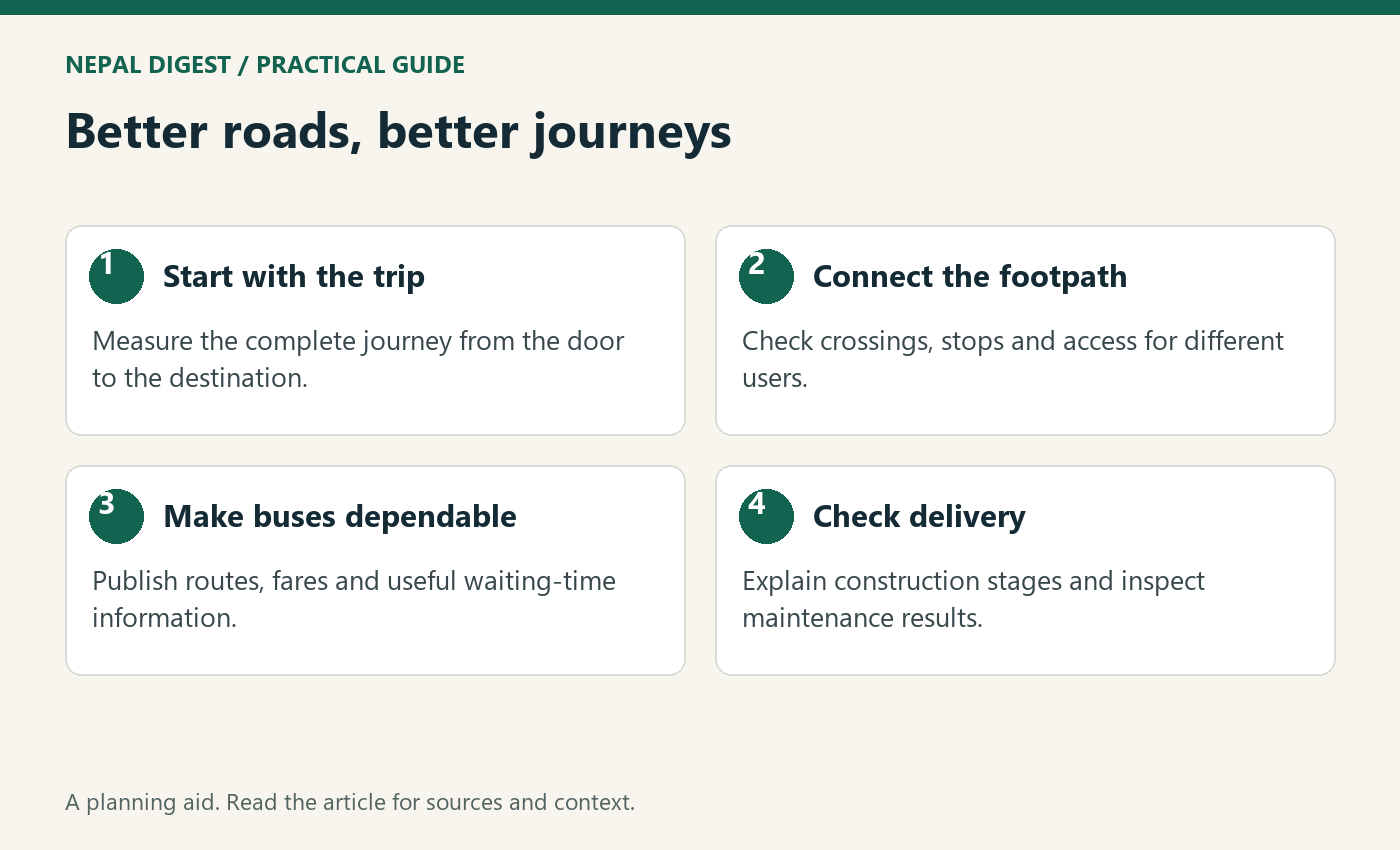
Table of Contents
Kathmandu roads should be judged by the journeys they make possible
A street can look busy while moving people poorly. Counting vehicles at a junction says little about the number of passengers inside them, the people waiting to cross or the worker who has already walked twenty minutes to reach a bus. A useful transport plan starts with destinations: schools, hospitals, markets, workplaces and the connections between them.
For a household, the relevant measure is the complete journey. Leaving home, finding a safe path to a stop, waiting, travelling, changing vehicles and reaching the final entrance all consume time. Improving one fast section while leaving a dangerous crossing at the other end can produce a project that looks successful on paper and remains difficult to use.
That changes the question for Kathmandu’s roads. The objective should be dependable access for the greatest range of people. A city cannot evaluate that objective solely through how quickly a private vehicle travels when traffic is light. It needs to understand who can complete necessary journeys on an ordinary working day.
Treat walking as part of the transport system
Every bus passenger is also a pedestrian at the beginning and end of a trip. A footpath that disappears at a bridge or forces someone into traffic interrupts the whole network. Repairs should therefore follow continuous routes rather than isolated attractive sections. School entrances, health facilities and interchange points are practical places to begin.
The World Bank’s 2014 discussion of Kathmandu public transport highlighted particular difficulties for older people, passengers with limited mobility and people travelling with small children. That is historical evidence, rather than a current passenger survey, but it explains why accessibility belongs inside transport planning.
An access review can ask concrete questions. Is there room for a wheelchair? Can someone see approaching traffic before crossing? Are steps, drainage channels and parked vehicles blocking the route? Does a pedestrian have to make a long detour to cross a short distance? Answering these questions exposes problems that a photograph of a newly paved road can miss.
Make bus reliability visible to passengers
More buses are useful only if passengers can understand and depend on the service. A clear route, a recognisable stop, a legible fare and a reasonable expectation of when the next vehicle will arrive all reduce uncertainty. Information should be usable by someone taking the route for the first time, including people who cannot rely on a smartphone.
One practical improvement is to measure waiting time at several stops across the day. A published average can conceal a long gap during the hours when schoolchildren or shift workers actually travel. Observations should distinguish ordinary congestion from problems such as vehicles gathering at one end of a route or departing without adequate information.
Kathmandu’s roads also need places where buses can stop without making boarding a contest between passengers and moving traffic. Stop placement, crossing design and the space required for queues should be considered together. A shelter installed far from a useful crossing does not resolve the full problem.
Give construction a credible delivery plan
Disruption during repairs is sometimes unavoidable. Unexplained disruption is a different matter. Residents and shopkeepers need to know the intended sequence of work, how deliveries and emergency access will be maintained, who handles complaints and what happens when the schedule changes. A project notice should provide more than a completion slogan.
A World Bank analysis published in March 2026 identifies weaknesses in project preparation, land acquisition, procurement and cash management as recurring obstacles to Nepal’s infrastructure delivery. Its national findings do not describe every Kathmandu street contract, but they provide a useful checklist for questioning whether a proposal is ready.
For local roads, readiness includes coordination with water, drainage and utility work. Completing a surface before a planned excavation creates avoidable disruption. Contracts also need maintenance responsibilities and a process for inspecting defects. Residents should be able to distinguish work that is delayed from work that has been completed badly.
Connect housing decisions with everyday access
A home’s rent is only one part of its location cost. A cheaper room can require expensive, tiring travel; a more central room may make walking possible but put pressure on the household budget. Transport and housing policy meet in these daily decisions, particularly for people whose working hours do not fit standard services.
Before approving a major development, planners can examine how people will reach it without requiring every household to purchase another vehicle. The questions include walking connections, service capacity, delivery access and nearby schools or healthcare. A building’s gate does not mark the end of its effect on surrounding roads.
This is also a reason to evaluate access at the neighbourhood scale. A reachable clinic, public space or daily market can reduce the need for longer trips. Such choices require coordination across institutions, because transport officers cannot determine where every essential service will be located.
Publish results that people can recognise
A practical scorecard would track travel time, waiting time, safe crossings, accessibility and the reliability of repairs. It would identify the route, the observation period and the method used. Without that detail, a claim that traffic has improved cannot be compared with a resident’s experience or checked after the next season.
Begin with one corridor and include users with different needs. Ask a student, a trader carrying stock and an older passenger to describe their complete journey. Combine their observations with counts and timed trips rather than treating one account as representative of the whole city. Publish the shortcomings as well as the gains.
Better roads will not emerge from a single choice between construction and public transport. They depend on how street space, services, housing and maintenance fit together. The worthwhile test is whether people can reach the places they need safely and predictably. For related coverage, read Nepal Digest’s discussion of electric transport and Kathmandu’s air and its guide to living alone in Kathmandu.