

Nepali employees working in Japan’s Ibaraki prefecture have a new figure to check against their pay: ¥1,136 an hour, effective from 18 October 2026. The previous regional minimum was ¥1,074. The ¥62 increase is about 5.8 percent.
The immediate task is to examine the rate for work performed from the effective date, particularly where an October pay period crosses the change. A bank deposit alone will not show whether the calculation is correct. Workers need the relevant hours, wage components and payslip breakdown.
The Ibaraki Labour Bureau’s announcement and gazette notice were issued on 18 September 2026. This is now an effective wage change, rather than a recommendation awaiting a decision. It is a regional floor for Ibaraki workplaces; readers elsewhere in Japan should check their own prefecture’s rate and effective date.
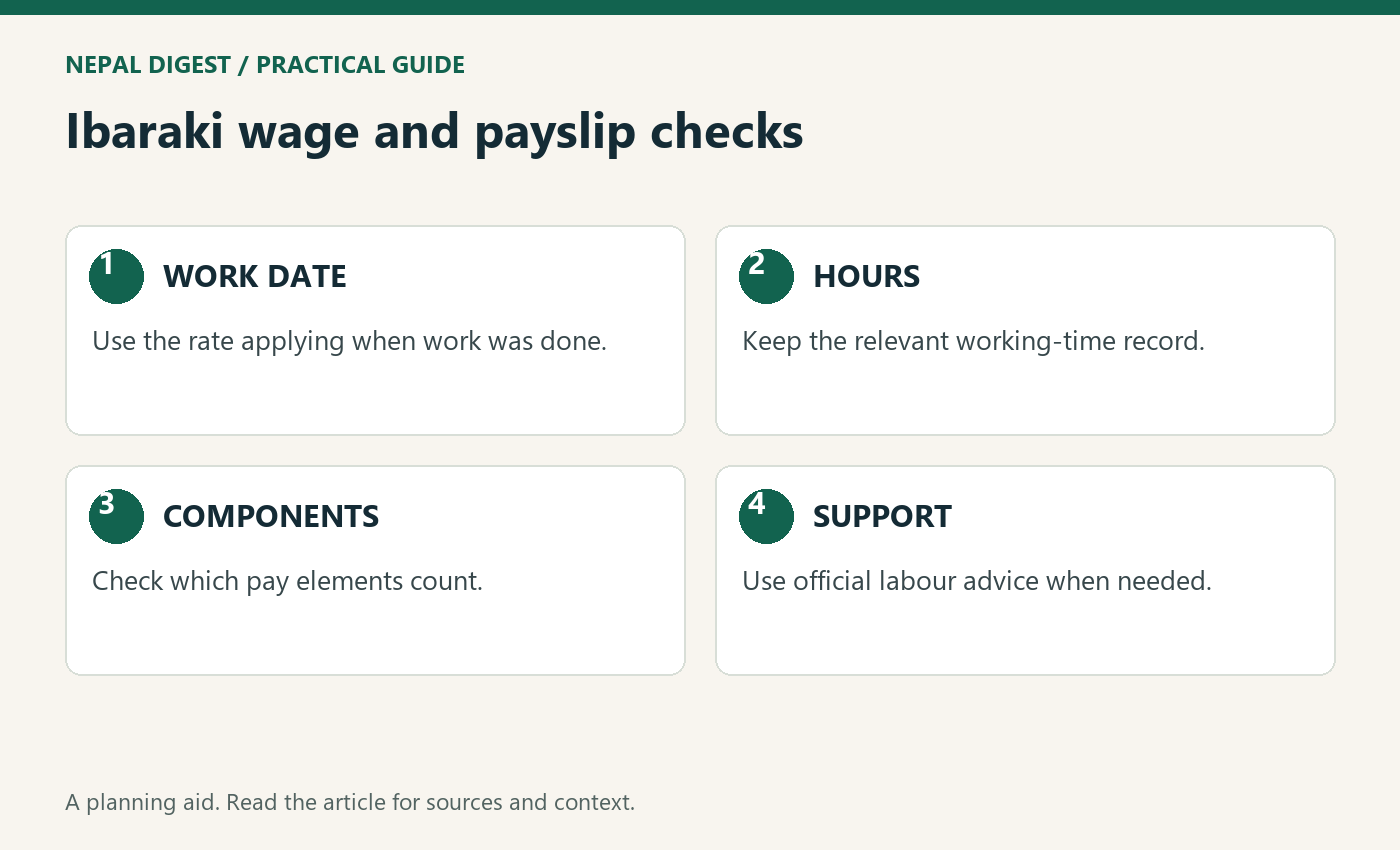
Table of Contents
Ibaraki: who should check their pay?
The announcement covers, in principle, employees at workplaces in Ibaraki, including permanent, temporary and part-time workers. That makes it relevant to Nepalis employed there, including students doing permitted part-time work. Japan’s official guidance on employing foreign nationals confirms that minimum-wage law also applies to foreign workers.
Start with the workplace’s prefecture. A home address in Ibaraki does not establish the rate for a job located somewhere else. If you have two jobs in different prefectures, make a separate check for each. Ask for clarification where your assignment or work location is unclear.
Some industries have their own specified minimum wages. Where a higher applicable industry minimum exists, the regional figure does not replace that higher requirement. The bureau’s minimum-wage information page is a useful starting point for checking the applicable category.
What does ¥62 an hour mean?
Consider an illustrative employee whose eligible ordinary hourly pay was exactly ¥1,074 and who works 80 eligible ordinary hours after the new rate takes effect. At ¥1,136, those hours correspond to ¥90,880 in eligible ordinary pay. The same hours at the previous floor would produce ¥85,920: a difference of ¥4,960.
This is a calculation to explain the change, not a report about an identified worker or a prediction of anyone’s take-home pay. Actual earnings depend on hours, the agreed rate and other pay components. Deductions also affect the amount arriving in a bank account.
A worker already receiving ¥1,200 in eligible hourly pay is above the new regional floor. The change alone does not establish a further ¥62 entitlement for that person. Check any separate contractual pay promise independently. Likewise, the illustration assumes the same hours; it does not promise that an employer will offer a particular number of shifts.
Use the date the work was done
For an hourly worker whose pay period includes days before and after 18 October, a single October total can hide the relevant distinction. Separate the ordinary hours worked before the effective date from those worked on or after it. The new floor applies from 18 October, even if the wages are paid later.
For example, an October payment covering only September work is not evidence that September hours should have been paid at October’s new floor. Conversely, a later payment date does not move the effective date forward. Keep the pay period and the payment date in separate columns when checking the record.
A simple personal worksheet can contain the work date, ordinary hours, stated hourly rate and corresponding eligible pay. Keep overtime or other special entries separately so they can be understood. If payroll uses a blended calculation, ask the employer to explain how the effective-date change has been reflected.
Which parts of a payslip count?
The minimum-wage comparison uses eligible pay under the official rules. It is not simply the largest total printed on the payslip, and it is not the net amount received after deductions. Japan’s labour ministry provides a list of wage components excluded from the comparison.
These include occasional payments, such as a marriage allowance; payments made at intervals longer than a month, such as bonuses; pay for work beyond scheduled hours and on non-scheduled working days; and the additional night-work premium above ordinary pay. Perfect-attendance, commuting and family allowances are also excluded.
Other regular allowances may count. An allowance’s label should therefore be checked rather than assuming every allowance is excluded. Ask payroll which components it has included in the minimum-wage calculation and compare that explanation with the ministry’s guidance.
This distinction is especially useful when a payslip contains several Japanese terms that are unfamiliar. Request a breakdown of each item instead of drawing a conclusion from the total. Preserve the original document alongside any translation so a labour adviser can check the actual wording.
Daily and monthly pay need an hourly comparison
Employees paid by the day or month should also check the equivalent hourly amount. The ministry’s official calculation guide sets out different methods for hourly, daily, monthly and mixed pay arrangements.
For daily pay, the basic comparison divides eligible daily wages by the day’s scheduled working hours. For monthly pay, it divides eligible monthly wages by average monthly scheduled working hours. Mixed arrangements require the relevant components to be converted and combined appropriately.
A rough calculation based on one unusually busy month can be misleading. Ask for the scheduled-hours basis used by payroll, and keep excluded allowances and additional work payments separate. Where the arrangement is complicated, take the documents to an official adviser rather than treating an informal calculator as a final legal assessment.
A practical payslip check
- Confirm the workplace and applicable floor. Record the prefecture, employer and any relevant industry category.
- Keep the evidence together. Save the employment terms, payslip, shift roster, time records and wage-related messages.
- Identify work from 18 October onward. Match those dates to the correct pay period.
- Check eligible pay. Separate excluded components and use the appropriate hourly conversion.
- Ask for an explanation of any gap. State the dates, hours and calculation clearly, and retain the reply.
A useful payroll question is: “Which wage items and scheduled hours did you use to check my pay against the new Ibaraki minimum?” This requests the underlying calculation. A general assurance that the total payment is higher may leave the important question unanswered.
If your employer gives a correction, check that the revised payslip identifies the affected period and amount. Keep the original and corrected versions together. If the explanation remains unclear, write down the unresolved question before seeking advice. This helps distinguish a missing payment from a misunderstanding about which wage items count, and gives an adviser a specific calculation to review. Do not send original identity documents or unredacted bank records to an unofficial social-media account offering to investigate.
Where Nepali-language help is available
The labour ministry’s foreign-language counselling directory lists a Nepali telephone service at 0570-001-708, Monday to Friday, from 10am to 3pm Japan time, with a noon-to-1pm break. Calls to this daytime service are charged. Check the directory for current availability and holiday closures before calling.
The same directory lists other labour advice services and local offices. Before seeking help, prepare the employer’s name, workplace address, dates worked and the specific pay issue. Keeping a short timeline and copies of records can make the consultation more useful than a description based only on memory.
The ministry’s explanation of the minimum-wage system says an agreement below the applicable minimum is invalid to that extent, and an employer paying below it must pay the difference. Signing an older contract does not remove the applicable minimum-wage protection.
The wage revision does not itself expand a student’s immigration permission to work. Keep wage compliance and permission conditions as separate checks. This guide verifies the rule and explains how to review a payslip; it does not establish that any particular employer has underpaid Nepali workers.
Rules and service information checked on 19 October 2026.
Related reading: Your First Australian Payslip, Explained for Nepali Workers; Lost Your Phone Abroad? Protect Your Accounts and Recover Access.