

How Marvel Studios used Kathmandu, Swayambhunath, Pashupatinath and Patan to turn Nepal into the cinematic doorway between modern medicine and the Mystic Arts.
When Marvel Studios needed a place where one of its most rational characters could lose confidence in the rational world, it came to Kathmandu.
Doctor Strange, released in 2016 and directed by Scott Derrickson, begins with Dr. Stephen Strange as a brilliant, arrogant neurosurgeon whose identity is built on control. After a catastrophic car accident damages his hands, conventional medicine can no longer restore the career that defines him. His search for healing eventually takes him to Nepal and to the hidden institution of Kamar-Taj, where the rules of reality begin to collapse.
Benedict Cumberbatch plays Strange, with Chiwetel Ejiofor as Mordo, Tilda Swinton as the Ancient One, Benedict Wong as Wong, Rachel McAdams as Christine Palmer and Mads Mikkelsen as Kaecilius. The film was produced by Kevin Feige as part of the Marvel Cinematic Universe.
The Nepal sequences are brief relative to the entire film, but they became some of the most recognisable international images of Kathmandu in twenty-first-century popular cinema.
Nepal’s Film Development Board records filming in Kathmandu, Swayambhunath, Pashupatinath and Patan Durbar Square. Disney’s own film archive confirms that Doctor Strange was filmed in Nepal, Britain and New York. Contemporary reporting from Kathmandu documented Cumberbatch and Ejiofor filming around the valley in November 2015.
The timing made the production especially significant. Nepal was still recovering from the April 2015 earthquake, which had killed thousands and damaged heritage sites throughout the Kathmandu Valley. Marvel arrived only months later.
Watch Marvel’s Official Trailer
The official trailer prominently features Kathmandu, including the city’s rooftops and sacred sites, before opening into the film’s psychedelic visual universe.
Official trailer published by Marvel Entertainment.
Why Kathmandu?
Director Scott Derrickson wanted an “Eastern city” that would feel unfamiliar to much of the global audience. Kathmandu offered something difficult to reproduce elsewhere: dense historic streets, religious life embedded into urban space, layered architecture and an immediate visual relationship between everyday commerce and sacred practice.
The production considered the city not merely picturesque but narratively functional.
Stephen Strange arrives looking for a cure. The Kathmandu sections move him away from the clean, controlled spaces associated with Western medicine and into streets where he is disoriented. He does not know where Kamar-Taj is. He does not understand the social environment. His money and professional status no longer give him authority.
Kathmandu therefore performs a psychological role. It strips the character of certainty before the Ancient One strips him of his assumptions about reality.
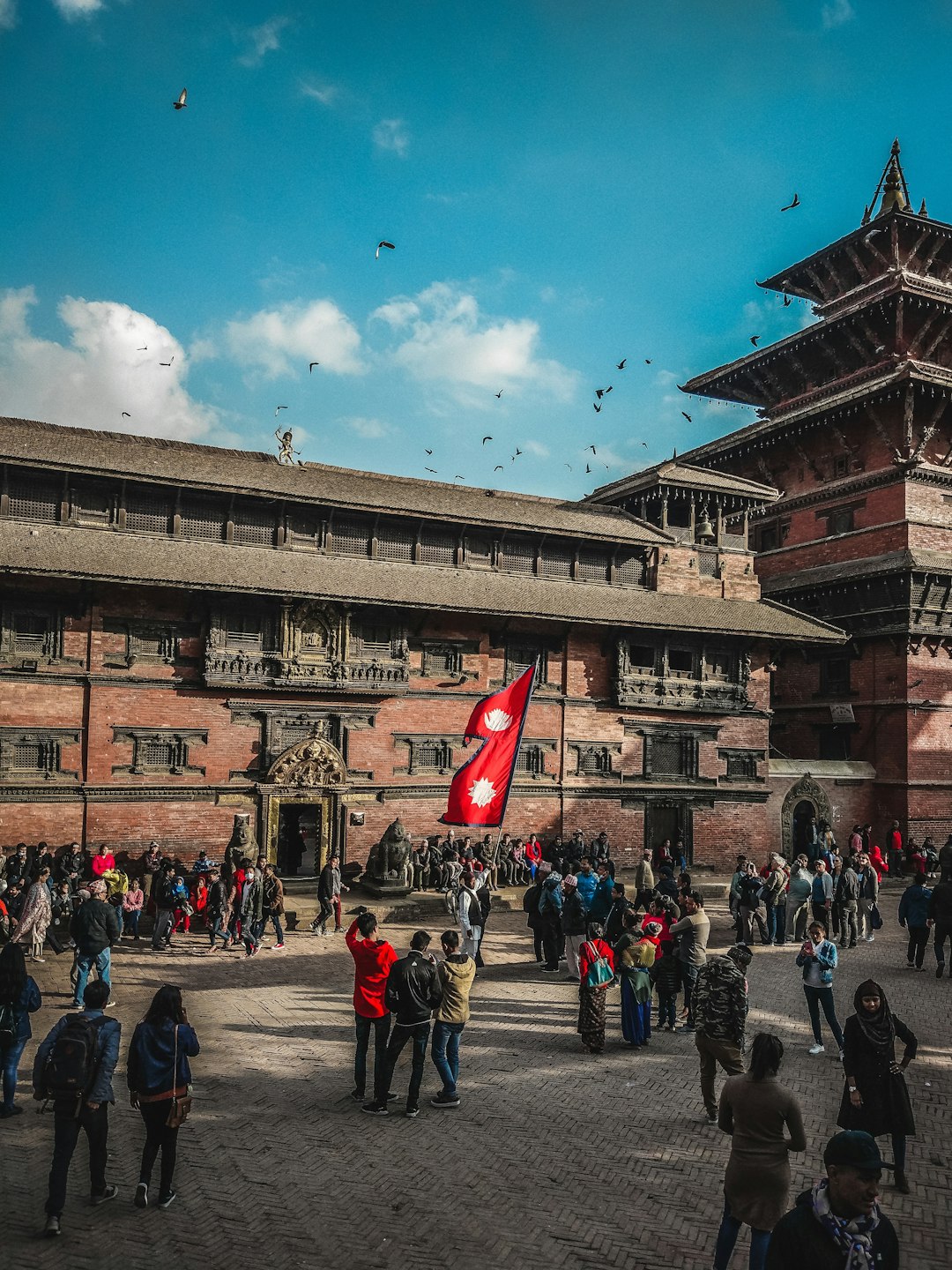
Patan Durbar Square on a Marvel Set
Patan was one of the production’s most visible locations. Set photographs of Benedict Cumberbatch moving through Patan Durbar Square spread internationally during filming.
For Nepali audiences, the effect was unusual. A familiar heritage space—normally associated with temples, royal architecture, festivals and daily urban life—was suddenly part of the world’s largest superhero franchise.
Marvel did not need to transform Patan completely. That was the value of filming there. Brick courtyards, carved wood, stone sculpture and temple roofs already created a visual density no generic backlot could easily reproduce.
This is a recurring pattern in foreign filmmaking in Nepal. The built environment supplies production value accumulated over centuries.
Swayambhunath and the Global Image of Sacred Kathmandu
Swayambhunath is one of the most visually recognisable religious sites in Nepal. Its hilltop position, stupa, prayer flags and panoramic relationship with the Kathmandu Valley make it almost irresistible to filmmakers seeking an immediate symbol of sacred geography.
Doctor Strange uses that symbolic power efficiently.
For a global audience, Swayambhunath communicates “spiritual Asia” in seconds. That cinematic usefulness is both an advantage and a problem.
The advantage is visibility. Millions of viewers encounter a real Nepali religious site.
The problem is reduction. Swayambhunath can become background shorthand for mysticism rather than a living Buddhist and Newar sacred complex with its own history, communities and rituals.
Pashupatinath and a More Complicated Cultural Space
Pashupatinath adds another layer because it is one of Hinduism’s most important Shiva temples and a functioning cremation landscape along the Bagmati River.
Its presence inside a movie centred on a fictional mystical institution illustrates how Hollywood often combines religious geographies to create a broader atmosphere.
Kamar-Taj is not presented as Hindu or Buddhist. It is a fictional order drawing visually and philosophically from multiple traditions.
Kathmandu’s actual religious plurality helps make that fusion believable. Hindu and Buddhist sacred spaces coexist throughout the valley, often with histories far more intertwined than outsiders expect.
But the film does not explain that complexity. It uses the visual richness while constructing its own mythology on top of it.
The Ancient One and the Representation Debate
The casting of Tilda Swinton as the Ancient One became one of the film’s major controversies. In Marvel comics, the character had historically been associated with Tibet and an older Asian male stereotype. The film changed the character dramatically.
Marvel and the filmmakers argued that they were attempting to avoid an outdated stereotype. Critics argued that the solution amounted to whitewashing an Asian role.
The controversy also intersected with the politics of Tibet and the Chinese film market. Screenwriter C. Robert Cargill later discussed how political sensitivities surrounding Tibet complicated adaptation choices.
Nepal therefore became connected to a much larger question: when a global studio changes a fictional spiritual geography, is it correcting an old stereotype or replacing it with another?
There is no simple answer, but the debate matters because location and casting are not separate. Kathmandu supplies Asian spiritual authenticity while the highest authority inside Kamar-Taj is played by a white British actor.
After the 2015 Earthquake
The timing of the shoot gave the Nepal production a significance beyond scenery.
The April 2015 earthquake had devastated communities and damaged monuments across the Kathmandu Valley. Some locations initially considered by the production were affected. Rather than abandoning Nepal, Derrickson and Cumberbatch publicly supported the decision to continue filming there.
The filmmakers said the production could draw attention back to Nepal after the disaster and contribute economically through local spending and employment.
That argument should not be exaggerated into a claim that a Hollywood film materially rebuilt Nepal. It did not.
But major productions do circulate money through transport, accommodation, crews, permits, catering and services. More importantly, the presence of a Marvel production signalled internationally that Nepal remained accessible.
Real Kathmandu, Rebuilt Kathmandu
As with many large productions, not everything that looks like Kathmandu was shot in Kathmandu.
After the Nepal location work, production moved to Britain. Sets at Longcross Studios recreated Kathmandu streets and built the interiors of Kamar-Taj.
Production designer Charles Wood described the difficulty of reproducing Kathmandu’s irregular streets, old brick, tile, texture and architectural history. That difficulty explains why the real location was so valuable.
A studio can copy surfaces. It is much harder to manufacture the accumulated disorder of a living old city.
The final film combines the two seamlessly: genuine Kathmandu establishes credibility, then controlled sets allow elaborate action and visual effects.
Why Marvel Needed an “Eastern” Gateway
Stephen Strange begins as a man who believes knowledge is measurable. Surgery is anatomy, technique and precision. His hands fail, and his model of the world fails with them.
The film could have placed Kamar-Taj anywhere. But narratively, Marvel wanted geographical distance to represent intellectual distance.
Strange travels away from New York not only to find treatment but to encounter a worldview his professional identity has dismissed.
This is a familiar Western story structure: the rational Westerner travels East and discovers spiritual knowledge unavailable at home.
Doctor Strange modernises the structure through superhero spectacle, but it does not escape it.
The Long History Behind That Trope
Nepal Digest’s foreign-film series makes the pattern visible across decades.
Les Chemins de Katmandou treated Kathmandu as escape from Western society. The Night Train to Kathmandu treated Nepal as a gateway to a hidden kingdom. The Golden Child connected Himalayan Buddhism to supernatural destiny. Little Buddha used Nepal to introduce Buddhist philosophy to Western viewers.
Doctor Strange inherits all of these ideas in compressed Marvel form.
Kathmandu becomes the place where modern rationalism encounters older knowledge.
The trope is powerful because it contains a genuine observation—Nepal does contain philosophical and religious traditions very different from secular Western professional culture. But cinema often simplifies that difference into a binary: West equals science, East equals spirituality.
Real Nepal contains both.
Marvel’s Kathmandu and Everyday Kathmandu
The most obvious absence from the movie is ordinary Kathmandu.
Millions of people work, commute, study, shop, run businesses, build software, argue about politics and live modern lives in the valley. None of that is relevant to Stephen Strange’s story.
The movie selects the Nepal that supports mysticism.
Again, that is normal narrative filmmaking. New York superhero films do not represent every reality of New York either.
The issue appears when the same selective image is repeated across many foreign productions. If global audiences repeatedly see Nepal only as mountains, temples and spiritual mystery, those elements begin to stand in for the entire country.
Tourism Value Versus Cultural Reduction
There is no doubt that Doctor Strange gave Kathmandu extraordinary exposure. The Marvel Cinematic Universe reaches an audience Nepal’s tourism campaigns could never purchase through conventional advertising.
A viewer fascinated by the movie can search for Patan, Swayambhunath or Pashupatinath and discover real places behind the fantasy.
That is genuine soft power.
But tourism visibility is not automatically the same as accurate cultural representation. A place can benefit economically from an exotic image while still being simplified by it.
Nepal’s challenge is to convert curiosity into deeper understanding.
Benedict Cumberbatch in the Streets
Production photographs from 2015 remain some of the most memorable behind-the-scenes images ever produced by a foreign film in Nepal. Cumberbatch, bearded and dressed as a broken-down Stephen Strange, moved through real streets among local residents and ancient architecture.
The images work because the contrast is so strong. A globally recognisable actor appears not on a closed studio lot but inside spaces Nepalis use every day.
This makes the production itself part of Kathmandu’s cultural memory.
People remember where scenes were shot, who saw the actors and how streets changed during filming. Global cinema becomes local anecdote.
Visual Effects Begin With Real Texture
Doctor Strange is famous for effects in which cities fold, buildings rotate and physical space behaves like a puzzle. Those sequences required enormous digital work.
Yet the effects are convincing partly because they begin with recognisable physical environments.
Surrealism works best when viewers first believe the reality being distorted.
Kathmandu therefore contributes even to scenes that eventually leave literal Nepal behind. Real texture becomes the anchor for impossible imagery.
From Kathmandu to Kamar-Taj
Perhaps the film’s most influential contribution is the way it fused Kathmandu and Kamar-Taj in popular imagination.
Kamar-Taj is fictional. There is no hidden Marvel monastery in Kathmandu where sorcerers manipulate dimensions.
Yet visitors still search online for “Doctor Strange locations” and visit the real places connected to the film.
This is film tourism at its purest: fiction attaches itself to geography and creates a new reason to travel.
The same process occurred with Caravan and Dolpo, though in a very different cultural register.
How Doctor Strange Differs From Everest
Everest uses Nepal because the real historical event happened there. The mountain cannot be separated from the story.
Doctor Strange uses Nepal symbolically. The story could theoretically have placed Kamar-Taj elsewhere.
That difference makes the Marvel film especially valuable for studying representation. Nepal was selected because filmmakers believed it communicated something specific to audiences.
They wanted ancient, spiritual, dense and unfamiliar.
That is not all Nepal is. But it is what Marvel needed Nepal to mean.
A New Era of Foreign Filmmaking in Nepal
The scale of Doctor Strange demonstrated that Nepal could host location work for one of the world’s largest entertainment franchises.
Earlier foreign productions had already filmed in the Kathmandu Valley, from European art cinema to American television movies. Marvel placed Nepal inside a globally networked franchise economy where a few minutes of footage could be seen by hundreds of millions of people through cinemas, streaming, trailers and social media.
This changed the scale of visibility.
For Nepal’s film sector, the opportunity is obvious: international productions can bring spending, training, destination marketing and long-term image value.
The policy challenge is to ensure that heritage protection, local labour and cultural context are not secondary to the demands of foreign crews.
What Doctor Strange Left Behind
The movie did not transform Kathmandu into a superhero city. Kathmandu transformed the movie.
Its streets gave Stephen Strange’s journey weight. Its sacred sites created a believable threshold between medicine and mysticism. Its architecture gave Marvel visual complexity that would have been expensive and less convincing to invent from scratch.
At the same time, the film continued an old cinematic habit of treating Nepal as a doorway to spiritual otherness.
Both statements can be true.
That is why Doctor Strange deserves more than a simple “Hollywood filmed in Nepal” celebration. It is a case study in the exchange between location and imagination.
Marvel borrowed Kathmandu’s visual history.
Kathmandu gained a place inside Marvel history.
The exchange was unequal, commercially enormous and culturally fascinating.
Further reading: Disney: Doctor Strange · Nepal Film Development Board: Foreign Films Shot in Nepal · The Kathmandu Post: Doctor Strange filming in Nepal · The Kathmandu Post: Kathmandu in the first trailer