
Diaspora life can involve feeling responsible to more than one place at once. Work, school and everyday friendships may be based in one country, while family conversations, memories and plans keep another present. The balance is different for each person and can change over time.
That is why belonging is difficult to measure through a single test: speaking a language perfectly, attending every festival or deciding where to settle permanently. A more useful approach is to look at the relationships and routines through which people keep their connections workable.
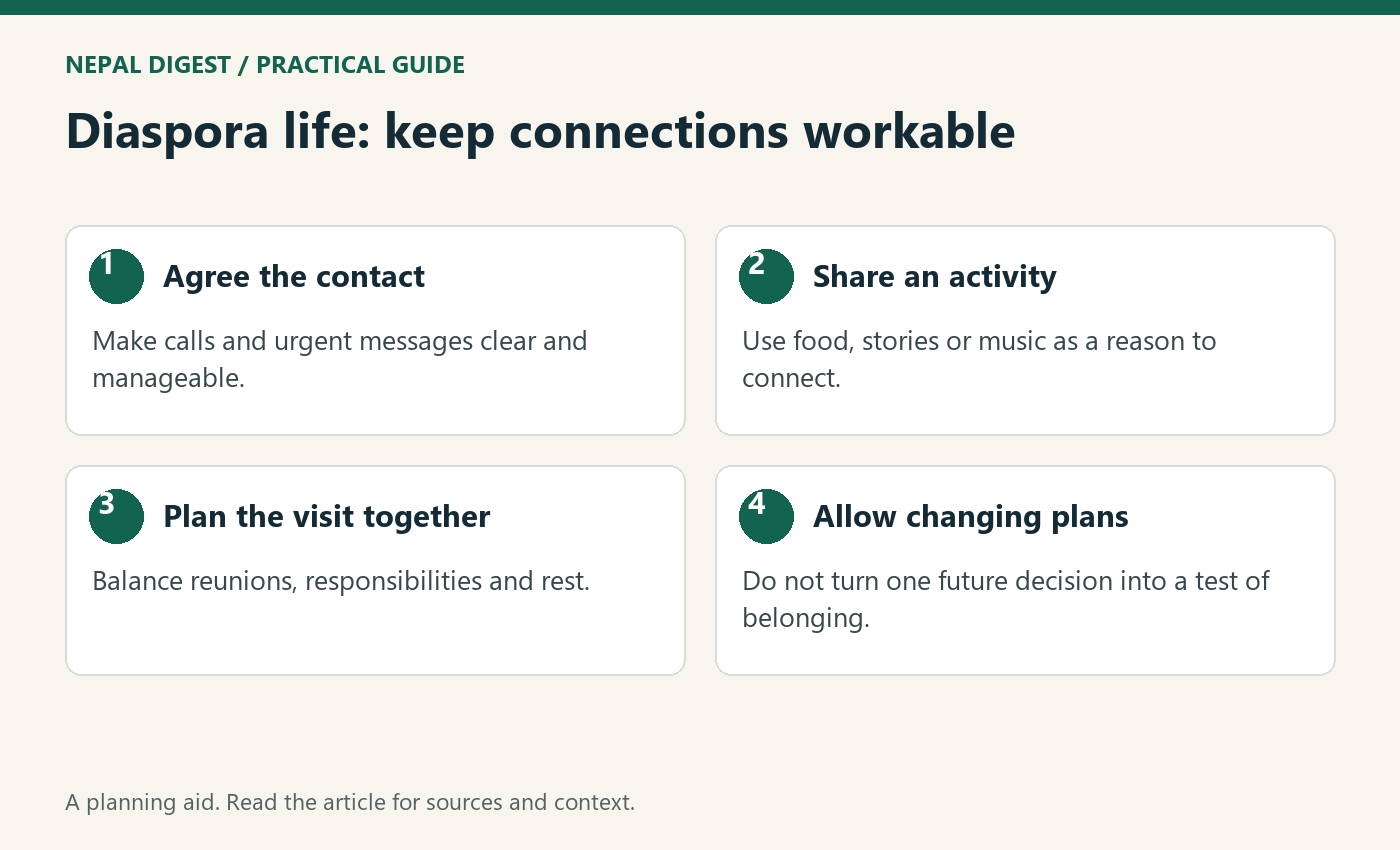
Table of Contents
Diaspora life includes different histories
The International Organization for Migration’s 2024 diaspora-mapping report was produced with the Non-Resident Nepali Association and in coordination with Nepal’s Ministry of Foreign Affairs. Its stated aims include understanding the diaspora’s skills, experience and motivations for contributing to Nepal.
That focus is a reminder that the diaspora should not be treated as one occupation, income group or reason for leaving. A person studying abroad, someone doing shift work, an established professional and a child raised outside Nepal may have different resources and priorities.
A personal story becomes more accurate when those circumstances remain visible. Living in the same destination country does not mean two people have the same immigration position, financial freedom, family responsibilities or plan for the future.
Make family contact manageable rather than constant
Regular contact can support a relationship, but the form needs to fit the people involved. A short scheduled call may work better than a long conversation nobody can reliably attend. Shift patterns, school and time zones need to be part of the arrangement.
Agree what counts as urgent and which channel to use for it. An unread group message should not have to carry every possible meaning. A clear request is easier to respond to than a stream of hints that someone is expected to interpret.
Nepal Digest’s guide to family group-chat boundaries offers a way to discuss reply expectations and private conversations. The purpose is to protect the relationship by making expectations clearer, rather than to make everyone available at every moment.
Language can become a shared activity
In diaspora life, language may mean different things to different generations. One relative may find it easiest to explain a feeling in Nepali; another may understand the language but respond more confidently in English or another language used at school.
Begin with an activity people actually want to do together. That might be cooking, discussing a song, following a match or asking a grandparent about an object in the house. A reason to communicate can be more inviting than an instruction to demonstrate loyalty through flawless speech.
Leave room for uncertainty and mixed-language conversation. Correcting every sentence can interrupt the story someone is trying to tell. Ask what kind of help is welcome, and distinguish a learner’s mistake from a lack of interest in family or heritage.
A visit home needs room for more than one person’s memory
A parent returning to a familiar place and a child visiting it may be making different journeys. The parent can have a list of reunions and unfinished obligations; the child may need introductions, rest and an explanation of routines.
Discuss the visit before booking every day. Agree which commitments matter most, how much travelling is realistic and where people can have unstructured time. A meaningful visit does not have to recreate every experience an older relative remembers.
The same care applies to relatives in Nepal. Hosting takes work, and a visitor’s timetable may not match a household’s ordinary responsibilities. Asking what is convenient can prevent a homecoming from becoming a test of how much everyone is willing to provide.
Community participation should leave room for choice
Festivals, sports, language groups and professional networks can offer ways to meet people with a connection to Nepal. They are possibilities for participation, not a compulsory checklist that determines whether someone belongs.
Choose a commitment that fits the time and energy available. A clearly defined task at one event can be more sustainable than agreeing to help with everything. If someone is new to a community, practical information about location, cost and what to expect can make an invitation easier to accept.
Diaspora life can also include friendships with people who do not share the same background. Those relationships need not weaken a connection to Nepal. A person can learn new routines and still keep the relationships and interests that matter to them.
Keep future plans separate from everyday affection
Questions about returning, citizenship, property and retirement can become emotionally loaded when they are treated as proof of love. It helps to distinguish the practical decision from the relationship. Someone can care deeply about family while being unsure where they will work or live.
When a decision involves documents or legal status, identify the actual question and use the relevant official information. Memories and family expectations do not determine a person’s current rights or obligations. Avoid assuming that every relative abroad falls into the same category.
For now, a smaller plan may be more useful than a final declaration about home. Choose the next call, visit, shared project or conversation. Review what is working and change what is not.
Diaspora life between two homes does not require a perfect balance every week. It requires enough honesty and flexibility for connections to survive real schedules and changing circumstances. Belonging can be something people practise together, rather than a verdict one generation delivers on another.
A practical family conversation can start with one ordinary week. Each person can describe a workday, a school routine and a task they would like help with. Someone abroad may need a quiet weekend after shifts, while someone in Nepal may be managing appointments or caring responsibilities that are invisible in short calls. Agreeing on one achievable action, such as arranging a document scan or sharing a recipe with a younger relative, makes the exchange more concrete. Revisit the arrangement after a month. A routine that once worked can become difficult when jobs, school hours or household responsibilities change, and adjusting it does not diminish the relationship.