
Traditional crafts find a new generation when people can learn the skill, earn from the work and adapt it thoughtfully to present needs. A beautiful object is only the visible result. Behind it are decisions about materials, teaching, time, design and the relationship between a maker and a buyer.
Nepal’s creative economy includes different kinds of craft businesses and community initiatives. The examples below illustrate particular approaches; they do not prove that every craft or every region is experiencing the same revival.
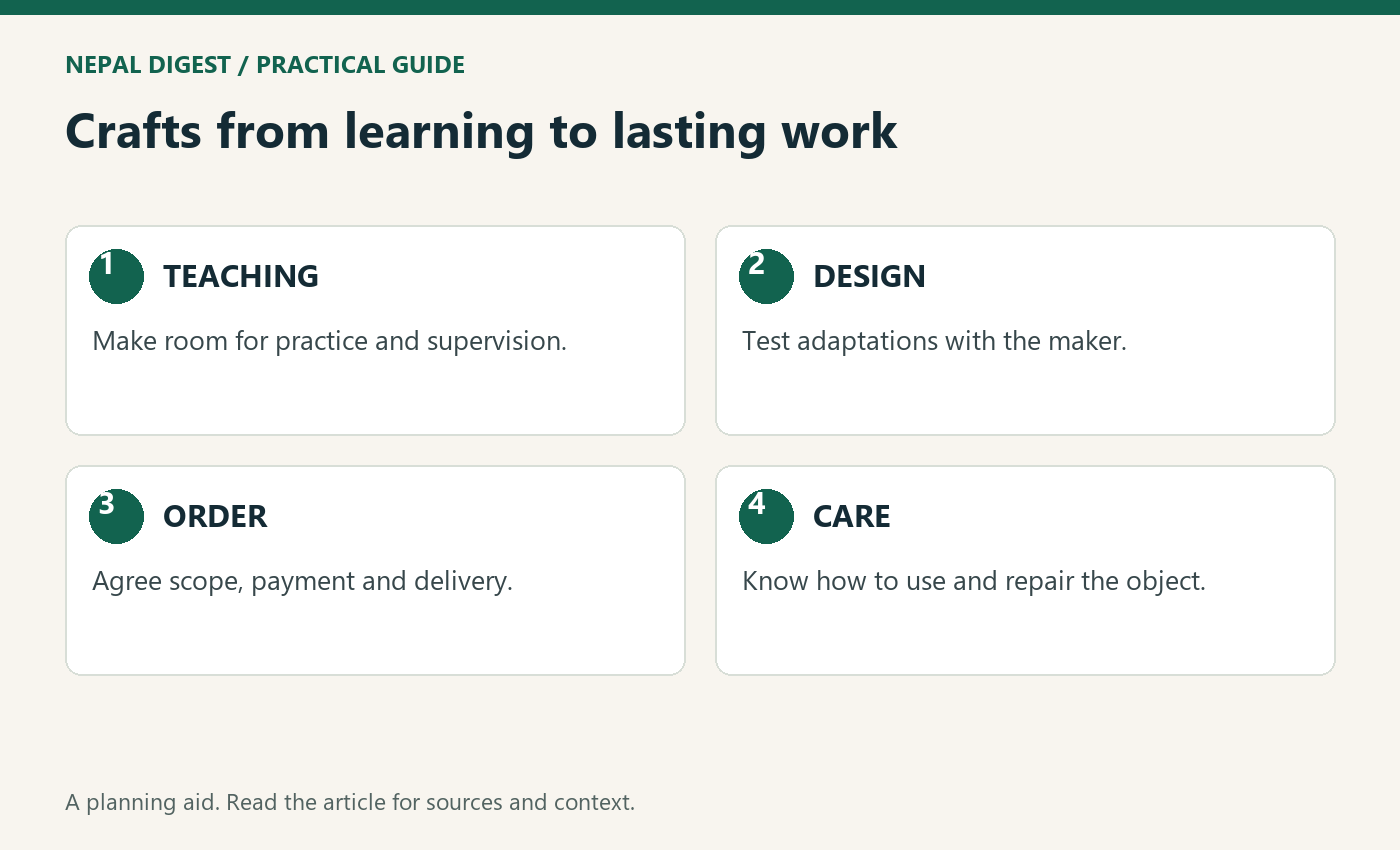
Table of Contents
Crafts need a route from learning to work
UNESCO’s 2026 case study of Project Sarangi describes an initiative established by Kiran Nepali in 2014 that connects instrument teaching, production and employment. It discusses a structured curriculum and work on consistency in instrument design. The case shows how a skill can be supported by an organisation rather than only by admiration for the finished object.
For an aspiring maker, the important question is how the learning process is organised. Who demonstrates a technique, how does the learner practise it and what makes a piece ready to sell? A short demonstration can spark interest, but it is different from the repeated practice needed to work independently.
Teaching also takes time away from production. A workshop should plan for that time and recognise the instructor’s contribution. If a learner is helping with commercial orders, agree the work, supervision and payment arrangement clearly rather than allowing an informal lesson to become indefinite unpaid labour.
Design can change while knowledge remains visible
A buyer interested in crafts may want a familiar technique in a different size, colour or use. That can create useful work when the adaptation respects what the maker knows and what the material can do. Begin with the purpose of the object rather than a demand to reproduce an image exactly.
A prototype allows both sides to examine the change. Check how it feels, how it is finished and whether it performs the intended function. Record which features are essential and which can vary. A handmade item may contain variation, but that does not remove the need for an agreed standard.
Credit should describe the actual collaboration. A designer’s idea, a workshop’s process and an individual artisan’s skill may all contribute. Discuss how each will be acknowledged before public promotion begins, especially when a product is being presented as a partnership with a particular community.
A documented textile example
UNESCO’s Tara Oriental case study describes the company founded by Anin and Jolly Rajbhandari in 1997, connecting cashmere production in Thaiba with design and export markets. It also discusses material-supply constraints and the challenges of building a label. This is one established enterprise, not a model that every small workshop can simply copy.
The broader practical question is how design, production and a reliable customer relationship fit together. A maker needs to know what is being ordered, when it must be ready and how quality will be judged. A buyer needs an honest account of materials, delivery and care.
Avoid treating the word local as a complete description of a supply chain. A product can involve skilled work in Nepal and materials from elsewhere. Ask which stages happen where, and describe them accurately. Clear information gives the craft its proper value without requiring a misleading story about every input.
An order should make the hidden work visible
Before confirming an order, write down the item, quantity, dimensions, material description, finish and delivery arrangement. Include the approved sample or photographs where appropriate. These details protect the relationship by reducing the chance that two people are imagining different products.
Ask how changes will be handled. A different colour, an extra piece or a revised deadline may affect the work already completed. Agree who will approve changes and whether the price or delivery date needs to be reviewed. A casual message can have a substantial effect inside a small workshop.
Payment terms deserve the same clarity. Discuss deposits, staged payments and the final balance in advance. Do not assume that a maker can finance all materials and labour while a buyer decides whether the finished work suits them. A fair arrangement considers the practical risk on both sides.
Buy an object you understand how to use
Ask what the object is made from and how it should be cared for. The answer should be specific to the piece rather than a general claim about traditional quality. If there are limits on washing, moisture, heat or storage, knowing them before purchase helps the object remain useful.
Look closely at the areas that will receive wear: joins, edges, handles, fastenings or surfaces used in ordinary handling. Ask about repair options and what kind of change is expected with use. A maker’s explanation can help distinguish a material characteristic from a problem that should be addressed.
If buying a gift, include the care information and an accurate account of the maker or workshop. Do not add a dramatic origin story that the seller did not provide. A modest, verified description is a better introduction to the work than a claim that the object represents an unchanged ancient tradition.
A small workshop visit can teach more than a display
Arrange a visit rather than assuming a working space is always open to visitors. Ask whether observation is possible, how long is suitable and whether there is a fee for a demonstration or lesson. Production deadlines and private work should take priority over a visitor’s wish to watch.
During the visit, choose a specific question about a technique or tool. Follow instructions about where to stand and what can be touched. Ask permission before taking photographs, especially when a design, process or customer order is not intended for public circulation.
Afterwards, credit the people who agreed to be identified and describe what you actually observed. A short visit can introduce a process, but it does not establish expertise in the whole craft. Leave room for the maker’s explanation to be more complex than a social-media caption.
A new generation needs continuity
A crafts programme can count trainees and exhibitions, but it should also ask what happens later. Can learners continue practising? Are tools and materials accessible? Is there a realistic route to paid work, and can experienced makers afford to keep teaching? These questions reveal whether enthusiasm has become a durable opportunity.
Keep records that a future learner can use, with permission from the people whose knowledge is involved. A photograph of a finished piece may need an explanation of the steps, the common mistakes and the judgment used to assess readiness. Documentation should support teaching without overriding access conditions agreed with the maker.
Crafts endure through capable people, fair relationships and objects that find a place in everyday life. Explore related Nepal Digest coverage of changing traditions and local brands for further questions about continuity and new markets.