
Nepal’s coalition experience raises a lasting question about patience: when does time allow a government to do difficult work, and when does a request to wait become a way to avoid explaining delay? The distinction matters regardless of which party holds office.
Context updated 21 October 2026: this article retains its original headline but now examines the coalition question as historical and institutional analysis. It should not be read as a report that the 2024 Congress–UML alliance remains Nepal’s current government. The argument below concerns standards for judging delivery, not an unverified claim about a present coalition’s private intentions.
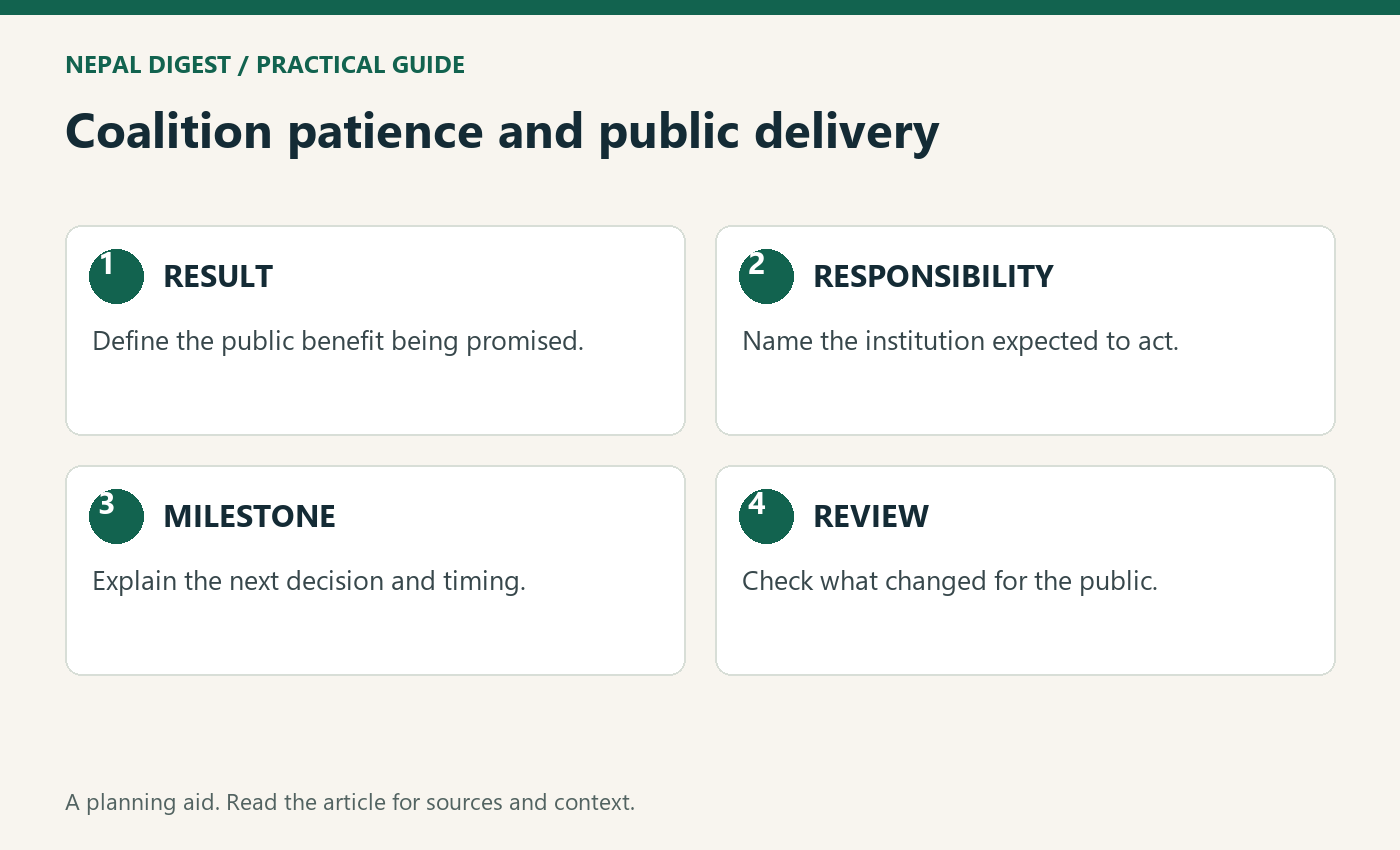
Table of Contents
Put the coalition discussion in its proper period
A Radio Nepal report dated 21 July 2024 recorded KP Sharma Oli informing the House about the seven-point agreement between the Nepali Congress and CPN (UML), reached on 1 July. That is a dated record of an alliance agreement, not evidence of the same arrangement continuing indefinitely.
The political context subsequently changed. Associated Press reported on 27 March 2026 that Balendra Shah took office as prime minister after the Rastriya Swatantra Party’s election victory. These dates must remain visible whenever an older coalition argument is discussed.
A headline can outlast the circumstances that originally made it plausible. The responsible response is to explain the period and distinguish historical context from current reporting. Readers should not have to infer a government’s identity from an undated reference to the ruling parties.
Patience needs a stated purpose
Some public work cannot be completed immediately. A programme may require a design, a budget, staff, procurement, coordination and an operating plan. Calling for patience is reasonable only when the government can explain which stage it has reached and what remains to be done.
The explanation should identify a result that matters to the public. Completing a meeting, signing a document and opening a service are different milestones. Each can be necessary, but none should be presented as interchangeable proof that the intended benefit has arrived.
A useful timetable names the next decision and the person or institution responsible for it. It also explains what could change the schedule. This gives citizens a basis for judging progress without pretending that every difficult project can be reduced to one immovable date.
A coalition agreement is not an implementation record
An agreement can show what parties say they intend to do together. To assess delivery, readers need subsequent decisions, budgets, operational information and evidence about what changed. The existence of an agreement does not settle whether its promises were carried out.
Separate political coordination from administrative capability. A stable arrangement at the top may reduce one kind of uncertainty while a department still lacks staff, a project still needs a workable design or a local authority still needs clear instructions. The next question is what action addresses that specific obstacle.
The same distinction applies to a government with a strong electoral majority. A different parliamentary arithmetic changes the political setting, but it does not remove the need to organise services, explain responsibilities and review whether a policy works in practice.
Measure the experience of an ordinary user
A public service can be judged through the process a person actually follows. What information is available, which documents are required, how long does a step take and how can an unresolved problem be raised? These questions translate a general promise of reform into something observable.
Choose a consistent measure and describe its limits. A change at one office may be useful without proving that the same improvement occurred everywhere. An average waiting time can also conceal very different experiences. Explain the location, period and method before drawing a broad conclusion.
Return to the same question later. One successful day or a launch event provides only a snapshot. Repeated information helps establish whether a new arrangement has become ordinary practice or remains dependent on exceptional attention from senior officials.
Delay deserves an explanation that can be checked
When a milestone is missed, explain the cause and its consequence. Was a decision postponed, a contract revised, a resource unavailable or an assumption wrong? A specific account allows the public to distinguish a difficult constraint from a failure that should have been anticipated.
The explanation should include the next action and a revised basis for review. Repeating that a matter is under consideration gives the reader no way to judge whether anything has changed. A record of decisions is more useful than a succession of reassuring adjectives.
Responsibility should also be clear when several institutions are involved. Coordination is a task, not an explanation that ends the inquiry. Identify which organisation is expected to convene others, resolve a conflict or publish the information needed for the next stage.
Scrutiny should remain consistent across parties
A coalition should not be praised for endurance alone, nor condemned merely because negotiation takes time. Ask what the arrangement enables, what it prevents and how its decisions affect the public. The standard should be applied to a preferred party and an opponent alike.
Distinguish a policy disagreement from a claim about misconduct. People can disagree about priorities, spending or the pace of change without assuming private wrongdoing. An allegation requires its own evidence, clear attribution and a fair opportunity for response.
Journalism can make this distinction visible by separating a documented event, an attributed explanation and editorial judgment. A reader should be able to tell which part of an article comes from a record and which part is an argument about what that record means.
The public should know what it is waiting for
A useful patience test has four parts: a defined result, a responsible institution, an understandable next milestone and a way to review the outcome. If one is missing, ask for it. This does not guarantee success, but it makes a promise easier to assess.
The virtues of patience lie in allowing capable work to proceed while keeping the purpose and progress visible. Patience becomes less defensible when it is detached from an explanation or when the same unresolved problem is repeatedly announced as a new priority.
Nepal’s coalition history remains relevant because it exposes the difference between maintaining an arrangement and delivering a result. The question for any administration is whether citizens can see what is being done with the time they are asked to give it.
For related institutional questions, read Nepal Digest’s coverage of hydropower and practical delivery and Kathmandu roads.